





 Portuguese
  English
  Spanish
  5 min of reading
  4 comments


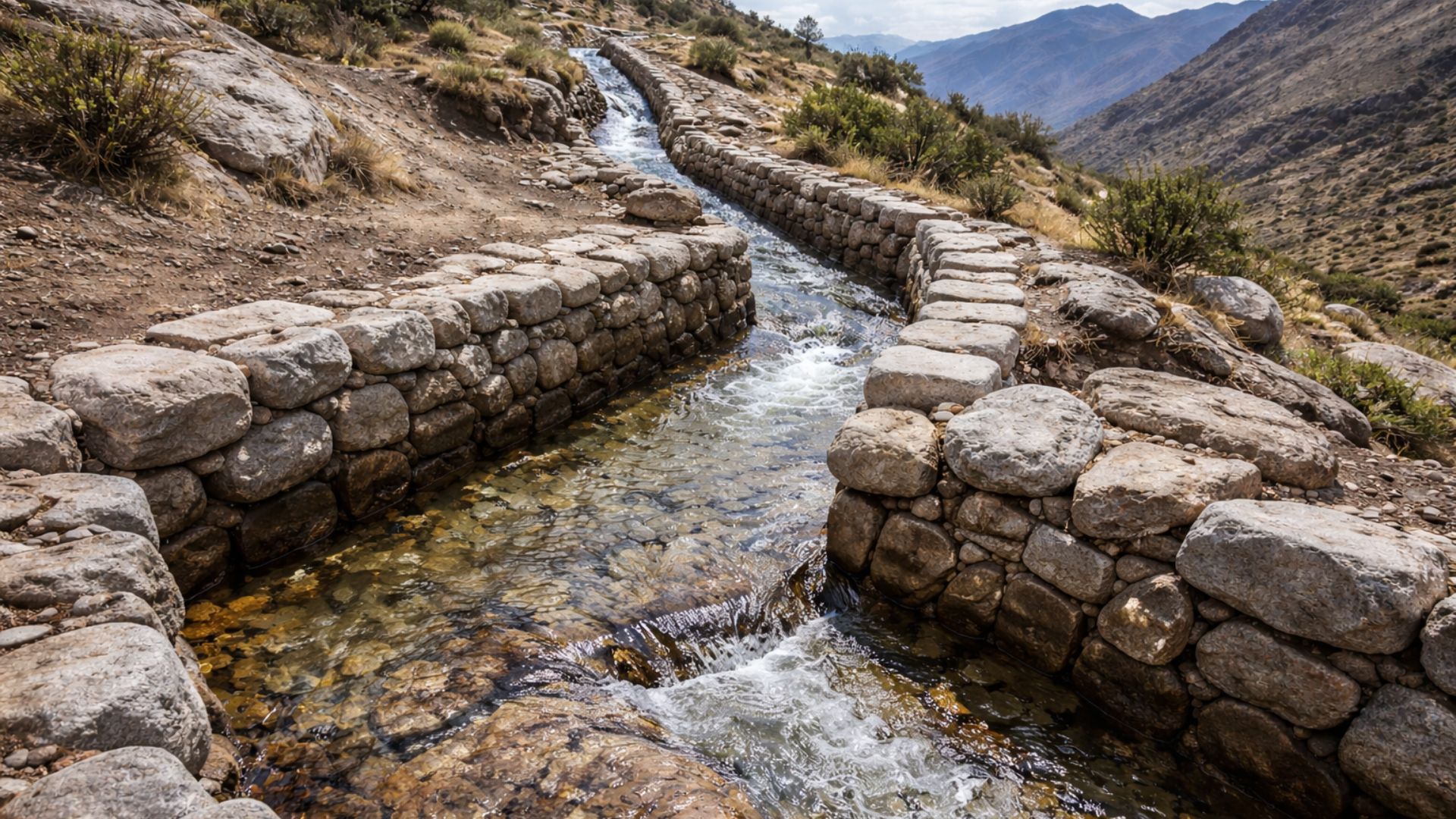


Ancestral Water Management Technique in the Peruvian Andes Infiltrates Rainwater into the Soil and Releases it Weeks Later in Springs, Helping to Reduce Scarcity During Drought and Complement Modern Urban Supply Systems Without Reliance on Large Engineering Works.
An water management technique created long before modern large works has regained attention in the mountains of Peru.
The recovery of amunas, ancestral channels that divert part of the rainwater to infiltration areas, makes this volume reappear weeks later in springs and watercourses, precisely when drought tightens.
The method combines simple engineering, community work, and careful terrain observation to transform temporary excess water into subterranean reserve, without relying on new dams as the first response.
-
Motorola launched the Signature with a gold seal from DxOMark, tying with the iPhone 17 Pro in camera performance, Snapdragon 8 Gen 5 that surpassed 3 million in benchmarks, and a zoom that impresses even at night.

-
Satellites reveal beneath the Sahara a giant river buried for thousands of kilometers: study shows that the largest hot desert on the planet was once traversed by a river system comparable to the largest on Earth.

-
Scientists have captured something never seen in space: newly born stars are creating gigantic rings of light a thousand times larger than the distance between the Earth and the Sun, and this changes everything we knew about stellar birth.

-
Geologists find traces of a continent that disappeared 155 million years ago after separating from Australia and reveal that it did not sink, but broke into fragments scattered across Southeast Asia.

How the “Invisible Storage” of Water Works
The logic is straightforward, yet counterintuitive for those who imagine that all “storage” needs concrete.
Instead of holding water in a visible reservoir, amunas spread the flow over slopes and rocky areas, favoring percolation in the soil.
Part of what infiltrates returns downstream, feeding natural springs and helping sustain base flow in rivers.
In a scenario of high seasonal variability, this means reducing the contrast between months of abundance and months of scarcity.
Scientific Evidence of the System’s Functioning
The most cited evidence of this functioning comes from a study published in the journal Nature Sustainability.
The research evaluated an indigenous system of “infiltration enhancement” nearly 1,400 years old, in the Huamantanga district of the central Andes.
The study describes a network that captures water from streams in the headwaters during the wet season and directs it to infiltration areas, increasing the yield and persistence of downstream springs.

In tracer experiments, the authors recorded that the infiltrated water was retained, on average, for 45 days before resurfacing.
This data confirms the system’s ability to contribute to flows during the dry season.
Sowing and Harvesting Water in the Mountains
In practice, amunas act as a system of “sowing and harvesting” water.
Sections of channels direct the flow to areas where the terrain allows for infiltration, such as slopes with natural fractures, more permeable soils, and areas where water can spread and lose speed.
In some locations, small structures and depressions help to control the flow and regulate the volume that enters the system.
These adjustments prevent diversion from turning into erosion or overloading the channels.
Water Pressure on Lima Drives Recovery
The contemporary interest in the subject is linked to a concrete pressure on Lima’s supply.
The region relies on water that springs from the Andean mountains and faces strong seasonality.
In rainy periods, supply tends to be more comfortable.
In dry months, availability drops and competition for water increases among human consumption, economic activities, and mountain communities.
The Peruvian capital is often described as a large city in a arid environment, making resource management sensitive to climatic variations and extreme events.

Natural Infrastructure as a Complement to Traditional Works
Within this context, projects for restoring the amunas have begun to be treated as support infrastructure, not as historical curiosities.
The research in Nature Sustainability goes beyond explaining the mechanism. The authors estimate the effects of expanding these structures to catchment areas associated with Lima.
The study calculates that, at a larger scale, the system could delay about 99 million cubic meters per year of runoff.
Additionally, it indicates an average increase of 7.5% in dry season flows, acting as a complement to conventional water engineering solutions.
Water Time Management, Not Creation of New Volumes
The key point is that the technique does not create water where it does not exist. What it does is reorganize the timing of water in the territory.
By displacing part of the volume from the rainy season to the underground, the system acts as a natural buffer.
This mechanism reduces the intensity of peak runoff and prolongs water availability in periods of lower precipitation.
For a metropolis that needs to endure dry months without rupture, any measurable gain in base flow carries operational weight.
Social and Territorial Dimension of the Amunas
The recovery of these structures also has a relevant social and territorial dimension.
The channels cross areas where communities maintain local practices of water maintenance and governance.
The efficiency of the system depends on periodic cleaning, repairs, and control of diversion at critical points.
When abandoned, the amunas lose conduction capacity and can silt up, reducing infiltration and degrading the surroundings.
Therefore, the recovery requires both engineering and community cooperation arrangements.
Modern Monitoring Proves the Results
On the technical side, current application benefits from monitoring that did not exist before.
In addition to flow and rainfall measurements, the use of hydrological tracers allows for visualizing the path of water within the mountain.
This technique connects the infiltration point to the resurgence point and measures response times.
Traceability helps separate discourse from performance, indicating where the system works best and which geological conditions favor infiltration.
Discrete Infrastructures and Water Security
The revaluation of these structures raises an uncomfortable question for cities that rely solely on “gray” infrastructure.
To what extent is it possible to enhance water security without multiplying expensive and difficult-to-license works.
In the Peruvian case, the discussion does not eliminate reservoirs, tunnels, or treatment.
It adds a layer of watershed management, acting above the city, in areas where the water originates.
By allowing water to slowly traverse the mountain, a type of invisible storage is created, which does not appear on the urban horizon but sustains the river when the flow would otherwise be declining.
Technical Surprise That Attracts International Attention
The story of the amunas has a component of technical surprise.
The idea that an ancient, low environmental impact infrastructure can generate measurable effects on modern supply challenges common assumptions.
What brought the topic to the global radar was the combination of local restoration with hydrological research published in a high-impact journal.
The study describes mechanisms, response times, and estimates of contribution at the basin scale, distancing the topic from romanticization and bringing it closer to verifiable data.
If water can be “stored” underground for weeks using only channels, slopes, and community maintenance, what other discrete infrastructures, already tested by time, are still off the map of official solutions to the water crisis?






Uma técnica simples e eficaz praticada pela sabedoria ancestral.
Foi isso q a matéria explicou, vc não precisava repetir!!!
Primeiro, temos que partir da preservação dos mananciais e das fontes.
Segundo, precisamos encarar o problema da crise climática c/urgência. Estamos negligenciando. É pra ontem e não estamos levando a sério.
Enquanto uns estão preocupados em invadir países, o mundo passa por sérios problemas climáticos.
Às vezes, obras simples são capazes de resolver e amenizar a escassez de falta d’água em pequenas comunidades e em grandes cidades como Lima, no Peru.
This is absolutely amazing and I am so blessed to have been able to read this story. Who would have thought that the mountains need to be secure and not bulldozed down. They are holding the future for us!