





 Portuguese
  English
  Spanish
  3 min of reading
  1 comment


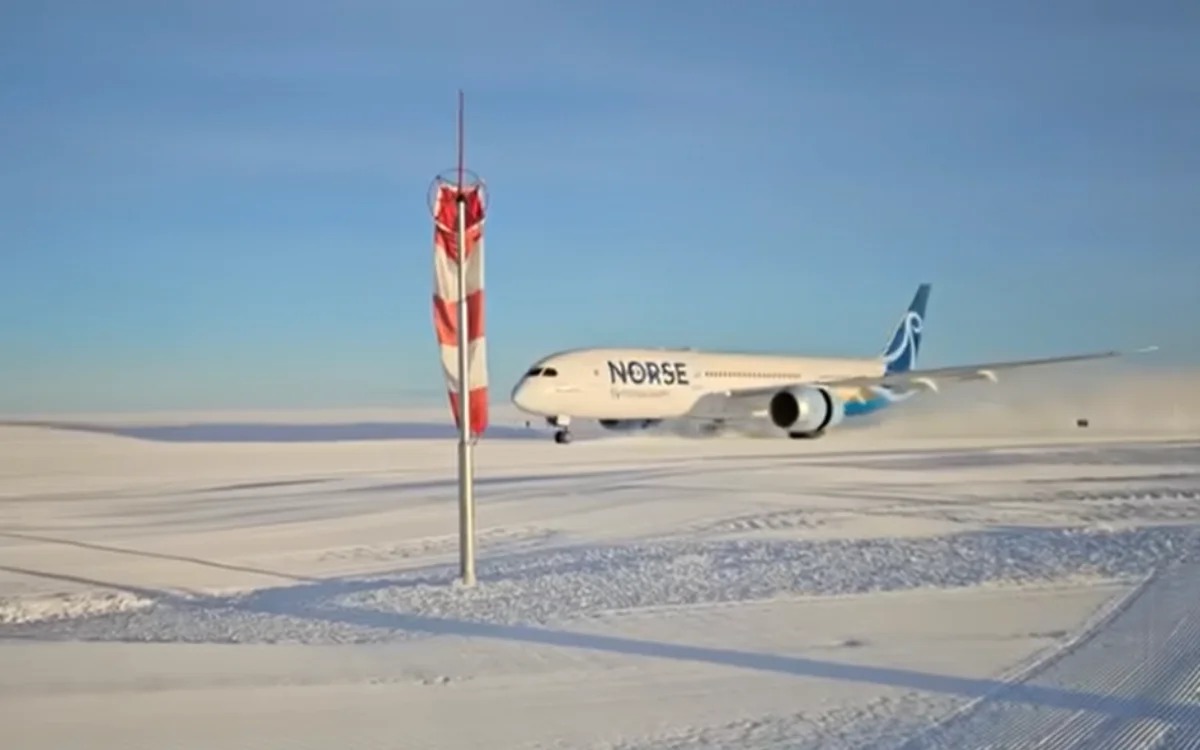


The Unique Landing of a Boeing 787 Dreamliner in Antarctica, Carried Out in November 2023 by a Pilot of Norse Atlantic Airways, Marked an Unprecedented Logistical Operation by Transporting 45 Researchers and 12 Tons of Scientific Equipment to a 9,840-Foot Ice Runway at Troll Air Base
The first landing of a Boeing 787 Dreamliner in Antarctica was carried out in November 2023 by a pilot of Norse Atlantic Airways, on an unprecedented mission that took 45 researchers and 12 tons of equipment to Troll Air Base, on an ice and snow runway.
Historical Landing on an Ice and Snow Runway
A Boeing 787 Dreamliner operated by Norse Atlantic Airways became the first aircraft of this model to land in Antarctica. The feat was captured in images deemed historical and shows the aircraft touching down on a runway made exclusively of ice and snow.
The aircraft landed at Troll Air Base, welcomed by a white strip in the Antarctic environment. The runway used is 9,840 feet (approx. 3 km) long and 100 feet (approx. 30 m) wide, characteristics that require absolute precision during approach and landing.
-
Friends have been building a small “town” for 30 years to grow old together, with compact houses, a common area, nature surrounding it, and a collective life project designed for friendship, coexistence, and simplicity.

-
This small town in Germany created its own currency 24 years ago, today it circulates millions per year, is accepted in over 300 stores, and the German government allowed all of this to happen under one condition.

-
Curitiba is shrinking and is expected to lose 97,000 residents by 2050, while inland cities in Paraná such as Sarandi, Araucária, and Toledo are experiencing accelerated growth that is changing the entire state’s map.

-
Tourists were poisoned on Everest in a million-dollar fraud scheme involving helicopters that diverted over $19 million and shocked international authorities.


Scientific and Not Commercial Mission
Despite the magnitude of the achievement, the flight did not have a tourist or commercial nature. The operation was planned to transport 45 researchers and 12 tons of scientific equipment to the Troll research station, located in Queen Maud Land, Antarctica.
The majority of the passengers were part of the Norwegian Polar Institute. Flight N0787 fulfilled the logistical role of supporting scientific activities in the region, underscoring the importance of air transport for research in extreme environments.
Cargo Capacity as a Deciding Factor
The choice of the Boeing 787 Dreamliner was not random. One of the main factors was the aircraft’s cargo capacity, which can accommodate over 5,000 cubic feet in its compartments. This feature was decisive for facilitating the transport of the 12 tons of equipment necessary for the mission.
The ample internal space allowed for the secure and efficient organization of the cargo, respecting the operational limitations imposed by climatic conditions and the infrastructure available in Antarctica.
Fuel Efficiency and Antarctic Logistics
Another central reason for choosing the model was its fuel efficiency. The aircraft traveled from Cape Town to Antarctica and returned using a single fuel tank, a factor considered essential for operations in remote regions.
According to Paul Erlandsson, Boeing’s field service representative, this efficiency helped address the logistical complexities of transporting, storing, and handling fuel in Antarctica, where there is no traditional infrastructure.
Challenges of Blue Ice Runways
Antarctica does not have conventional runways. Aircraft need to operate on runways known as blue ice, which are formed naturally and maintained by specific climatic conditions.
The video of the landing shows a precise approach on one of the world’s most challenging runways.
The operation sets a precedent for evaluating the potential for new landings of large aircraft on Antarctic ice, expanding logistical options for future scientific missions, even in an environment considered extremely hostile.










Cadê o filme do pouso? A reportagem ficou capalenga…