





 Portuguese
  English
  Spanish
  5 min of reading
  2 comments


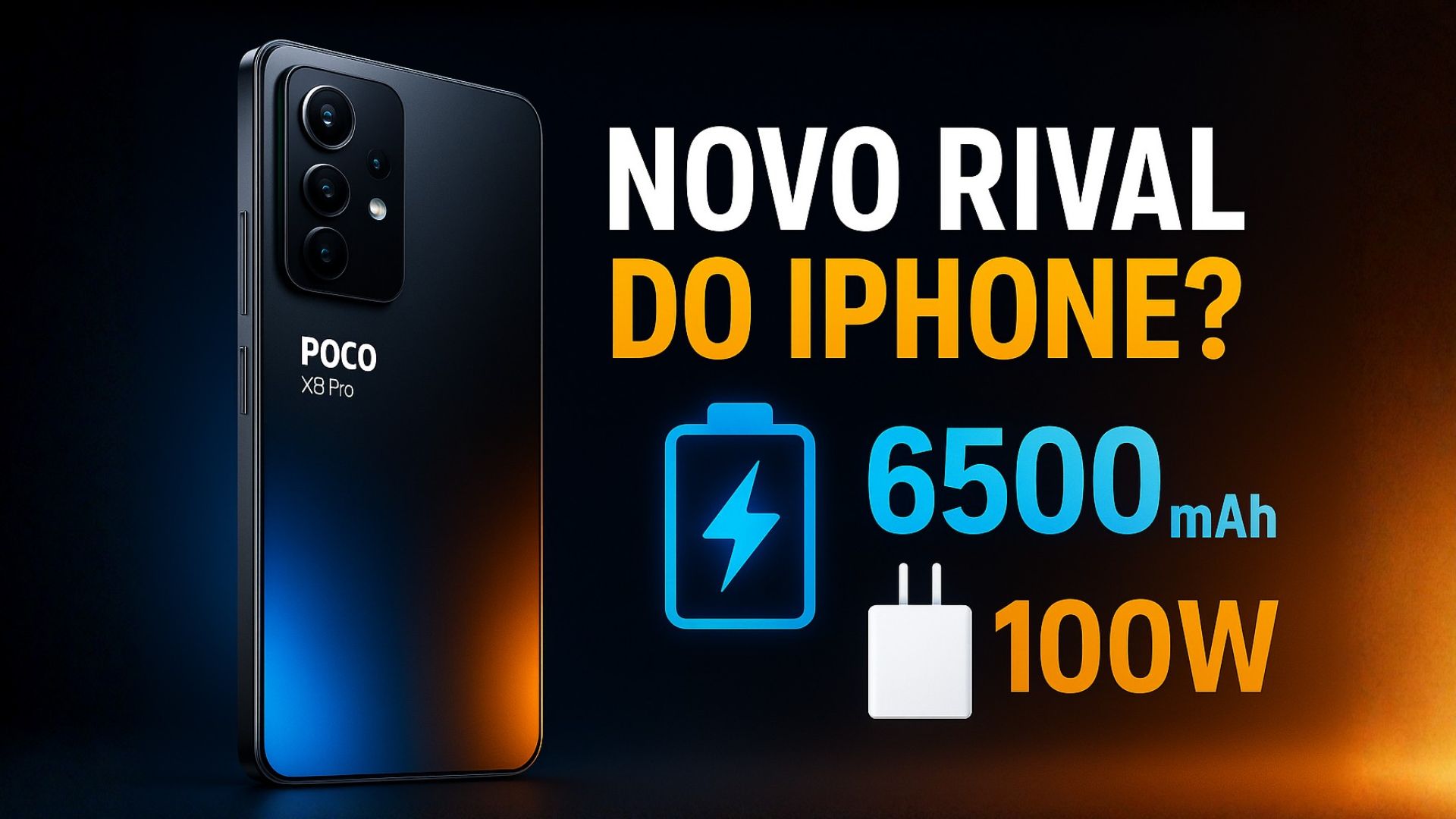


The New POCO X8 Pro Emerges With Giant Battery, Fast Charging, and Advanced Display, Seeking Space Among Premium Models and Renewing the Battle in the Segment of Powerful Mid-Range Devices.
The POCO X8 Pro has taken another step towards global launch by appearing in SGS certification with a 6,500 mAh battery and 100 W fast charging, indicating that Xiaomi is preparing an advanced mid-range device focused on autonomy and ultra-fast charging to compete with recent flagship models.
Certification and Support for Major Networks
The model was listed in the SGS database with the code 2511FPC34G, the same one seen in previous certifications with agencies such as the EEC, reinforcing that this is the global variant of the device.
The documentation confirms support for WCDMA, WLAN, Bluetooth, NFC, and 5G on bands n1, n3, n7, n8, n28, n38, n41, and n78, aligning the X8 Pro with the major networks used in international markets.
-
After decades of failed attempts, Brazil is once again looking to space with an orbital rocket measuring 12 meters, weighing 12 tons, costing R$ 189 million, and scheduled for launch in 2026, in a new race to finally achieve autonomous access to orbit.

-
The Earth will plunge into a few minutes of darkness in broad daylight in August 2026, when a total solar eclipse transforms the sky into one of the most impressive astronomical phenomena in recent years.

-
How the terraforming of Mars can transform the planet: artificial aerosols can increase the temperature by up to 35°C in 15 years, creating conditions for liquid water.

-
Scientists drilled nearly 8,000 meters into the ocean floor above the fault that caused the 2011 tsunami in Japan and discovered that a layer of clay 130 million years old was responsible for making the wave much worse than any model had predicted.


According to the registration, the smartphone was tested with a battery identified as BM6Q, with a nominal capacity of 6,330 mAh and a typical capacity of 6,500 mAh.
This represents a jump of 500 mAh compared to the global POCO X7 Pro, which had 6,000 mAh and was already notable for its long-lasting daily use.

In practical terms, the new cell is likely to deliver even more time away from the outlet for tasks such as gaming, video streaming, and social media.
The listed charging module is the MDY-19-EX adapter, with Class II protection and a maximum output of 100 W via USB-C, confirming support for fast wired charging at a power level greater than the previous generation.
With the POCO X7 Pro, which operated with 90 W, the total charging time was close to 50 minutes in independent tests.
With the combination of more capacity and greater power in the X8 Pro, the expectation is to maintain a total charging time of around one hour, even with the larger battery, although these numbers can only be confirmed after practical tests.
The Relationship Between POCO X8 Pro and Redmi Turbo 5
While the SGS certification is limited to battery, charger, and connectivity data, other regulatory bodies and leaks help shape the scenario of what Xiaomi is preparing for this model.
Records at the EEC and in IMEI databases indicate that the POCO X8 Pro will be the global version of the Redmi Turbo 5, repeating the strategy adopted in the previous generation, where the POCO X7 Pro was launched internationally as a derivative of the Redmi Turbo 4.

These same leaks suggest that the device should feature a flat OLED display of approximately 6.6 to 6.67 inches, resolution 1.5K, and refresh rate of 120 Hz, a combination that would place it on par with many premium models in sharpness and fluidity.
The goal is to capture the attention of users currently considering smartphones like the iPhone 17 Pro and the Galaxy S25/S26 series, which also focus on high refresh rate and high brightness panels.
Internal Hardware and Expected Performance
In terms of internal hardware, major specialized sources mention the use of the MediaTek Dimensity 8500 or Dimensity 8500 Ultra, a 4 nm chip aimed at high-performance mid-range devices, with versions of up to 12 GB of RAM and 512 GB of internal storage.
If these specifications are confirmed, the POCO X8 Pro is likely to position itself as a device capable of delivering performance close to recent flagships in gaming and multitasking, but at a more aggressive price typical of the POCO lineup.
Another recurring piece of information in leaks is the presence of a structure with metal sides and advanced certifications for water and dust resistance, such as IP68 or IP69, which is still rare among mid-range devices.

The association with the Redmi Turbo 5 reinforces this scenario: Chinese documents describe the model as a device focused on robustness, large battery, and an audience seeking prolonged autonomy, which aligns with the 6,500 mAh certification seen at SGS.
Updated Software and Market Expectations
In terms of software, the expectation is that the POCO X8 Pro will ship with Android 16 running on the HyperOS 3 interface, which began to be distributed by Xiaomi for its more recent models in 2025.
The new version of the interface focuses on performance, device integration, and artificial intelligence capabilities, which could help to take better advantage of the large-capacity battery and more powerful hardware of the device.
Regarding cameras, there are still no detailed specifications confirmed in certifications.

International publications mention the possibility of a main sensor of 50 megapixels accompanied by auxiliary lenses for ultra-wide and macro, following the formula of other recent models from the brand, but so far these details appear only in rumors with no official documentation.
There is also no public announcement of an exact date for the launch of the POCO X8 Pro.
Documents and market analyses suggest that Xiaomi is likely to repeat the timeline of the X7 lineup, with a global presentation between early and the first quarter of 2026, as the most recent certifications often precede commercial launches by a few months.
The strategy would be to take advantage of the period when competitors like the new Galaxy S models and the iPhone 17 itself are still in the spotlight, offering a mid-range device focused on cost-effectiveness and a robust technical specification.









123
456