





 Portuguese
  English
  Spanish
  4 min of reading
  8 comments


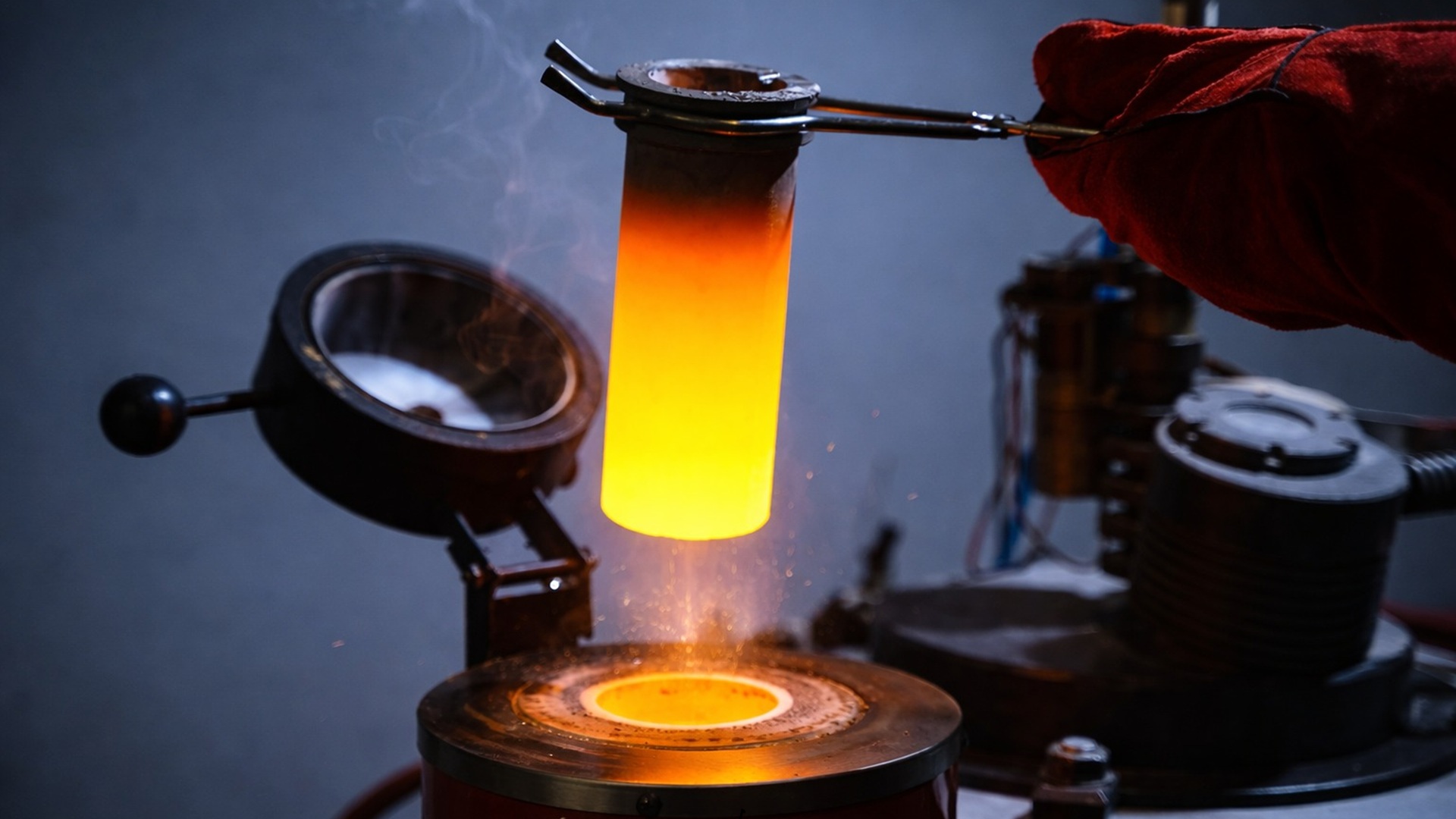


Experiment Conducted at the 27-Kilometer LHC Recorded Momentary Production of Gold-205 from Lead-208 for 10⁻²³ Seconds, with a Cross Section of 6.8 Barns and Measurements Impacting 27 TeV and 100 km Accelerator Projects
On July 30, 2025, researchers reported that collided lead ions at the Large Hadron Collider, located 27 kilometers beneath the Franco-Swiss border, momentarily transformed into gold-205 for about 10⁻²³ seconds, with a cross section of 6.8 barns.
The result was obtained at the LHC, which regularly collides heavy ions at speeds close to the speed of light. The analysis indicates that a single deposition of lead can produce gold nuclei with a cross section comparable to the total rate of hadronic collisions.
This makes the so-called modern alchemy much more frequent in the tunnel than previously thought. The experiment was conducted by the ALICE collaboration, led by Professor Daniel Tapia Takaki from the University of Kansas.
-
Motorola launched the Signature with a gold seal from DxOMark, tying with the iPhone 17 Pro in camera performance, Snapdragon 8 Gen 5 that surpassed 3 million in benchmarks, and a zoom that impresses even at night.

-
Satellites reveal beneath the Sahara a giant river buried for thousands of kilometers: study shows that the largest hot desert on the planet was once traversed by a river system comparable to the largest on Earth.

-
Scientists have captured something never seen in space: newly born stars are creating gigantic rings of light a thousand times larger than the distance between the Earth and the Sun, and this changes everything we knew about stellar birth.

-
Geologists find traces of a continent that disappeared 155 million years ago after separating from Australia and reveal that it did not sink, but broke into fragments scattered across Southeast Asia.

According to Tapia Takaki, collisions typically produce a lot of debris. The team developed a method to detect interactions where the ions merely skim past each other, generating almost no residuals beyond a flash of light and an altered nucleus.
Gold from Lead in Ultraperipheral Collisions
Ultraperipheral collisions occur when two nuclei pass close by without direct contact, but with interaction between electromagnetic fields. Instead of fragmenting, the ions exchange high-energy photons.
Using the Weizsäcker-Williams method, photons from one nucleus can probe or transform the other. This barrage can remove one, two, or three protons from the original nucleus.
When three protons are eliminated, lead-208 briefly transforms into gold-205. The nucleus remains in this state for about 10⁻²³ seconds, long enough to leave a signal in the calorimeters.
Previous ALICE tests suggested the existence of these events. However, the detector was optimized for frontal collisions. The team recalibrated readings, added vetoes, and refined a two-stage adjustment to isolate neutron and proton peaks.
Cross Sections, Proton Channels, and Theoretical Discrepancies
The analysis recorded a cross section for gold production of 6.8 barns. This value was 12% below the total inelastic rate of 7.67 barns for lead-lead interactions at the same energy.
This implies that with each hadronic collision of ions at the LHC, approximately another nearby event occurs in which a lead ion quietly transforms into gold before it decays.
The dataset fixed proton channel 0 at 157.5 barns, proton channel 1 at 40.4 barns, and proton channel 2 at 16.8 barns. The results matched or exceeded predictions from the RELDIS photonuclear model within 25%.
The discrepancies indicate limitations in the description of pre-equilibrium emission and coalescence of nucleons in individual channels. Photon-photon and photon-nucleus interactions occur without significant hadronic scattering, creating a clean environment for structural study.
Detection at 112.5 Meters and Selection of 2.05 Million Triggers
The ALICE collaboration uses zero-degree calorimeters positioned 112.5 meters downstream from the interaction point. They record neutral and charged fragments resulting from interactions.
The team selected events with proton energy within two standard deviations of the beam energy and at least one neutron detected in the neighboring calorimeter.
Two million events were isolated from 2.05 million triggers. Corrections considered acceptance, efficiency, and the probability of peripheral hadronic collisions mimicking electromagnetic events.
Monte Carlo simulations with RELDIS and AAMCC-MST indicated that hadronic impostors contributed less than one percent to the individual proton sample.
The adjustment revealed broad peaks at 1 and 2 protons, about twice as wide as the neutron peaks. Relativistic protons may lose energy at the edges of the calorimeter or upon interacting with beamline material.
A modified Gaussian model with width scaling for scattering correction was adopted by other heavy ions groups. The method has since been integrated into subsequent analyses.
Implications for Secondary Beams and Future 27 TeV and 100 km Machines
The removal of three protons generates gold, while the removal of one proton transforms the ion into thallium, which deforms differently in the LHC magnets.
Uncontrolled secondary beams may hit cold components, shut down superconducting magnets, or trigger safety systems. These factors can limit the performance of 27 TeV upgrades and the proposed Future Circular Collider of 100 km.
By measuring channels of 0 to 3 protons, the team provides data for loss maps used in the design of collimators and shielding. The information also feeds simulations for the U.S. Ion and Electron Collider.
In this context, the transformation of lead into gold ceases to be a curiosity and begins to integrate into operational and safety calculations of billion-dollar facilities.
Next Steps and Publication in Physical Review C
The team intends to extend the analysis to emissions of four and five protons when Run 3 data become available. This will increase sensitivity for nuclei close to hafnium and tantalum.
Researchers are working with theorists to refine photonuclear models and adjust neutron and proton ratios to experimental observations.
A specific trigger for ultraperipheral collisions is under development. It combines calorimeter logic with real-time machine learning filters.
The goal is to capture rare events without overloading the data acquisition system. If successful, modern alchemy could be observed almost in real-time.
The study was published in the journal Physical Review C.








Muito relevante e elucidativo
Pergunta é: o custo é viável? 🤔
\(10^{-23}\)… um femtossegundo!
O mesmo tempo que meu salário dura na conta…