





 Portuguese
  English
  Spanish
  5 min of reading
  0 comments



Hanging CDs In The Crop Work As Visual Repellents By Reflecting Light And Spinning With The Wind, Reducing Losses In Fruits And Vegetables. Understand How It Works And What Its Technical Limits Are.
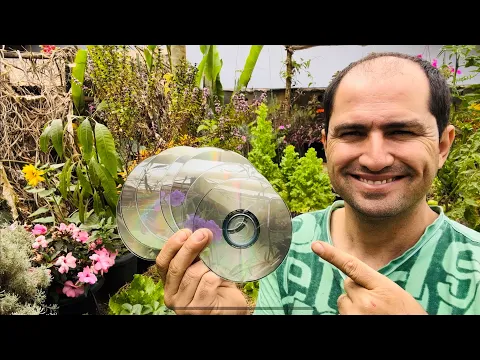
In various agricultural regions, especially where fruits and vegetables are exposed during the ripening period, producers resort to simple visual methods to reduce bird pressure on the harvest. One of the most known is the use of CDs hung in the crop, fixed to stakes, wires, fences, or branches near the plants. The principle is easy to understand. The compact disc has a highly reflective surface and, when spinning with the wind, projects flashes of light in unpredictable directions. These intermittent visual stimuli alter the environment and tend to make it difficult for some species that feed in the area to approach.
The mechanism is similar to that of the so-called agricultural reflective tapes (flash tape) and other visual deterrents used in gardens and orchards.
How CDs Work As Visual Repellents In Agriculture
The use of CDs has entered the repertoire of low-cost solutions because it combines two relevant technical characteristics: intense brightness and mobility with the wind. Movement is an essential part of the strategy.
-
The sugar-energy sector advances with agricultural technology, but agricultural productivity still raises concerns.

-
The eggshell that almost everyone throws away is made up of about 95% calcium carbonate and can help enrich the soil when crushed, slowly releasing nutrients and being reused in home gardens and vegetable patches.

-
This farm in the United States does not use sunlight, does not use soil, and produces 500 times more food per square meter than traditional agriculture: the secret lies in 42,000 LEDs, hydroponics, and a system that recycles even the heat from the lamps.

-
The water that almost everyone throws away after cooking potatoes carries nutrients released during the preparation and can be reused to help in the development of plants when used correctly at the base of gardens and pots, at no additional cost and without changing the routine.


When the disc remains static, the reflection becomes predictable. When it spins, the light fragments and creates an irregular pattern of brightness that appears and disappears quickly. This constant variation is what generates visual discomfort.

Studies on reflective deterrents indicate that the combination of reflection, movement, and novelty is what produces the initial repulsion effect. Scientific observations show that reflective compact discs can exhibit a repelling effect in the short term, especially when positioned to maximize reflections on both sides.
In practice, the CD acts as an ‘optical scarecrow’: it does not create a physical barrier but modifies the visual environment, increasing the perception of instability at the feeding point.
Why Light and Movement Are Disturbing
From a behavioral perspective, many birds that feed on agricultural crops respond to sudden and inconsistent visual stimuli. A strong brightness that appears unexpectedly can be interpreted as a sign of risk or disturbance in the environment.
The technical literature on bird damage management describes three common pillars in visual deterrent systems:
- Intense Light
- Movement
- New Element in the Environment
The initial effect is usually linked to novelty. Over time, if there is no real threat associated with the stimulus, habituation may occur, a phenomenon in which the animal learns that the object does not represent danger.
Therefore, experts emphasize that the use of CDs tends to be more effective as a method of pressure reduction, rather than as a definitive solution.
In Which Crops Are CDs Typically Used?


The technique appears most frequently in horticultural and fruit crops, especially when the fruits are ripe and more vulnerable. Orchards, vineyards, and areas with small and exposed fruits are common examples.
Losses caused by birds can vary significantly depending on:
- Type of Crop
- Time of Year
- Food Availability in the Landscape
- Size of Local Flocks
In high-value commercial crops, protective nets are often used as a physical barrier. CDs serve as a low-cost and easy-to-install alternative, albeit with greater variability in results.
Losses of Up to 40%: How They Are Estimated
Technical reports and government materials indicate that losses can be significant under certain conditions. In some cases, field studies report damages of up to 40% or more of the production in areas without control.
The methodology for estimating losses typically involves comparing protected and unprotected areas, allowing for more accurate calculation of the percentage of damage.
However, it is important to emphasize that these percentages are not universal. The level of loss depends on the ecological context, local pressure, and the abundance of alternative food in the region.
Technical Limitations of Using CDs
The main limitation of the CD as a visual repellent is habituation. Studies indicate that, over time, birds may become accustomed to the stimulus and resume their feeding behavior.
Additionally, environmental factors directly influence the performance of the method:
- Cloudy days reduce the intensity of reflections
- Absence of wind decreases the spin of the disc
- Tall vegetation may block light incidence
Effectiveness also varies depending on the species. Some respond more strongly to visual stimuli; others exhibit greater tolerance.
Comparison with Commercial Reflective Solutions
The improvised CD shares the same principle as commercial products like agricultural reflective tapes. These materials are specifically developed to maximize brightness and movement, covering larger areas of the planted area.
While the tapes provide continuous coverage along perimeters, CDs function as isolated points of brightness distributed throughout the crop.
In both cases, the mechanism relies on the same tripod:
- Intense Reflection
- Movement with the Wind
- Pattern Variation to Delay Habituation
Does It Work for Small Producers?
In general, evidence indicates that:
- CDs and reflectors can repel birds in the short term, especially in strong sunlight and windy conditions.
- Effectiveness tends to decrease over time due to habituation.
- Reduction of losses is possible, but depends on climate, species, and intensity of the attack.
- Results vary between properties and crops.
For small producers, the method can represent a complementary management strategy, especially in small areas where investing in nets would be unfeasible.
Hanging used CDs in the crop is a technique based on simple principles of visual deterrence through reflection and movement. The method can help reduce losses in fruits and vegetables, mainly in the short term and under favorable climatic conditions.
However, it is not a definitive solution. Effectiveness depends on light intensity, presence of wind, type of crop, and adaptability of the present species.
As a low-cost strategy, CDs can be integrated into a set of agricultural management practices, but their use should be seen as an auxiliary tool within a broader harvest protection plan.










-

-

-

-

-

15 pessoas reagiram a isso.