





 Portuguese
  English
  Spanish
  3 min of reading
  0 comments


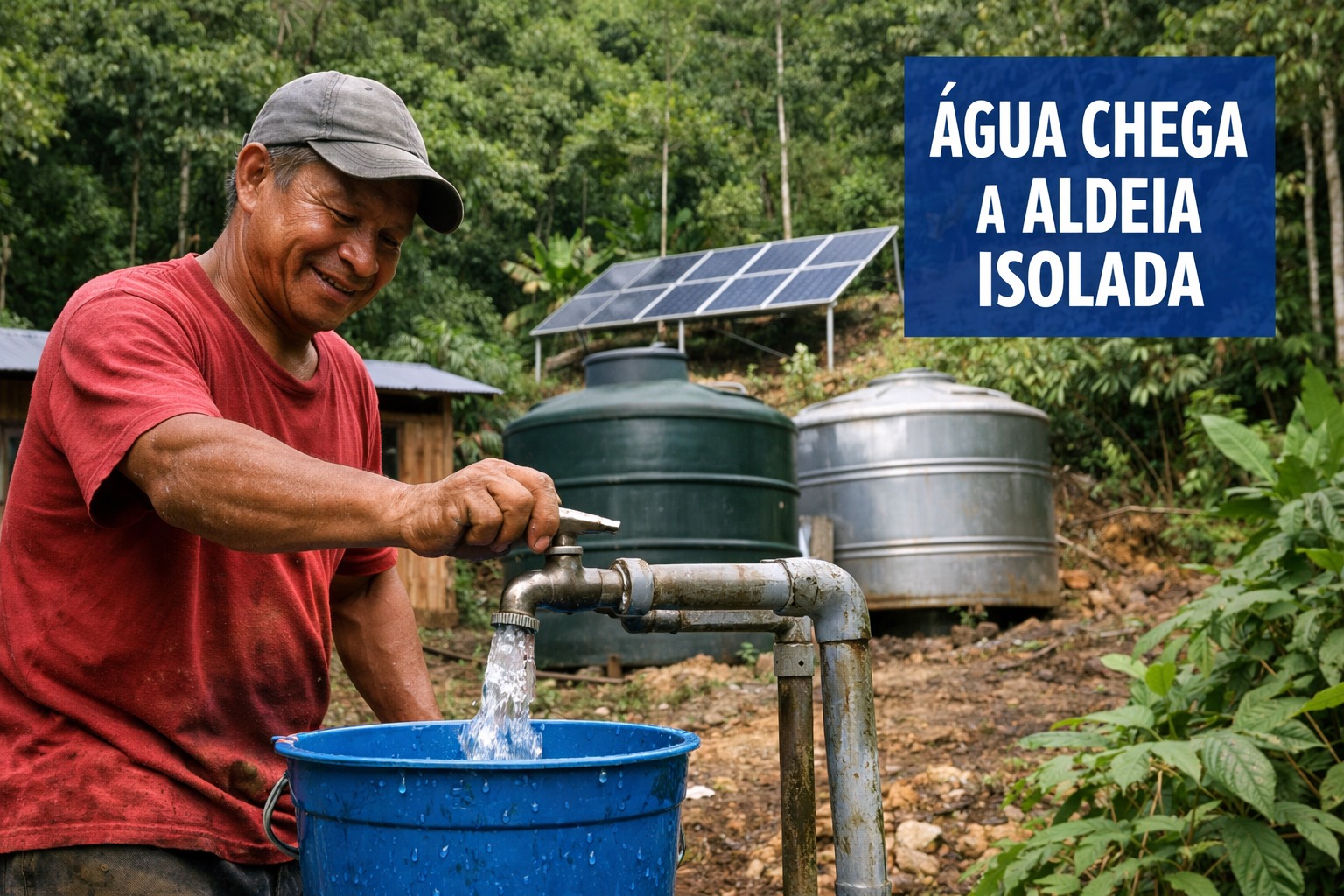
Simple And Sustainable Project Brings Clean Water To The Nairi Awari Community, Ending Long Walks To The River And Revealing How Accessible Technology Can Change Isolated Realities
In the heart of the tropical rainforest of Costa Rica, the indigenous people of the Nairi Awari village are experiencing a quiet yet profound change in their daily routine. In 2024, for the first time, water is reaching homes directly, eliminating the need for long walks to the river with buckets in hand. The new system works thanks to solar panels that pump water from a nearby spring, transforming old habits and reducing efforts that previously consumed part of the day.
A Difficult Path To Water
The 20 families of the Cabécar indigenous people live in a mountainous region, accessible only by a muddy path that cuts through the rainforest. The community is four kilometers from the nearest rural road and 100 km east of San José.
According to local resident Nelson Martínez, “it’s good to have clean water nearby,” he told AFP, summarizing the immediate impact of the change on families’ daily lives.
-
Russia spent $5 billion and 28 years modernizing a nuclear warship that had been inactive since 1997. The Admiral Nakhimov returned to the sea in August 2025 as the heaviest surface combat ship in the world, with 176 missile launchers, including hypersonic Zircon missiles.

-
James Webb finds 300 galaxies with mysterious scars, and this discovery may show that the universe was born much more violently than astronomers had imagined.

-
Haiti’s capital is experiencing an energy and construction crisis, facing blackouts, a blocked port, and buildings at risk after years of instability and a significant earthquake.

-
Government unlocks R$ 554 million for a highway that has been requested for decades and accelerates the duplication of BR.

To implement the system, it was necessary to transport two tanks, one of 2,500 liters and another of 7,500 liters, along the trail to the spring.
The water is filtered and pumped using energy produced by six solar panels, each with a capacity of 450 watts.
Until 2024, the houses still did not have electricity, as all the generated energy is used by the water pump installed in a clearing in the jungle.
Simple Technology And Direct Impact On The Village
The transfer of the panels to the site was described as “an odyssey” by Kenneth Solano, rural energy coordinator of the Inter-American Institute for Cooperation on Agriculture, responsible for implementing and monitoring the project, in an interview with AFP.
Previously, residents fetched water from a nearby ravine, taking it from a stream. “It was a waste of time,” recalls Martínez.
“Now it’s different, we have pipes and reservoirs, this helps a lot,” says the 54-year-old man, smiling as he turns on the tap in his rustic home. “This makes us happy.”
The supply system is simple, clean, and low-cost. It was not installed by the state but financed by Spanish Cooperation, with an investment of US$ 12,500.
For Solano, it is possible to serve rural communities with “low-impact technologies,” a solution that adapts to local conditions without major interventions.
Water, Health, And Basic Rights In The Village
In Costa Rica, eight indigenous groups represent 2.4% of the 5.2 million inhabitants, according to official data. The Cabécar number about 14,300 people and occupy approximately 151,400 hectares.
Data from 2024 is clear. Although more than 92% of Costa Ricans have access to clean water, the UN states that only 40% of indigenous peoples have this service in the country. “We all have the right to have water at home,” emphasizes Martínez to AFP.
In the small community school, children learn math while waiting for the repair of a solar panel that previously powered the classroom and some computers from the Ministry of Education.
Teacher Viviana Hernández tells AFP that, before the new system, students suffered from stomach illnesses caused by the river water. “Water is our source of life,” she says.
At noon, the simple lunch prepared in the wooden kitchen reinforces the importance of facilitated access, concluding the routine with a detail that once seemed distant: washing dishes with clean water, inside the house.
This article is based on a report from Swissinfo, published in 2024.







-

2 pessoas reagiram a isso.