





 Portuguese
  English
  Spanish
  4 min of reading
  0 comments


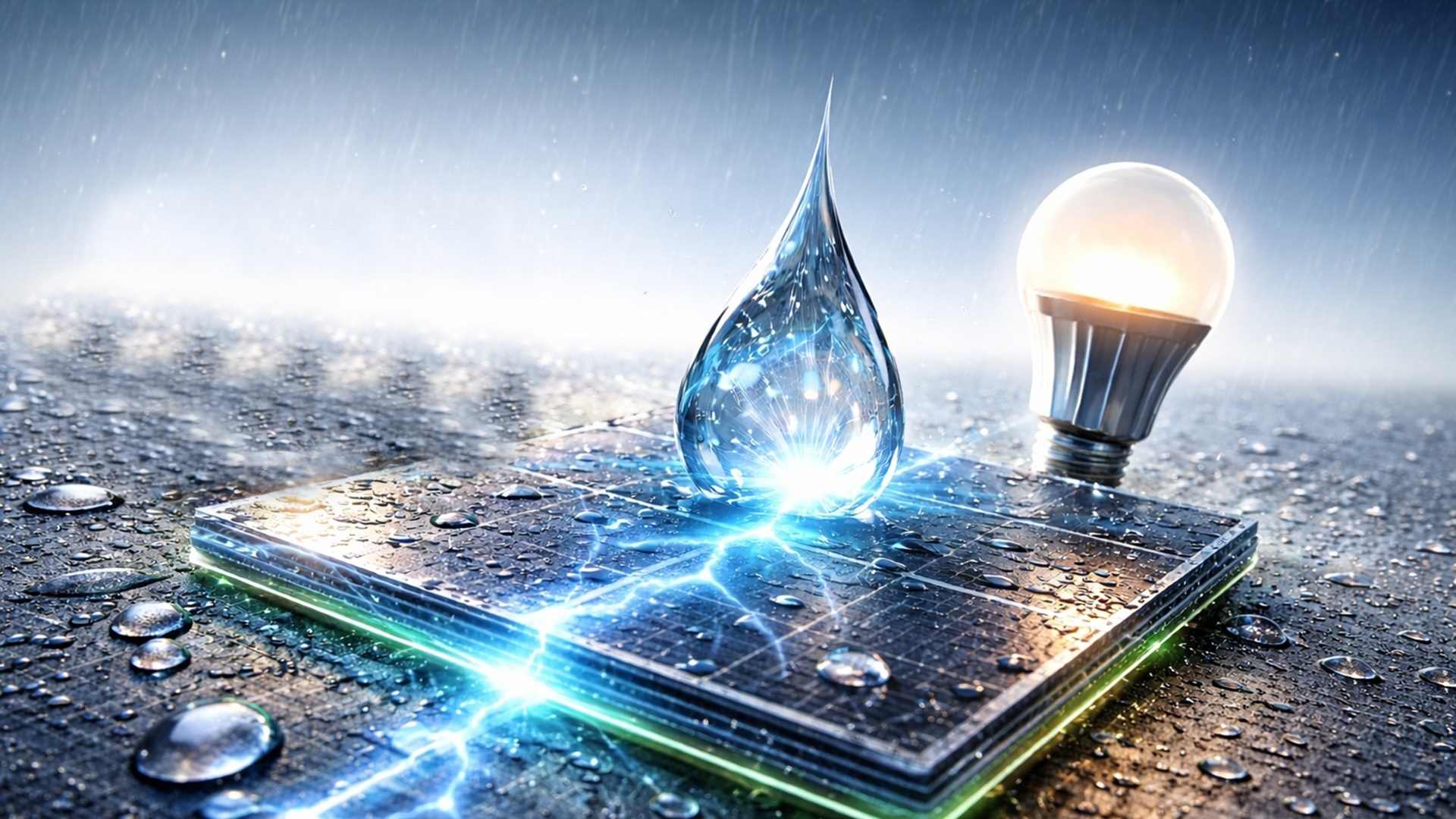
Hybrid Technology Developed at the Seville Materials Science Institute Combines Perovskite and Triboelectric Nanogenerator in Film of Less Than 100 Nanometers, Reaches Up to 110 V per Drop and Expands the Use of Rain Energy in Sensors, IoT and LED Circuits
Researchers at the Seville Materials Science Institute have developed a hybrid perovskite device capable of operating under sun and rain, generating up to 110 V per drop and expanding the use of rain energy in applications such as IoT and external sensors.
Rain Energy Expands Efficiency of Perovskite Cells in Cloudy Conditions
The device was created by researchers at the Seville Materials Science Institute in Spain. The innovation allows perovskite solar cells to operate simultaneously under sunlight and rain energy, overcoming limitations associated with cloudy conditions.
According to a press release, the innovation is expected to boost the implementation of the Internet of Things and external sensors used to monitor structures and environmental conditions. The integration of rain energy expands the autonomy of these systems in outdoor environments.
-
Motorola launched the Signature with a gold seal from DxOMark, tying with the iPhone 17 Pro in camera performance, Snapdragon 8 Gen 5 that surpassed 3 million in benchmarks, and a zoom that impresses even at night.

-
Satellites reveal beneath the Sahara a giant river buried for thousands of kilometers: study shows that the largest hot desert on the planet was once traversed by a river system comparable to the largest on Earth.

-
Scientists have captured something never seen in space: newly born stars are creating gigantic rings of light a thousand times larger than the distance between the Earth and the Sun, and this changes everything we knew about stellar birth.

-
Geologists find traces of a continent that disappeared 155 million years ago after separating from Australia and reveal that it did not sink, but broke into fragments scattered across Southeast Asia.

Advances in solar cell technology have allowed the construction of large plants capable of generating carbon-free electricity. Still, only a fraction of the energy received from the sun is utilized, which motivates research with new materials.
Perovskites exhibit conversion efficiencies higher than those of conventional solar cells and low production costs. Despite this, they face reliability issues, especially when exposed to prolonged environmental variations.
Rain Energy and 100-Nanometer Film Protect and Generate Electricity
To address these limitations, ICMS researchers developed a hybrid device with a thin film constructed using plasma technology. This film has a thickness of less than 100 nanometers.
In comparison, a human hair has an average thickness of 80,000 nanometers. The difference highlights the extremely thin nature of the coating applied to the perovskite solar cell.
The film serves a dual function. It acts as an encapsulant, protecting the chemical composition of the perovskite cell, and enhances light absorption. At the same time, it functions as a triboelectric surface, converting kinetic energy into electrical energy.
This conversion allows the utilization of rain energy. When hitting the surface, the droplets activate the triboelectric mechanism, producing a measurable potential difference, even under conditions without direct sunlight.
Rain Energy Reaches 110 V per Drop in Experiments at ICMS
In experiments conducted at ICMS facilities, researchers observed that a single raindrop could generate a potential difference of 110 V. This value was considered sufficient to power a small portable device.
Researcher Carmen Lopez stated in a press release that the work combines photovoltaic technology from perovskite solar cells with triboelectric nanogenerators in thin film configuration.
According to her, the proposal demonstrates the feasibility of implementing both energy harvesting systems in a single device. The combination integrates solar energy and rain energy into one functional structure.
The research results were published in the journal Nano Energy, as noted in the released material. The study addresses transparency, wettability, microstructure, and chemical composition of CFx film encapsulants for PSC.
Applications of Rain Energy in IoT, Sensors and Mega Structures
Conventional solar cells exhibit reduced performance on cloudy days. In regions with prolonged rain periods, this limitation can hinder the widespread adoption of traditional photovoltaic technology.
By developing a system that functions under both sun and rain, researchers have expanded the possibilities for energy autonomy. Rain energy helps keep devices active even under adverse weather conditions.
Researchers suggest that the device can power LED circuits, even when submerged in water. It can also assist perovskite solar panels in coping with temperature and humidity fluctuations.
The use of rain energy coupled with the protection offered by the thin film can benefit external sensors installed in mega structures such as bridges, and environmental sensors aimed at weather forecasting and precision agriculture.
The Internet of Things sector is also expected to benefit from the research. The ability to collect energy from rain and sunlight in a single hybrid panel can sustain devices distributed in outdoor environments for extended periods.
In the article, researchers highlighted the potential of coatings deposited using plasma techniques as a multifunctional solution. These coatings protect sensitive devices and develop systems capable of harvesting energy from various environmental sources.
With the integration of rain energy into perovskite cells, the hybrid device seeks to overcome reliability and performance limitations associated with climate variations, consolidating a combined approach for electricity generation in outdoor environments.
The research results were published in the journal Nano Energy .








-

-

2 pessoas reagiram a isso.