





 Portuguese
  English
  Spanish
  4 min of reading
  4 comments


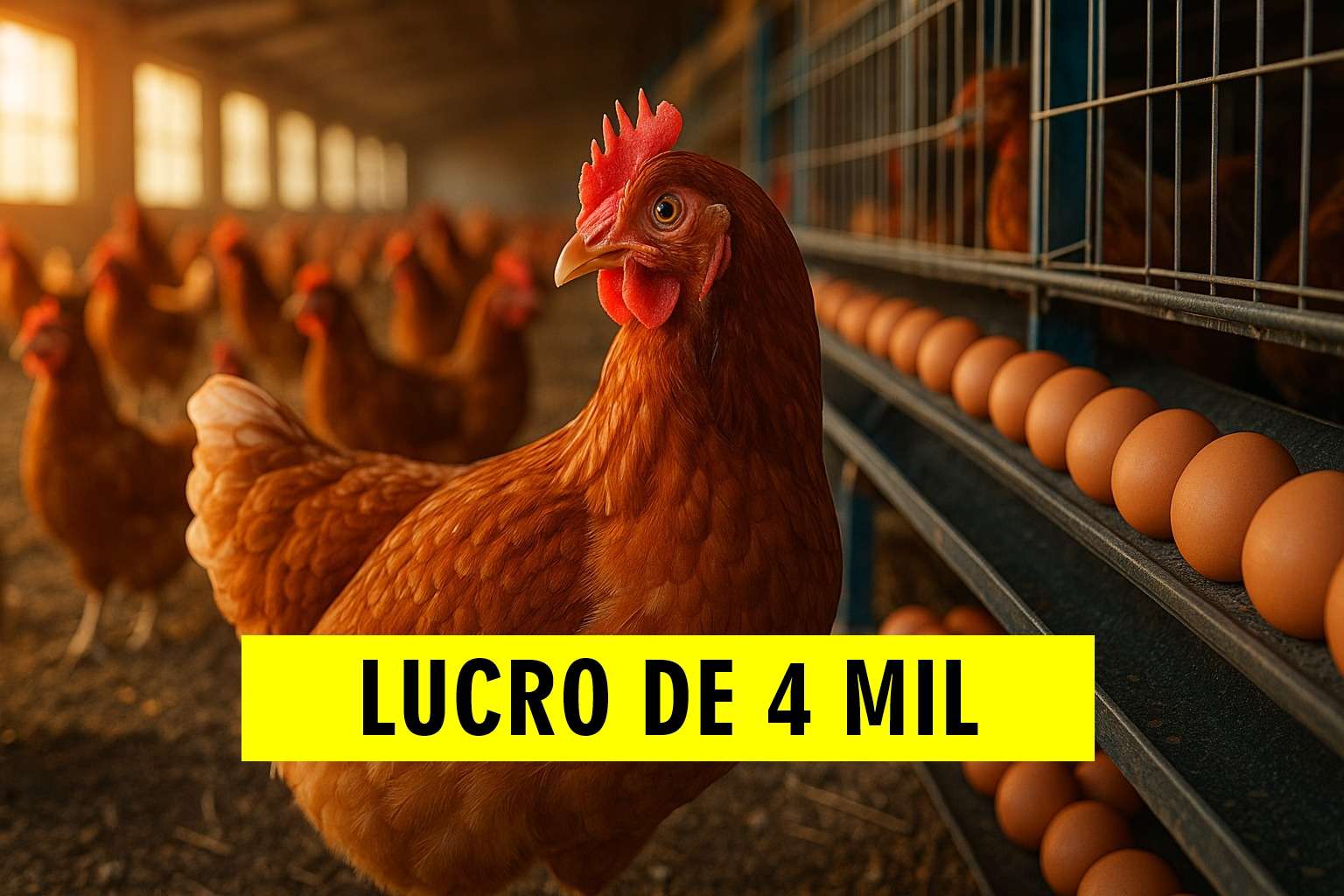


Creating Laying Hens Can Be More Profitable Than It Seems: With 200 Birds Producing 5,270 Eggs Per Month, Producer Details Costs, Real Expenses, and How Much It Is Possible to Earn Even With High Feed Expenses
Creating laying hens may seem risky for those who fear they won’t even be able to cover the feed costs. However, understanding the numbers and calculating each expense carefully can reveal that this rural activity does have profitable potential.
The creator and producer of the channel The Rural Investor shared real details about how much can be earned with 200 hens and what the main costs involved in the monthly egg production are.
Challenging and Expanding Market
The raising of laying hens requires planning because feed costs represent the largest part of expenses and are subject to constant fluctuations.
-
The water that almost everyone throws away after cooking potatoes carries nutrients released during the preparation and can be reused to help in the development of plants when used correctly at the base of gardens and pots, at no additional cost and without changing the routine.

-
The sea water temperature rose from 28 to 34 degrees in Santa Catarina and killed up to 90% of the oysters: producers who planted over 1 million seeds lost practically everything and say that if it happens again, production is doomed to end.

-
An Indian tree that grows in the Brazilian Northeast produces an oil capable of acting against more than 200 species of pests and interrupting the insect cycle, gaining ground as a natural alternative in soybean, cotton, and vegetable crops.

-
The rise in oil prices in the Middle East is already affecting Brazilian sugar: mills in the Central-South are seeing their margins shrink just as ethanol gains strength.


The prices of feed ingredients frequently rise, while the price of eggs does not always keep pace with this increase.
Even so, the activity grows every year and ensures good profits for those who know how to manage their accounts and calculate values correctly.
For those starting out, it is important to understand that the initial investment — such as the purchase of birds, infrastructure, and equipment — should not be considered within just one month.
This cost needs to be spread over time, functioning as an investment that will be recovered with continuous production.
Cost and Production Calculation With 200 Hens
In the simulation presented by Aparecido, real production and monthly expense data were considered.
Each hen consumes about 110 grams of feed per day. With 200 birds, the monthly cost of feed reaches R$ 1,568.60, representing the largest expense of the operation.
The average production considered was 170 eggs per day, equivalent to about 5,270 eggs per month and a productivity rate of approximately 85%.
This number may vary daily, but serves as a basis for calculating monthly profitability.
Additional Costs and Operational Expenses
In addition to feed, there are other significant expenses that should be included in the monthly budget of the operation.
The packaging for marketing the eggs, for example, represents about R$ 439.17, considering a production of just over 439 dozen and an average price of R$ 1 per tray.
The cost of water is relatively low, around R$ 9.56 monthly.
Expenses with vaccines and medications vary according to the reality of each producer and can be included in the calculation.
Fuel costs for deliveries represent an approximate expense of R$ 400 monthly, which may vary according to the distance of clients and frequency of distribution.
Electricity also adds to the bill. To maintain a lighting setup with four LED lights of 40 W for four hours a day, the estimated monthly cost is R$ 19.84. This amount can vary depending on the region and the price per kilowatt.
Total Expenses and Balance of Accounts
Adding up all costs — feed, packaging, water, electricity, and fuel — the total monthly expense comes to R$ 2,437.17. This amount represents the investment needed to maintain the production of 200 hens for 30 days.
In the initial calculation, the profit appears negative because the selling price of the eggs was not considered. It is at this point that the correct pricing makes all the difference in the viability of the business.
Monthly Profit According to Selling Price
When selling each dozen of eggs for R$ 12, the profit per dozen reaches R$ 6.45, with a total estimated monthly profit of R$ 2,832.83. Even selling at a lower price, R$ 10 per dozen, there is still profitability: the monthly profit would be R$ 1,954.50.
Those who can sell at higher prices — for example, R$ 15 per dozen — can achieve much higher profits, reaching R$ 4,115.03 per month.
These numbers highlight the importance of adapting calculations to the producer’s reality and the local market, adjusting costs and selling prices according to conditions.
Planning and Knowledge Make a Difference
The values presented are based on Aparecido’s real experience and may vary according to the region, the quality of the feed, and the marketing strategy. Therefore, he recommends that every producer do their calculations before starting the operation and organize a detailed financial plan.
Having precise control over costs and revenues helps identify improvement points and ensure that the activity remains profitable. Management spreadsheets facilitate this process, allowing for tracking expenses, calculating profit margins, and planning future investments.
Additionally, studying and learning about raising laying hens is essential. The knowledge gained before starting can be the deciding factor between success and failure in the business. Educational materials, videos, and specific courses help avoid common mistakes and maximize the profit potential of production.
Conclusion: Profitability Depends on Calculation and Strategy
Raising 200 laying hens can indeed yield significant profits, provided that the producer knows how to accurately calculate their costs and price the eggs appropriately. With planning and financial control, it is possible not only to cover all expenses — including feed, the main cost of the activity — but also to ensure a consistent monthly income.
Adapting to the local reality, understanding the market, and investing time in learning are essential steps for those who wish to transform poultry farming into a profitable and sustainable activity. With these strategies, the business stops being a risk and becomes a real opportunity in the rural environment.










Não sei onde se consegue vender ovos a 12 a 15 reais a dúzia. A média da cartela e de 15 a 20 reais com duas dúzia e meia. Essas contas apresentadas aí não condiz com produção em grande escala.
A diferença e que o preço que você especificou e de ovos de granja diferente de ovos caipira
Os preços de venda utilizados na materia sao para venda direta ao consumidor final. O produtor precisa estar preparado para segurar as despesas por pelo menos 6 meses para conseguir abrir o mercado para a venda direta. Se for vender para padarias e supermercados vai vender muito mais barato e é preciso ficar atento a isso.
…ovo é um alimento completo!…e a demanda cresce a cada dia!…talvez “eu” optaria pela criação semi caipira!…com ovos com melhor valor no mercado!…😎