





 Portuguese
  English
  Spanish
  4 min of reading
  0 comments


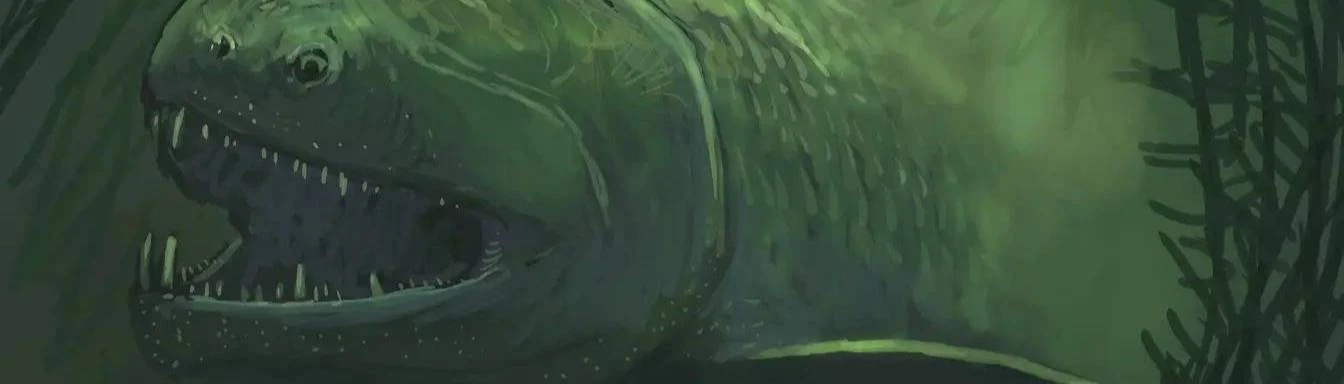
With Up to 7 Meters and 20-Centimeter Teeth, Rhizodus Hibberti Was a Colossus of Prehistoric Rivers and May Have Been the Largest Freshwater Fish in History.
Long before dinosaurs dominated the Earth, the rivers and lakes of the planet already harbored a predator so large and powerful that it challenges any comparison with modern fish. The Rhizodus hibberti, an extinct fish that lived over 330 million years ago during the Carboniferous period, is now considered by much of the scientific literature as the largest freshwater predatory fish ever documented. Its extreme size, colossal dentition, and absolute position at the top of the food chain make it a true river monster of prehistory.
What Was Rhizodus Hibberti and When Did It Live
The Rhizodus hibberti belongs to the group of lobe-finned fish known as sarcopterygians—the same lineage that, millions of years later, would give rise to the first terrestrial vertebrates. It lived approximately 360 to 330 million years ago, in a world very different from today, with vast swampy forests, wide rivers, and shallow, oxygen-rich waters.


Its fossils have been found mainly in regions that today correspond to Europe, such as Scotland and England, as well as parts of North America. These locations were near the equator at the time, favoring warm and productive aquatic environments, ideal for the growth of giant animals.
-
Motorola launched the Signature with a gold seal from DxOMark, tying with the iPhone 17 Pro in camera performance, Snapdragon 8 Gen 5 that surpassed 3 million in benchmarks, and a zoom that impresses even at night.

-
Satellites reveal beneath the Sahara a giant river buried for thousands of kilometers: study shows that the largest hot desert on the planet was once traversed by a river system comparable to the largest on Earth.

-
Scientists have captured something never seen in space: newly born stars are creating gigantic rings of light a thousand times larger than the distance between the Earth and the Sun, and this changes everything we knew about stellar birth.

-
Geologists find traces of a continent that disappeared 155 million years ago after separating from Australia and reveal that it did not sink, but broke into fragments scattered across Southeast Asia.

Dimensions That Redefine the Concept of Freshwater Fish
The most widely accepted estimates indicate that the Rhizodus hibberti could reach between 6 and 7 meters in length, a size comparable to that of a small city bus. In terms of body mass, calculations vary, but many studies point to over 1 ton, possibly reaching higher values depending on the robustness of the individual.
For comparison, the arapaima, considered today to be the largest living freshwater fish, rarely exceeds 3 meters and about 200 kg. Even the beluga sturgeon, often cited as the largest current freshwater fish, is classified as anadromous, spending much of its life in marine environments. The Rhizodus, on the other hand, was completely associated with river and lake systems, making its supremacy even more impressive.
A Dentition Made to Crush Bones
The most frightening aspect of the Rhizodus hibberti was its mouth. Its main teeth could reach up to 20 centimeters in length, thick, sharp, and deeply rooted in the skull. It was not just about piercing prey but grabbing, crushing, and tearing apart other large aquatic animals.
Anatomical studies suggest that its bite was extremely powerful, capable of breaking bones and cracking shells. This suggests that the Rhizodus did not limit itself to hunting smaller fish, but also attacked large primitive amphibians and other aquatic vertebrates sharing the same habitat.
The Absolute Predator of Carboniferous Rivers
In the ecosystem in which it lived, the Rhizodus hibberti had no direct competitors. It occupied the absolute top of the food chain, playing an ecological role similar to that of large modern crocodilians or sharks in marine environments.

Its hunting strategy likely combined ambushes in shallow waters with quick bursts of force, using its muscular body and lobe-finned to propel short and devastating attacks. Any animal sharing the same river was potentially on the menu of this giant.
Comparison With Other “Giants” of Freshwater
When it comes to size records in river environments, names like beluga sturgeon, arapaima, and giant Asian catfish often come up. However, none of them comes close to the set of characteristics of Rhizodus hibberti.
The beluga sturgeon can exceed 1.5 tons, but relies on marine environments to complete its life cycle. The arapaima is impressive, but represents less than half the estimated length of the Rhizodus. Meanwhile, large catfish reach high masses, but do not come close to the dentition and predatory power of this prehistoric colossus.
Therefore, many paleontologists argue that Rhizodus hibberti should be regarded as the largest predatory freshwater fish that ever existed, even though there are specific debates about its exact weight and biomechanics.
Why Did Rhizodus Disappear
The disappearance of Rhizodus hibberti is linked to the major environmental transformations at the end of the Carboniferous period. Climate changes, the reorganization of continents, variations in water levels, and the evolution of new groups of vertebrates profoundly altered aquatic ecosystems.
Environments that previously favored gigantism began to fragment, reducing the space and resources necessary to sustain such extreme predators. Gradually, the Rhizodus and other aquatic giants gave way to smaller and more specialized faunas.
A Forgotten Colossus of Natural History
Although little known outside academic circles, Rhizodus hibberti occupies a unique place in the history of life on Earth. It proves that rivers and lakes of the past harbored predators as terrifying as any marine creature, and that gigantism was not exclusive to oceans or terrestrial dinosaurs.
More than just a giant fish, the Rhizodus represents an extreme chapter of evolution when the combination of favorable environments, abundant food, and absence of competitors allowed the emergence of true river monsters.
Imagining prehistoric rivers dominated by a fish up to 7 meters long, with teeth larger than kitchen knives and strength enough to crush bones, it becomes clear that nature has been much more brutal—and fascinating than we commonly imagine. The Rhizodus hibberti is not just a record holder: it is a reminder that the limits of life have always been much broader than those we see today.







-

Uma pessoa reagiu a isso.