





 Portuguese
  English
  Spanish
  6 min of reading
  0 comments


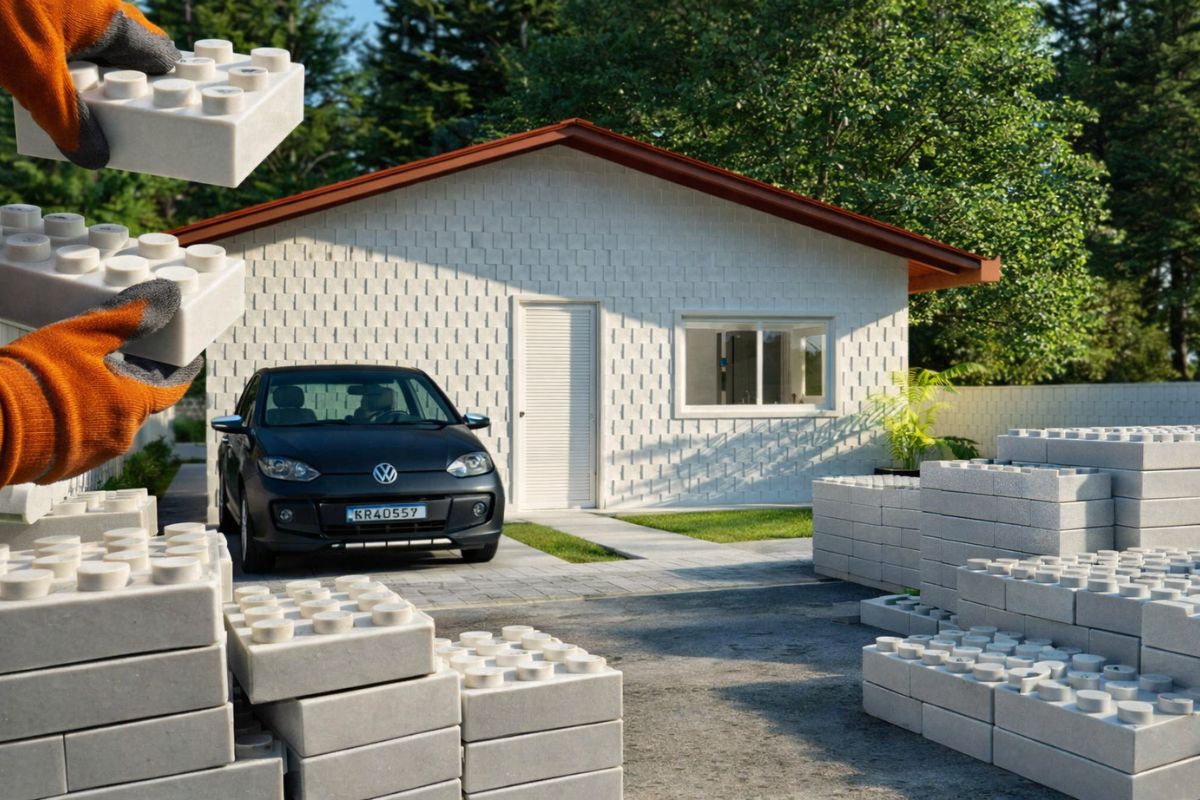
The São Paulo Company Fuplastic, Known for Lego-Inspired Blocks, Wants to Bring Housing Made of Recycled Plastic to Popular and High-End Projects by Selling Kits and Building Quick Structures. The Promise Is to Reuse Parts, Reduce Inputs, and Accept Returns, with 2 to 9 Tons Recycled per Residence by 2026
Housing made of plastic still sounds like an unlikely idea for many people, but it has become an expanding market in Brazil, with companies trying to transform waste into habitable, removable, and reusable structures. Fuplastic, from São Paulo, wants to enter this competition in 2026 with houses built from interlocking blocks inspired by the Lego system.
The plan is to use a technology that the company claims to have first consolidated in construction solutions with recycled plastic, serving commercial projects and custom structures, and now take this to two extremes: popular houses, focusing on scale, and high-end residences, as a technical showcase. The central question is not just “Can you live in it?” but “Can it be replicated on a large scale without losing quality and material traceability?”
What Changes When a “Lego-Type Brick” Factory Decides to Sell Ready-Made Houses

The Fuplastic was born in the world of components, not complete works. The idea of recyclable plastic bricks appeared in 2016 and started with more discreet applications, such as junction boxes used in construction for electrical connections, a type of underground structure common in the sector.
-
Friends have been building a small “town” for 30 years to grow old together, with compact houses, a common area, nature surrounding it, and a collective life project designed for friendship, coexistence, and simplicity.

-
This small town in Germany created its own currency 24 years ago, today it circulates millions per year, is accepted in over 300 stores, and the German government allowed all of this to happen under one condition.

-
Curitiba is shrinking and is expected to lose 97,000 residents by 2050, while inland cities in Paraná such as Sarandi, Araucária, and Toledo are experiencing accelerated growth that is changing the entire state’s map.

-
Tourists were poisoned on Everest in a million-dollar fraud scheme involving helicopters that diverted over $19 million and shocked international authorities.


Over time, the same principle of pre-molded and interlocking pieces has been extended to more visible uses, such as stores, kiosks, and stands made almost entirely of plastic, in projects for companies like Kibon, Oakberry, and Localiza. This path matters because it indicates a transition: from “construction piece” to “housing product with technical responsibility, logistics, and post-use”.
When it talks about 2026, the company centers on delivering complete projects and assembly, like a “popular house kit”. The strategy, according to CEO Bruno Frederico, is to scale the product in projects covered by Minha Casa, Minha Vida, while maintaining a more sophisticated portfolio to demonstrate the system’s potential.
Inside the Material: Polypropylene, Heating, and Why Interlocking Works

The interlocking brick from Fuplastic is made from polypropylene, a type of plastic known for being moldable under high temperatures. In daily life, it appears in common items such as packaging, chairs, automotive parts, cups, and toys, which broadens the range of possible sources for the recycled raw material.
In the factory, the described process involves separating and cleaning plastic waste, followed by heating and reshaping to form new pieces. The practical difference here is that the “brick” is not an inert block like in traditional masonry: it originates from an industrial cycle and needs to maintain dimensional consistency to interlock and allow pre-assembly.
This focus on interlocking helps explain why the company insists on the kit logic. Instead of relying entirely on “wet” work and long stages on-site, the proposal is to bring construction closer to an assembly process, with modules and pieces that can be disassembled, reused, and reassembled, without the investment being lost along with the address.
Assemble in Days and Disassemble When Necessary: What Real Cases Reveal About Logistics

Speed is marketed as a differential, but the most concrete argument arises when it comes to disassembly.
In Mato Grosso, a client used the system to build a medical clinic and, upon realizing weak foot traffic at the chosen location, transported the four-ton structure on a truck to another address without altering a single plastic brick.
In another case, a Localiza store was closed in Barreiras, Bahia. The pieces were disassembled and sent to Rio de Janeiro to expand another unit, according to the CEO.
This type of account shifts the conversation about plastic housing because it includes flexibility as part of the value: construction ceases to be necessarily “fixed” and becomes “transferable”.
Still, this flexibility comes with inevitable technical questions: how is the foundation addressed, which still requires cement, how does the interlocking behave with thermal variations, and how is the assembly controlled to avoid improvisation.
The company itself acknowledges that it sells projects and guarantees assembly, which suggests that standardization is part of the model, not just a detail.
Where Scale Enters: Minha Casa, Minha Vida on One Side, 450 m² Showcase on the Other
To gain scale, the declared bet is to enter the segment of popular houses, in projects associated with Minha Casa, Minha Vida.
Bruno Frederico claims there are discussions with developers for a future scenario of up to 300 units, along with possibilities in other countries, such as Angola and Paraguay.
In the high-end segment, the mentioned showcase is the Milagres 9.0 house, in São Miguel dos Milagres, Alagoas.
The property features 450 m² of built area, six suites, and is made up of 18,000 blocks. The work was said to have been executed in 30 business days using the pre-assembled system, with a timeline that the CEO summarizes as starting on September 12 and having a furnished house by November 1. It is a deliberate contrast: while the popular seeks repetition, the high-end seeks proof of performance at the project scale.
The company also compares speed with traditional masonry, stating that one week of work on this project would equal eight months of a conventional construction in the same condominium.
As this is a declaratory comparison, the relevant point is what it reveals about the proposal: reducing time on-site and relying more on manufacturing and pre-assembly than on slow execution on location.
Recycling 2 to 9 Tons and the Promise of Circularity at the End of the Cycle

On the environmental account, Fuplastic maintains two very different ranges of waste incorporation: in the popular model, about two tons of recycled plastic per house; in the high-end segment, up to nine tons, as in the case in Alagoas that is said to have used plastic retrieved from beaches.
In 2025, the company claims to have recycled about 300 tons just from plastic bottle caps, around 70 million units, to manufacture pieces.
This number is important because it connects the scaling discourse to a real source of material: without volume and regularity of supply, the promise of replicating houses “in series” loses support.
Another central point is post-use. The company says it is willing to receive back used bricks when there is demolition or disassembly, to reuse them in new constructions. And, in the case of popular houses, Bruno Frederico claims that the project would be “carbon negative,” because it would neutralize more emissions in the plastic than it would spend on the cement foundation.
Here, the care is to separate what is executive affirmation from what is public measurement: the presented idea is that recycled material “carries” environmental compensation, but the validation of this depends on methodology and audit.
The discussion about plastic housing has ceased to be internet curiosity when it started encountering concrete cases: a clinic that moves locations without becoming waste, a store that disassembles and reuses 100% of the parts, and a 450 m² house built with 18,000 blocks in just a few weeks.
At the same time, the leap to popular housing in 2026 poses the greatest challenge: to standardize, control quality, ensure proper assembly, and prove that circularity is not just a promise, but a routine.
If you had the option of living in a dismantlable house that can be reassembled elsewhere, what would weigh more in your decision: structural confidence, thermal comfort, prejudice against “plastic,” or the idea of recycling tons of waste in each home?
And, looking at Minha Casa, Minha Vida, where do you think this type of solution should be tested first and for what reasons?










-

Uma pessoa reagiu a isso.