






 Portuguese
  Spanish


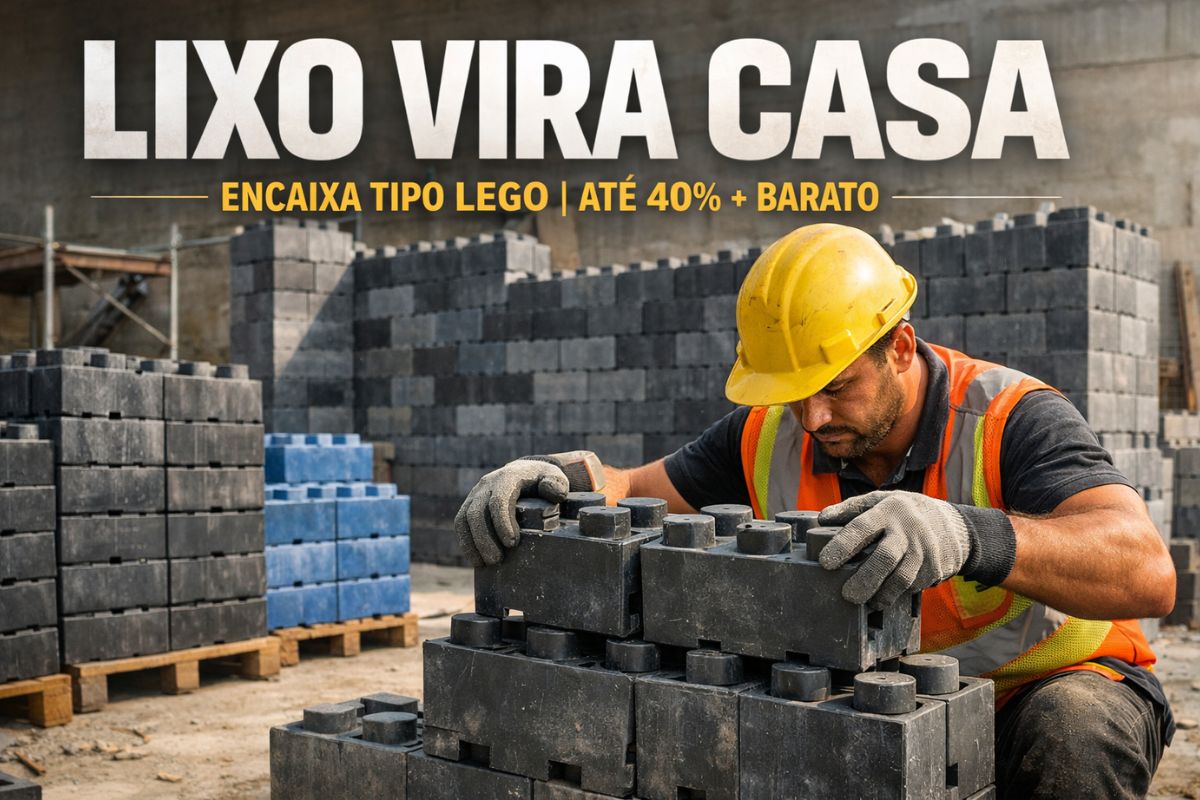


Plastic bricks made from recycled waste fit together like Lego pieces, allowing for full houses to be erected in few days, with clean work, cost up to 40% lower, less waste, less labor and high resistance to water, fire and quakes, expanding safe housing in several countries.
In recent years, as the plastic waste crisis and housing deficit continue to rise in various regions of the world, an unexpected solution emerges: recycled plastic bricks that fit together like Lego and allow complete houses to be built in few days, with clean work and structures ready for almost immediate use. The proposal is already being applied in projects supported by international organizations, focusing on schools and housing.
Inspired by modular systems, the method transforms tons of waste into structural blocks that eliminate the need for cement in the connection between pieces. The technology repurposes discarded plastic, reduces the volume of waste in traditional construction, and opens the way for faster, quieter, and more accessible construction, especially in vulnerable regions.
How Recycled Plastic Bricks Are Created
It all starts with the collection of plastic waste, which would otherwise end up in landfills or even the ocean. This material is sorted, shredded, and subjected to controlled heating until it reaches the appropriate melting point.
-
Experts Share 5 Practical Ways to Detect Hidden Wiring in Walls Before Drilling, Using Simple Techniques and Affordable Devices to Prevent Electrical Damage and Unexpected Costs

-
Brazilian Architect Wins International Award for Empowering Ugandan Women to Build Their Own Homes
-
Singapore Constructs Massive Waste Island with 7 km Dike to Combat Space Shortage
-
Australia’s Massive 5.5 km Iron Mine Visible from Space Fuels Global Industry with Giant Trains



Next, the melted plastic is molded into standardized blocks that resemble interlocking toy pieces.
These plastic bricks are designed to connect through pressure, without the need for mortar in the structural union.
The tight fit ensures the locking of the walls and creates a continuous structure. Industrial standardization facilitates transportation, storage, and assembly, in addition to allowing the same type of piece to be used in walls, internal partitions, and even small annexed structures.
Faster, Cleaner, and Up to 40% Cheaper Construction
Upon arriving at the construction site, the system completely changes the workflow. Instead of piles of common bricks, sand, cement, and concrete mixers running all day, the team works with pallets of ready-to-fit blocks.
As the pieces are modular and come leveled from the factory, it is possible to raise entire walls in few hours, merely by fitting and locking them.
The assembly generates virtually zero waste.
There is no waste of mortar, no leftover broken bricks, and no excessive dust. This makes the construction environment cleaner and quieter, which is important in densely populated urban areas or in communities where schools and houses are built amid already occupied neighborhoods.
Another central point is the cost. As the technology reduces the intensive use of cement and simplifies the structural phase, the final value of the construction can be up to 40 percent lower when compared to traditional masonry.
The need for highly specialized labor also decreases in many stages, as part of the work resembles more of a guided assembly than a complex construction, although technical supervision remains essential.
Resistance to Water, Fire, and Quakes
Despite their lightweight appearance, recycled plastic bricks are designed to withstand severe conditions. The material is formulated to be waterproof, which protects the structure against seepage and constant moisture, especially in rainy regions. This reduces typical problems of walls that absorb water and deteriorate over time.
The blocks also receive treatment to be fire-resistant, delaying flames and gaining time in emergency situations.
At the same time, the final structure has a degree of flexibility that differentiates it from rigid masonry.
This slight elasticity helps the assembly to withstand tremors without extensive cracking, something valuable in areas prone to light or moderate seismic activity.
When compared to common bricks, the new material offers clear advantages: the construction time drops from months to few days, there is practically no waste on site, and thermal insulation is naturally better, which helps keep the house more comfortable on hot or cold days without relying too much on heavy air conditioning.
From the Waste Crisis to the Social Impact of Modular Housing
According to global initiatives linked to Unicef, recycled plastic bricks are already being used to build schools and housing in vulnerable regions, in a dual strategy: tackling the plastic waste problem while simultaneously reducing the housing deficit.
Each wall built with this system represents less waste in landfills and more families with a safe roof.
The logic of modular housing changes the way of thinking about social housing. Instead of long and expensive construction projects, the focus shifts to rapid assembly, simplified logistics, less impact on the surroundings, and expedited delivery of classrooms, community service posts, and housing.
The concept of literally assembling a house with interlocking pieces has redefined the idea of emergency construction and permanent social projects.
The question remains simple and direct: would you live in a house made from recycled plastic bricks if it were cheaper, quicker to build, and as safe as traditional masonry?






Amei essa reportagem. Todos os resíduos tem um aproveitamento, uns viram tijolos, outros asfaltos, contenção de rios e encostas, enfim exite solução para todos os lixos. Basta as pessoas q as fábricas recicle 100% do seu próprio lixo. E o lixo tbm pode ser uma grande solução para energia elétrica. Em cada cidade poderia ter uma usina de energia q fosse abastecida com lixos a eliminação dos resíduos viram energia elétrica. Basta ser inventado um super filtro para tratar a fumaça que não pode ir pro meio ambiente.
Já existe casas com esse material?
Pretendo fz uma pequena com 2 quartos.
Claro que sim.