





 Portuguese
  English
  Spanish
  5 min of reading
  0 comments


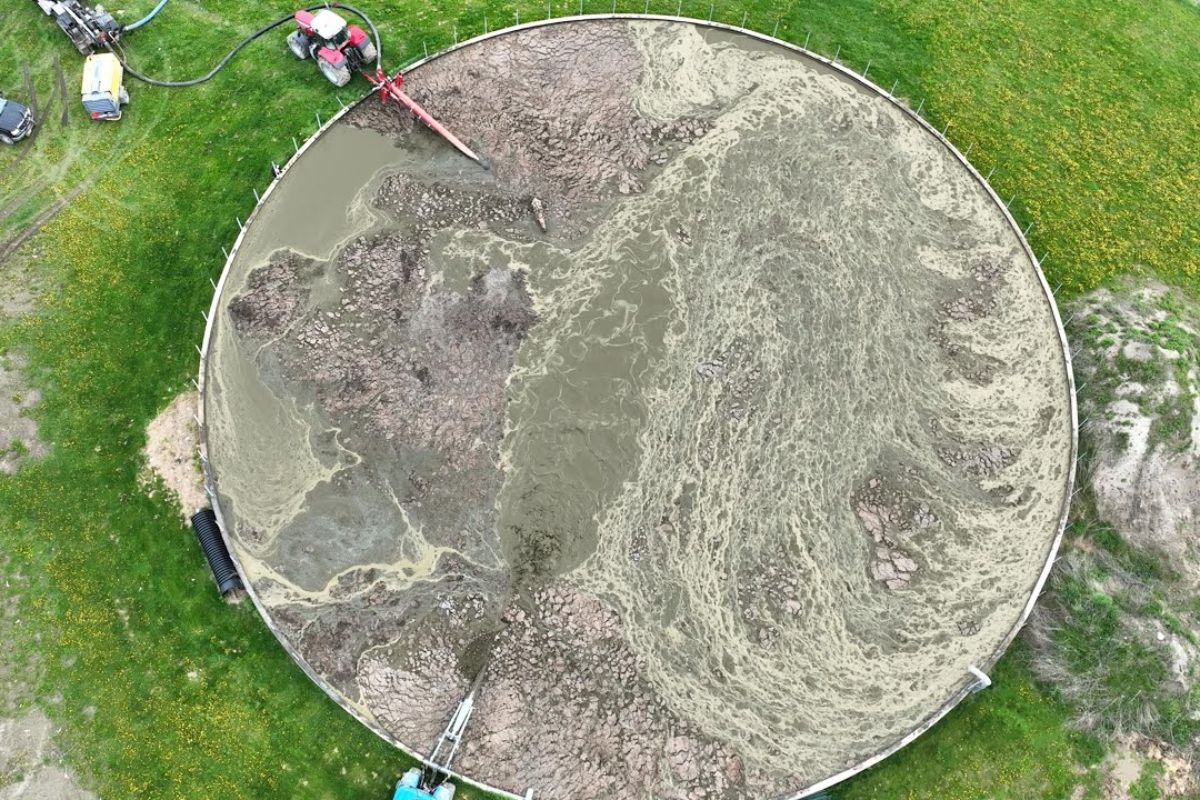
The Operation Gathered Industrial Pumps, 8-Inch Hose Over Miles, and Heavy Tractors to Remove Manure from a Lagoon That Was Rising Dangerously. In Southern Ottawa, the Pressure Was Maintained for More Than Ten Hours, with Engines Ranging from 425 to 340 Horsepower and Constant Leak Risk in the Area.
What seems like an agricultural routine becomes a critical operation when the level of a manure lagoon nears its limit and the clock starts working against the farm. In southern Canada, a team returned to a location previously visited the fall before and began a nonstop sequence of setup, testing, and pumping, focused on preventing overflow.
The operation combined tractors above 300 horsepower, a main pump powered by a 425-horsepower engine, and a main hose cited as a significant investment. The logic was simple: quickly lower the level, stir with control, and apply the manure in the field without losing pressure or safety.
Where the Lagoon Became a Risk and Why the Operation Had to Start Early

The area described is located south of Ottawa, on a dairy farm in southern Canada, where the manure lagoon had already been seen as a priority since arrival.
-
Friends have been building a small “town” for 30 years to grow old together, with compact houses, a common area, nature surrounding it, and a collective life project designed for friendship, coexistence, and simplicity.

-
This small town in Germany created its own currency 24 years ago, today it circulates millions per year, is accepted in over 300 stores, and the German government allowed all of this to happen under one condition.

-
Curitiba is shrinking and is expected to lose 97,000 residents by 2050, while inland cities in Paraná such as Sarandi, Araucária, and Toledo are experiencing accelerated growth that is changing the entire state’s map.

-
Tourists were poisoned on Everest in a million-dollar fraud scheme involving helicopters that diverted over $19 million and shocked international authorities.


The tension point was the high level, considered near the top, which increased the risk of overflow and also limited the margin to safely start agitation.
Before agitating, the decision was made to remove part of the contents from the lagoon to reduce the volume.
This step reduces the chance of splashes, leaks, and stress on the lagoon’s walls, which were noted as vulnerable to damage during reverse maneuvers with heavy equipment near the edge.
How Pressure Is Maintained Over Miles with Pump, Line, and Dedicated Engine

The backbone was the main pump of the operation’s line, presented as a unit powered by a 425-horsepower engine.
It fed the network that carried the manure from the lagoon to the application system in the field, building pressure progressively until the operation could begin.
The mentioned infrastructure includes an 8-inch main hose, with an approximate cost of US$ 15 per foot, and the purchase of 3.2 to 4.8 kilometers of hose, which helps explain why this setup is treated as a heavy investment.
Pressure is not just force; it is stability: when it drops, the flow fails, the application loses uniformity, and operational risk increases.
Tractors in Sequence: Why Power and Control Matter More Than Speed
In the incoming sequence, tractors and specifications appear that help scale the workload. A Massey Ferguson 6490, cited with a 6.6-liter engine and 185 horsepower, entered the scene early on.
Next, a Massey Ferguson 7480, powered by a 6-cylinder Perkins engine of 6 liters with 143 horsepower, was associated with the context of the farm and infrastructure.
When the pace demanded alternatives, a Massey Ferguson 8690 took over, with an 8.4-liter engine and 340 horsepower.
The applicator was coupled to an STX 325, referring to the New Holland TJ 325, and the operation continued even after a reported problem with a fuel line burst in one of the sets.
In manure operations, redundancy is survival: if one tractor stops, the entire chain needs to keep running.
Stirring, Dissolving Solids, and the Moment When Manure Changes Behavior
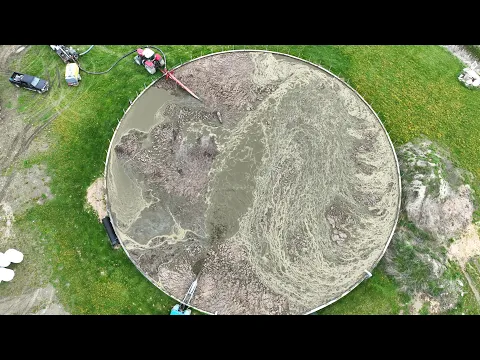

With the level lowered, agitation began and was described as a phase in which the manure starts to “spin,” with solids at the surface beginning to dissolve.
As the tank continued to lower, the overall stirring accelerated homogenization, breaking down clumps and improving continuous pumping capacity through the line.
This detail is critical for safety and agricultural application.
Poorly homogenized manure increases clogs, creates pressure fluctuations, and raises the chance of technical stops, exactly the type of interruption that can compromise a narrow window of over ten hours of uninterrupted work.
Clogs and Response: Compressed Air, Sponge Ball, and PSI as a Field Tool
The operation recognizes that long lines clog, and describes a clog-clearing method using a large sponge ball, approximately the size of a bowling ball, pushed through the line with highly compressed air.
For this, an Atlas Copco JD7 was mentioned, producing 750 CFM and 150 PSI, powered by a John Deere 6.8-liter engine with 250 horsepower.
In practice, it is a field solution to maintain flow without dismantling miles of hose.
When the hose stops, the clock doesn’t stop, and the risk of the lagoon rising again or the application being incomplete increases, especially in an operation designed to prevent overflow and distribute the manure with control.
The Volume Size and What “Ten Hours” Means in Real Life
The video mentions “5 million liters of manure” in the context of the challenge, along with a volume of 100,000 gallons stored under the barn that also needed to be pumped into the tank and then to the fields.
Throughout the process, the level of the lagoon dropped to “3” at the moment agitation began, without a detailed unit but used as an operational safety milestone.
In just over ten hours, the work was described as completed, with the chain of pump, hose, and tractors operating synchronously.
What is at stake is not just productivity: it is to prevent the lagoon from exceeding limits, protect structures, reduce the risk of leaks, and transform a liability into applied fertility with criteria.
The operation in southern Canada exposes a type of agricultural routine that only seems simple until the lagoon gets too high and the flow needs to run for miles without failing.
Between the high-powered pump, expensive long hose, and tractors above 300 horsepower, manure becomes a practical engineering test, logistics, and field risk control.
If you were in charge, what would be your priority in an operation like this: lower the lagoon level as quickly as possible, ensure perfect agitation above all, or first invest in redundancy of tractors and pumps so as not to depend on a single machine?










-

-

-

10 pessoas reagiram a isso.