





 Portuguese
  English
  Spanish
  4 min of reading
  2 comments


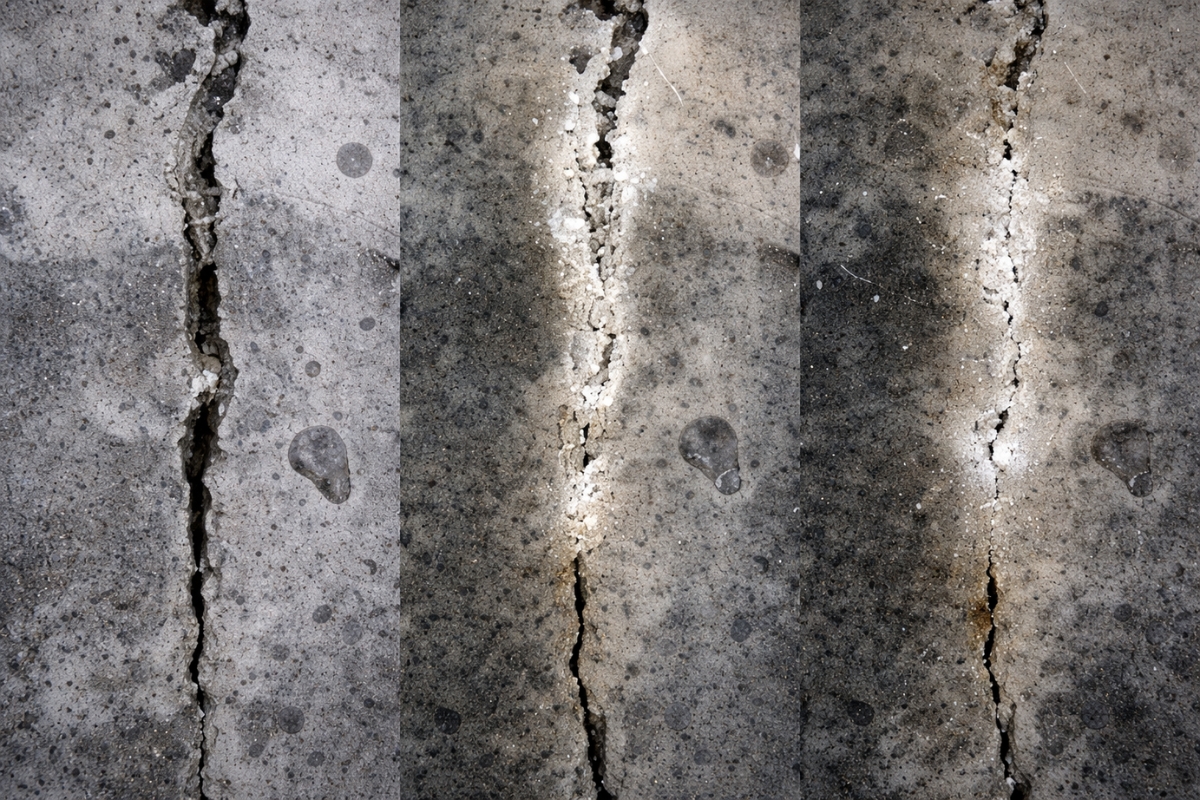


Bacteria That Became “Microscopic Masons”: Inside Alkaline Concrete, Spores Lie Dormant for Years, Reactivating with Moisture, Producing Minerals That Harden in the Crack, Decreasing Permeability and Turning Initial Cracks into a Contained Problem Before Becoming Chronic Infiltration
Concrete supports cities — and also carries an old defect: it cracks. Sometimes there are almost invisible fissures, but over time they become an open pathway for water, salts, and other substances that accelerate corrosion of reinforcement and shorten the lifespan of bridges, tunnels, buildings, and dams.
Now, researchers are working on a solution that seems straight out of a movie, but is applied science: self-healing concrete, capable of sealing cracks from within with the help of bacteria that form minerals. The proposal is simple and powerful: when water enters through a crack, the material itself “reacts” to close the problem.
In one sentence: a crack appears, water enters, the bacteria “wake up,” and minerals help seal the path.
ARTICLE CONTINUES BELOWSee also
Motorola launched the Signature with a gold seal from DxOMark, tying with the iPhone 17 Pro in camera performance, Snapdragon 8 Gen 5 that surpassed 3 million in benchmarks, and a zoom that impresses even at night.

Satellites reveal beneath the Sahara a giant river buried for thousands of kilometers: study shows that the largest hot desert on the planet was once traversed by a river system comparable to the largest on Earth.

Scientists have captured something never seen in space: newly born stars are creating gigantic rings of light a thousand times larger than the distance between the Earth and the Sun, and this changes everything we knew about stellar birth.

Geologists find traces of a continent that disappeared 155 million years ago after separating from Australia and reveal that it did not sink, but broke into fragments scattered across Southeast Asia.
TU Delft (Delft University of Technology) in the Netherlands is one of the institutions describing this type of research, based on bacterial mineral precipitation to increase the durability of concrete.

Why a Small Crack Can Become a Huge Loss
In practice, the problem is not just aesthetic. Cracks allow infiltration. And infiltration opens doors to accelerated deterioration, especially in:
- coastal regions (saline environment)
- areas with high humidity
- structures exposed to water continuously
- places with thermal variations and shrinkage/expansion cycles
The sooner a crack is “sealed,” the lower the chance it becomes an expensive headache — and, in some cases, dangerous.

How “Concrete with Bacteria” Works
The technology uses a natural phenomenon: some bacteria can induce the formation of calcium carbonate (a mineral similar to that found in limestone). In simple terms, this acts like a “mineral cement” depositing itself inside the crack.
The concept described by TU Delft is based on:
- Inserting bacteria (in spore form) into the concrete
- Keeping these spores inactive until the right moment
- When a crack occurs and water enters, the system activates
- The bacteria begin to produce conditions for mineral formation
- The mineral deposits in the crack and helps to reduce water passage
The logic is preventive: it’s not about “repairing a collapse,” but rather preventing a small crack from becoming a big problem.
How These Bacteria Manage to Survive in Concrete?
Concrete is an extreme environment. That’s why the research uses spore-forming bacteria, a type capable of remaining “dormant” for long periods under harsh conditions — and reviving when it encounters water, which is precisely the typical trigger when a crack opens.
This detail is central: the system only comes into action when there is a signal that durability may begin to be compromised.

What This Technology Can Change in Infrastructure
If self-healing reduces permeability and infiltration, the chain effects can be significant:
- less internal steel corrosion
- less corrective maintenance
- more lifespan for critical structures
- fewer interruptions (works, blockages, emergency repairs)
In large-scale projects, maintenance is not just a cost: it’s logistics, risk, and direct impact on the daily life of millions of people.
What is Still a Challenge (and Why It Matters)
Even though promising, this technology needs to overcome real barriers to become common in construction:
- cost compared to traditional concrete
- performance in real conditions (climate, humidity, time)
- technical standardization and acceptance by norms and projects
- consistent proof in long-term scenarios
In other words: it’s a strong path, but not “magical.” Engineering needs evidence, repeatability, and viability.
A Quiet Change: Engineering Meeting Biotechnology
Self-healing concrete represents a larger trend: smarter materials, which do not rely solely on initial strength, but on durability over time. By using biological processes as a tool, civil construction can gain a new layer of “defense” against one of its most common enemies: cracks.








Foi criado em 2006 na Holanda, colocado em prática 2011 já no país e 2015 já estava reconhecido no mundo. Notícia bem antiga.
Excelente. Solução auto funcional! 👏👏