





 Portuguese
  English
  Spanish
 4 min of reading
  0 comments


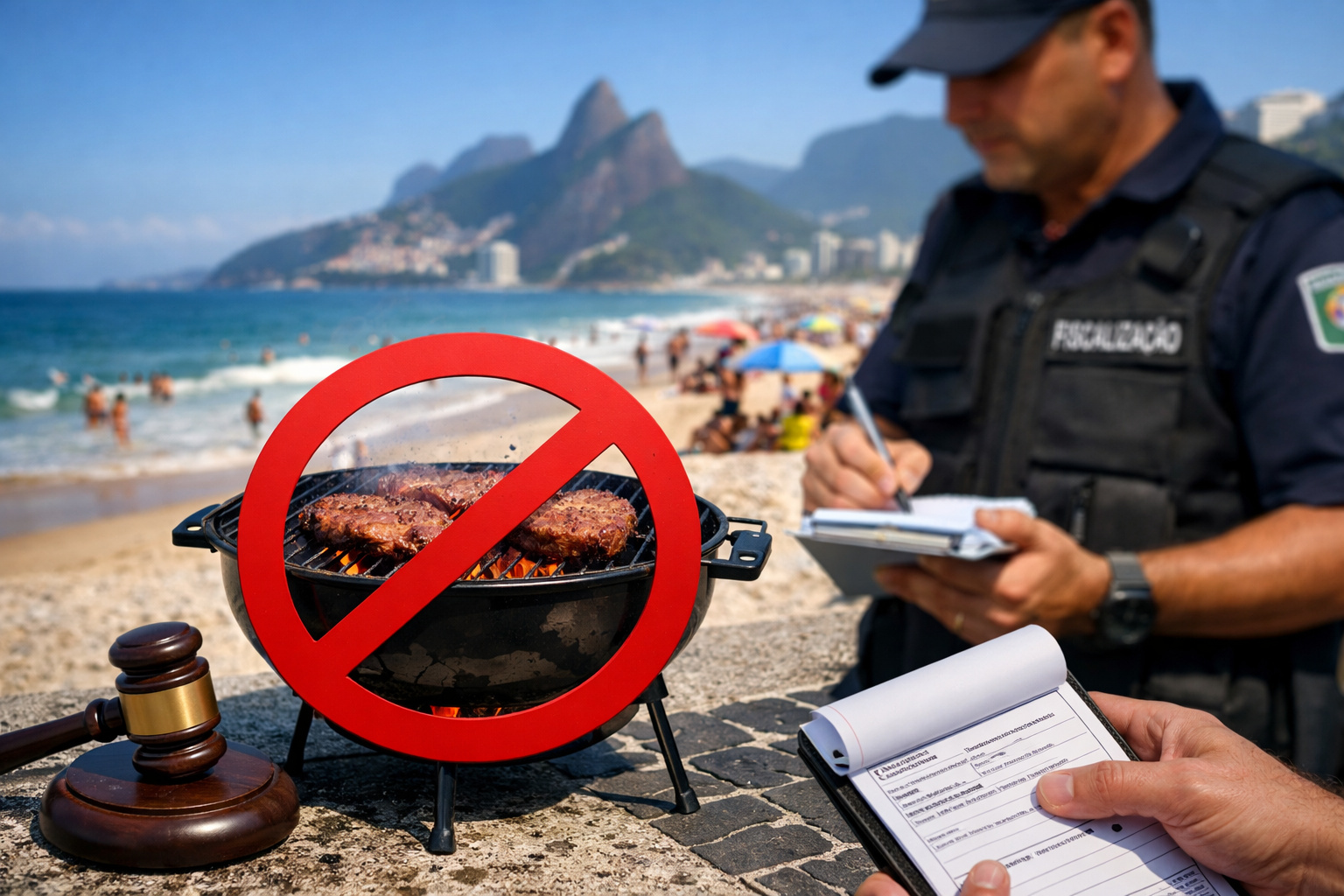
Municipal Decree Tightens Rules on Rio’s Waterfront, Impacting Leisure, Informal Work, and Urban Coexistence by Prohibiting Barbecues, Portable Grills, and Fire on Beaches, Parks, and Public Spaces Throughout the Marvelous City.
At the end of May, a silent change began to profoundly alter the use of beaches and public areas in Rio de Janeiro. On May 27, 2025, the City Hall published Decree Rio No. 56,160, which reinforced urban planning for the waterfront and prohibited the use of fire, barbecues, portable grills, and any similar equipment in beaches, parks, sidewalks, and other public spaces. Although the text did not gain much initial publicity, its effects were quickly felt by residents, street vendors, and visitors to the city.
The regulation is part of a set of planning and safety measures that had already been internally discussed by the municipal administration but gained momentum with the increase of conflicts, litter, fire hazards, and accidents in leisure areas. In practice, the decree transforms common practices — such as improvised barbecues on the sand or in parks — into administrative infractions subject to fines and seizure of materials.
Decree Rio No. 56,160 Is the Legal Basis for Prohibiting Barbecues in Public Areas
The Decree Rio No. 56,160/2025 regulates urban planning for the waterfront and public spaces, focusing on safety, the environment, and collective coexistence. Among the central points of the text is the explicit prohibition on the use of fire in public places, encompassing barbecues, grills, portable grills, adapted cans, and any other means of food preparation involving combustion.
-
The noise law will no longer be in effect at 10 PM starting in June with a new rule valid during the 2026 World Cup.
-
The Chamber opens a debate on driver’s licenses at 16 years old as part of a reform that includes around 270 proposals to change the Brazilian Traffic Code and may redesign rules for licensing, enforcement, and circulation in the country.

-
The new Civil Code could revolutionize marriages in Brazil with “express divorce” and changes that could exclude spouses from inheritance.

-
Banco do Brasil sues famous influencer for million-dollar debt and intensifies debate on delinquency, risks of seizure, and direct impact on Gkay’s credibility.




The justification for the decree is anchored in three pillars: accident prevention, environmental protection, and preservation of the collective use of spaces. The city hall argues that fire in open areas poses a direct risk to bathers, children, cyclists, and public property itself, in addition to generating difficult-to-manage waste.
Barbecue at the Beach and in Parks Became an Administrative Infraction
With the enactment of the decree, having a barbecue on the beach or in parks has been formally prohibited, regardless of whether it’s a small gathering or a larger event. The rule applies to both residents and tourists, without distinction.
The decree does not require repeated offenses for penalties to be applied. It is sufficient to confirm the infraction for the public agent to determine the cessation of the activity, apply the appropriate fine, and confiscate the equipment used. This includes charcoal, grills, portable barbecues, and improvised utensils.
Fines and Confiscation of Materials with the Support of the Municipal Guard
One of the most notable points in Decree Rio No. 56,160 is the reinforcement of the integrated action of the Municipal Public Order Secretariat (Seop) with the Municipal Guard. Supervision has become more pronounced, especially on weekends, holidays, and peak times at the beaches.
In addition to the administrative fine, the decree authorizes the immediate confiscation of materials, even in initial approaches. The logic adopted by the municipality is to cease the risk on the spot, preventing the problem from continuing while the administrative process takes its course.
Why Did Rio Decide to Tighten Now
The city hall of Rio de Janeiro has been recording an increase in occurrences involving irregular use of the waterfront: accumulated litter, burns, fights, damage to pavement, and even the beginnings of fires in nearby vegetation areas. The improvised barbecue has come to be treated as one of the symbols of this disorder.
Another decisive factor was the pressure from residents and formal merchants, who claimed unfair competition and degradation of public spaces. The decree thus emerges as a response to a scenario of urban and tourist weariness.
Does the Rule Apply Only to Beaches?
Although the major repercussions occurred on the beaches, the Decree Rio No. 56,160 is not limited to the waterfront. The prohibition of fire extends to parks, squares, sidewalks, green areas, and other public spaces, significantly broadening the scope of the regulation.
This means that barbecues in urban parks, common on weekends, have also become targets for enforcement. Recreational use of the space remains allowed, but without practices involving fire or collective risk.
Tourists Can Also Be Fined
As with other municipal regulations, the decree does not differentiate between residents and visitors. Tourists are subject to the same rules and penalties, which has surprised those unfamiliar with local legislation. From a legal standpoint, ignorance of the law does not exempt one from liability.
The city hall has started to reinforce educational actions but made it clear that guidance does not replace punishment when there is deliberate noncompliance.
Urban Planning and Cultural Change
Decree Rio No. 56,160 represents more than just a specific prohibition. It signals an attempt to change the culture of public space use, prioritizing safety, cleanliness, and coexistence. The municipal administration hopes that the initial tightening will tend to reduce conflicts over time.
In practice, barbecues are no longer seen as a tolerated tradition and have instead come to be treated as activities incompatible with open and shared public areas.
Few people knew, but now there’s no doubt: in Rio de Janeiro, barbecues on beaches and in parks have become an administrative infraction, based on a municipal decree that is valid and in full effect.
And you, reader: prohibiting barbecues in public areas is excessive rigor or a necessary measure to preserve safety and coexistence in a city as contested as Rio?










-

Uma pessoa reagiu a isso.