





 Portuguese
  English
  Spanish
  5 min of reading
  0 comments


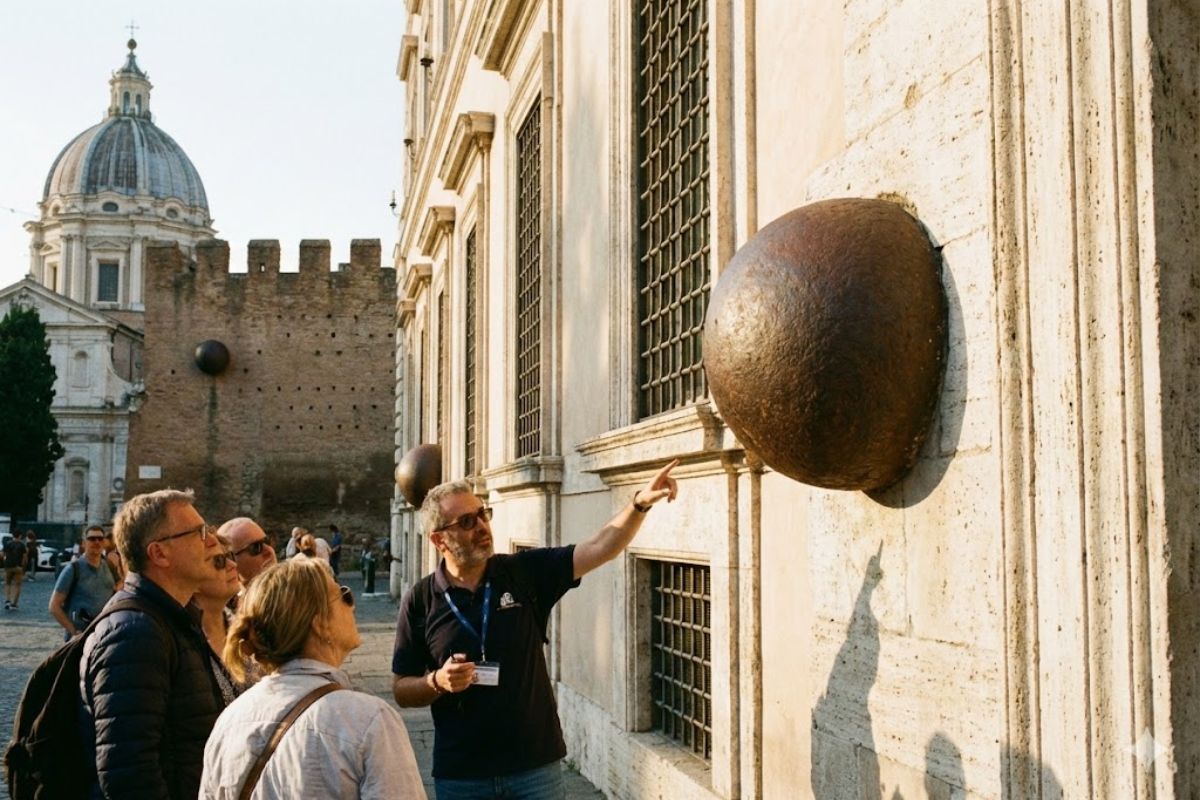
In Rome, The Tourist Landscape Hides Artillery Scars: French Shells From 1849 Are Incorporated Into Church, Palace, And Old Wall. A “Miraculous Bullet” Of 14 Cm Stopped At A Crowded Altar, Another Injured Marble At Palazzo Colonna, And The Aurelian Guards A Silent Sphere On The Corso D’ Italia, On Via Po.
Rome often seems like a pacified city, almost immune to shocks, but the conflict remains visible where few look. In specific spots, the war is not “remembered” by plaques; it is literally trapped in walls, stairs, and masonry, like an object that has refused to leave.
What these marks tell is simple and unsettling at the same time. When artillery enters the urban fabric, the past ceases to be narrative and becomes material: diameter, trajectory, impact, stopping place. In Rome, this appears in 1849 with French fire and later in 1870 with the dispute that culminated in the Breach of Porta Pia.
Rome and the “Miraculous Bullet” That Stopped Where It Should Not

In Rome, one of the most direct vestiges of 1849 is inside the church of San Bartolomeo all’ Isola Tiberina.
-
Friends have been building a small “town” for 30 years to grow old together, with compact houses, a common area, nature surrounding it, and a collective life project designed for friendship, coexistence, and simplicity.

-
This small town in Germany created its own currency 24 years ago, today it circulates millions per year, is accepted in over 300 stores, and the German government allowed all of this to happen under one condition.

-
Curitiba is shrinking and is expected to lose 97,000 residents by 2050, while inland cities in Paraná such as Sarandi, Araucária, and Toledo are experiencing accelerated growth that is changing the entire state’s map.

-
Tourists were poisoned on Everest in a million-dollar fraud scheme involving helicopters that diverted over $19 million and shocked international authorities.

The sphere has 14 cm in diameter and was fired by the French, passed through a wall, and, according to the preserved record, ended its trajectory at the altar of the Chapel of the Virgin, at a time when the place was crowded.
The detail that transforms the episode into a symbol is not just the impact, but the outcome: there were no victims, which consolidated the nickname “miraculous bullet.”
Instead of being removed, the piece was walled up in the left wall of the chapel and gained a commemorative inscription, a decision that transforms an artifact of attack into permanent historical proof within Rome’s religious routine.
Rome, Palazzo Colonna And The Marble Marked By A French Shot

Another impact attributed to the French hit the Palazzo Colonna, specifically the marble staircase of the Hall of Honor, now visible during visits to the Gallery.
The account associated with the vestige describes a typical urban combat dynamic: the shot was said to have originated from the Janiculum area and entered through an open window, finding the marble as the final energy dissipation surface.
Here, the record is drier: there is no confirmed information about victims. Even so, the detail of the open window is technically relevant because it suggests a combination of line of sight and everyday vulnerability, something common when residences and palaces become conflict scenes.
In Rome, the result is a piece that converts architecture into a document, without relying on reconstructions or dramatizations.
Rome, Villa Medici And The Legend That Trips Over The Physics Of Range

The Villa Medici, on the Pincio, enters this cartography through a hybrid path, between material mark and transmitted narrative.
The most repeated versions attribute the shot to Queen Christina of Sweden, with controversial motivations: impatience over a guest’s delay or frustration over a missed meeting with Cardinal Decio Azzolino. In some stories, the shot would have been taken from the Castel Sant’Angelo, toward the Villa.
But the very tradition circulating in Rome recognizes the central problem: none of the cannons in use in the 17th century at Castel Sant’Angelo would have had compatible range for that trajectory.
Still, the Villa keeps an indication that fuels the debate: on the original bronze door, there is a “peculiar” dent, which sustains the question that urban legends love to leave hanging, what hit here and under what circumstances did that happen.
Rome and The Aurelian Wall With A Sphere Embedded In The Present
If 1849 appears in the city as a memory of French fire, another mark connects to 1870, in the context of Rome’s annexation to the Kingdom of Italy.
Along the Aurelian Wall, on the Corso d’ Italia, a sphere remains embedded in the masonry of the tower facing Via Po, reminding that the ancient walls also participated in the modern chapter of battle.
The historical framework cited for this mark is the dispute between royal and papal armies, which ended with the famous Breach of Porta Pia.
At this point, Rome shows an important contrast: the same urban space that today organizes traffic and routine holds, at the height of a wall, an object that makes the city admit that the political transition was also a military operation, with enough ferocity to leave metal or stone trapped in what was, above all, defense.
What Rome Decides To Preserve When War Becomes Landscape
These vestiges are not merely curiosities: they reveal a preservation choice that changes the way Rome presents its own history.
Walling up a sphere in a chapel, maintaining an impact on the marble of a hall, conserving a dent in the door, and accepting an embedding in the wall are decisions that treat the city as an open archive, where the “before” and the “now” share the same framing.
And there is a silent effect in this: when the mark remains, the interpretation never ends.
Between the objective data, such as the diameter of 14 cm and the date of 1849, and the nebulous territory of legends, such as the supposed shot by Queen Christina, Rome creates a narrative that does not need to shout. It just needs to keep existing, with its details trapped in the stone.
In your case, what weighs more when seeing Rome like this: the force of the material data, like the walled bullet and the embedded sphere, or the persistence of legends, like the story of Villa Medici? If you had to choose one of these vestiges to visit first, which would it be and why?










-

-

-

3 pessoas reagiram a isso.