





 Portuguese
  English
  Spanish
  4 min of reading
  0 comments


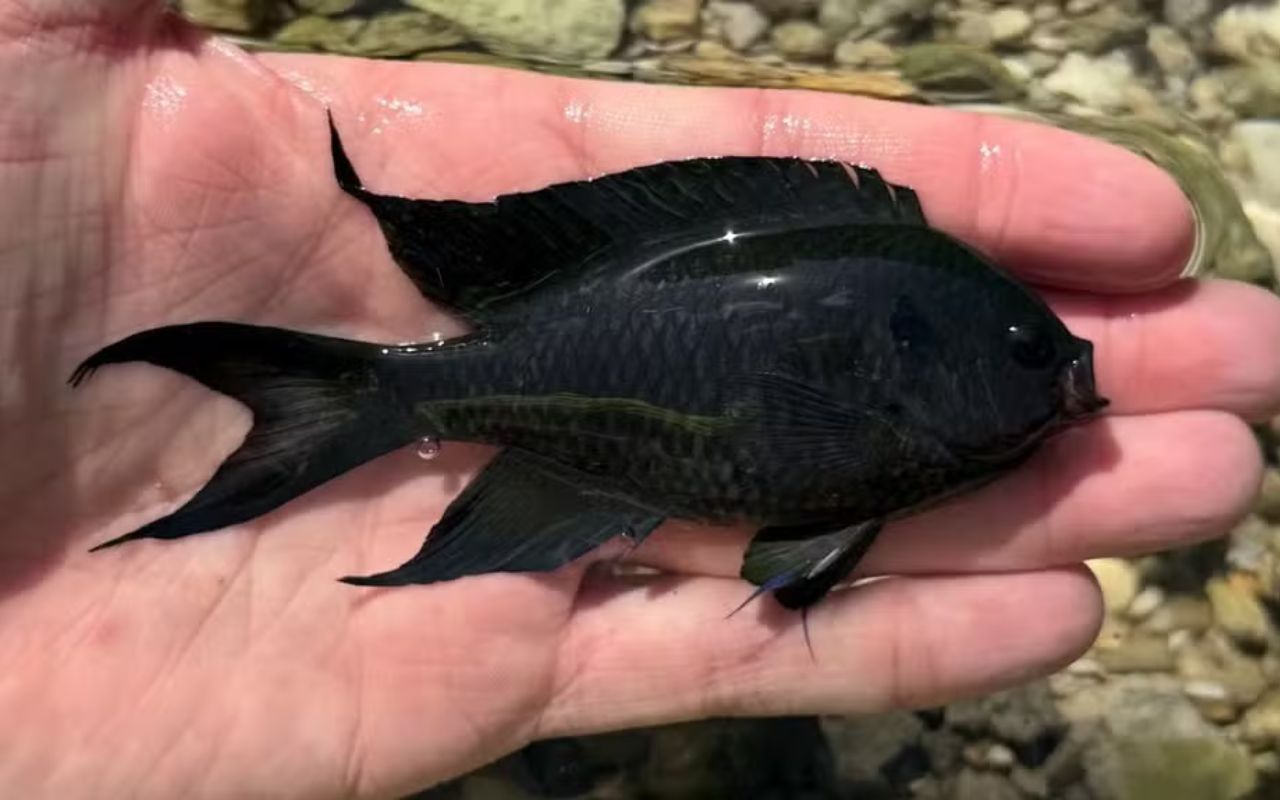
Royal Damselfish, Exotic Species from the Indo-Pacific, Recorded on the Coast of São Paulo and Concerns Experts Due to Possible Impacts on Brazilian Reefs.
The emergence of small schools of Royal Damselfish (Neopomacentrus cyanomos) in protected areas of the São Paulo coast has put the species in the spotlight of marine science.
The fish, native to the Indo-Pacific, was officially documented in Brazil only in 2023, but it has already shown adaptability and reproductive capabilities in the South Atlantic.
Researchers are monitoring the species due to concerns about impacts on native fish, especially in sensitive environments like coral reefs and coastal islands.
-
Motorola launched the Signature with a gold seal from DxOMark, tying with the iPhone 17 Pro in camera performance, Snapdragon 8 Gen 5 that surpassed 3 million in benchmarks, and a zoom that impresses even at night.

-
Satellites reveal beneath the Sahara a giant river buried for thousands of kilometers: study shows that the largest hot desert on the planet was once traversed by a river system comparable to the largest on Earth.

-
Scientists have captured something never seen in space: newly born stars are creating gigantic rings of light a thousand times larger than the distance between the Earth and the Sun, and this changes everything we knew about stellar birth.

-
Geologists find traces of a continent that disappeared 155 million years ago after separating from Australia and reveal that it did not sink, but broke into fragments scattered across Southeast Asia.

Royal Damselfish: A Recent Discovery That Requires Vigilance
Although considered a newly arrived species in Brazil, the Royal Damselfish has not gone unnoticed for long.
The most recent alert occurred at the end of January 2026, when biologist and diver Eric Comin identified a school of the species during a dive off the São Paulo coast.
“I went diving, as I am a specialist, and I caught a glimpse and knew it was an invasive species and made the record. They are indeed reproducing successfully, but it is essential to have continuous monitoring to see if the species is successfully establishing itself in our region,” explains Comin.
The confirmation of active reproduction reinforced the need to closely monitor the expansion of this invasive fish.
Where Has the Royal Damselfish Been Recorded?
Prior to this recent record, the Royal Damselfish had already been documented at strategic points along the São Paulo coast.
The first confirmed records in the country occurred on coastal islands such as Queimada Grande Island, the Marine State Park of Laje de Santos, and the Tupinambás Ecological Station in the Alcatrazes Archipelago.
These areas are considered important refuges for Brazil’s marine biodiversity, heightening the experts’ concern regarding the effects of the presence of an exotic species in these environments.
An Ancient Species Out of Its Place
Despite being new to Brazil, the Royal Damselfish has been known to science for almost two centuries.
The fish, scientifically named Neopomacentrus cyanomos, was described in 1856 by Dutch specialist Pieter Bleeker.
In its original distribution area, the species occurs in a vast region that includes the Indian Ocean and the Pacific Ocean.
It can be found from East Africa, the Red Sea, and the Persian Gulf to countries like the Philippines, Indonesia, Malaysia, southern Japan, northern Australia, and New Caledonia.
Characteristics of the Royal Damselfish
The Royal Damselfish is a small fish, measuring about 10 centimeters in length.
Its diet is primarily based on zooplankton, consisting of small animals that rely on ocean currents for movement.
The body is elongated, with coloration ranging from dark blue to black, and has a white spot near the dorsal fin.

Young individuals display yellowish fins that darken as they mature.
Along the Brazilian coast, researchers have observed schools ranging from five to 30 individuals, typically in more protected and sheltered areas.
The Likely Route of Invasion
The primary hypothesis for the arrival of the Royal Damselfish in Brazil is linked to international shipping.
Researchers believe that the species may have been transported on ships coming from the Caribbean, where it had already established itself as an invader since 2014.
The most likely mechanism is ballast water — water taken from the sea and stored in internal tanks of the vessels to ensure stability and operational safety.
When this water is discharged at destination ports, exotic species can be released into the local environment, causing biological imbalances.
Why Does the Royal Damselfish Pose a Risk?
Even though it is small, the Royal Damselfish exhibits behavior that concerns experts.
During the breeding period, the species becomes extremely territorial, competing for space with native fish.
“During spawning, they establish completely territorial behavior and fiercely defend the spawning area against any other species. As a result, they compete for habitat with native species. So they have competition for space and food. It is a very territorial and aggressive species,” comments biologist Eric Comin.
Another alarming factor is the species’ preference for artificial structures, such as oil platforms.
In areas like the Gulf of Mexico, the Royal Damselfish forms high-density schools, amplifying its potential for environmental impact.
Scientific Monitoring and Next Steps
So far, censuses conducted in Brazil indicate the presence of small schools.
Nonetheless, the exact impacts of the invasion are being assessed, especially concerning competition for food and space in the reefs.
To guide monitoring, researchers use models that consider ocean currents and the species’ thermal tolerance.
Surveillance includes natural areas, artificial structures, and also citizen science, with reports from divers helping to map the expansion of the Royal Damselfish.
“Actually, it is important to have an inventory of the ichthyofauna, a set of fish species in a specific region, conduct these biodiversity monitoring programs, especially in conservation units to assess the impact of these invasions on native species to have a measure of control over it all,” argues Comin.
Found at depths between five and 30 meters, the Royal Damselfish could alter local population dynamics if it establishes a high density.
Even though initial studies in other regions indicate limited impact in the short term, the high invasion potential keeps the species under constant observation along the Brazilian coast.
Source: g1








-

-

-

-

-

7 pessoas reagiram a isso.