





 Portuguese
  English
  Spanish
 5 min of reading
  0 comments


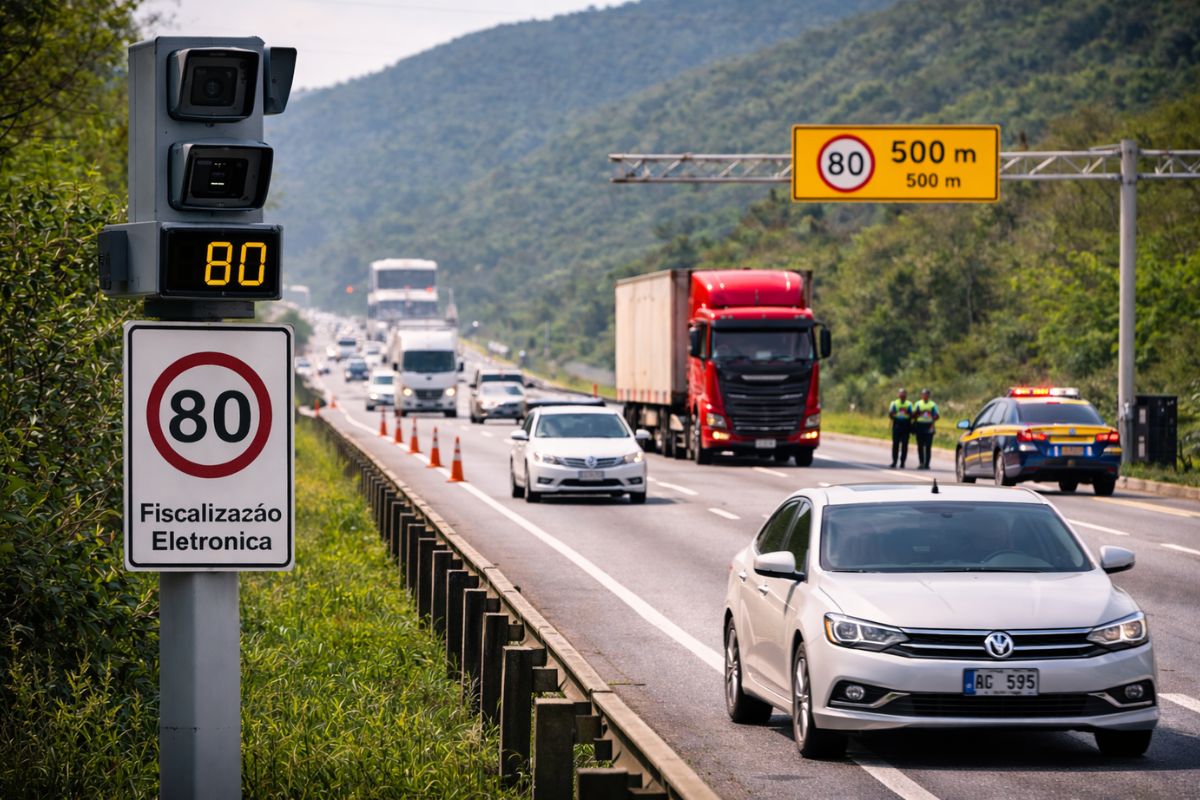
With a Contract Signed in 2025, the Return of Speed Cameras on Federal Highways in Santa Catarina Starts in April 2026 Gradually, After Technical Studies, Signage, and INMETRO Measurement, with 201 Points and 321 Stretches Planned in the Federal Network of Santa Catarina and Fines Only Released After Mandatory Certification
The speed cameras on federal highways in Santa Catarina are back at the center of discussion with activations scheduled to start in April 2026, but the actual timeline is not an instant turnaround. According to DNIT, the equipment will be put into operation as each point fulfills technical and regulatory requirements.
In practice, this means that electronic enforcement will return in phases, with installation, analysis, and certification happening at different rhythms across the State. The main change for drivers is understanding that the presence of equipment does not mean immediate automatic fines, as there is a mandatory process before release.
Resumption Starts in April, But Gradually
The new cycle of enforcement came after the signing of a contract in November 2025.
-
The government requests the Federal Revenue Service for a new system to automate the income tax declaration, reducing errors, time, and bureaucracy for millions of Brazilians.

-
Pix in installments, international Pix, and contactless payment without internet: the Central Bank revealed the new features coming to the tool that is already used by almost every adult in Brazil.

-
Mercado Livre has just started selling medications with delivery in up to three hours to your door, and this move could completely change the way Brazilians buy medicines on a daily basis.

-
In Dubai, rising tensions from the war in the Middle East are causing super-rich individuals to leave the Gulf and direct their fortunes to a new financial refuge in Asia.


From that point on, DNIT began organizing the reinstatement of the equipment for the federal network in Santa Catarina, with a total forecast of 201 monitoring points and 321 monitored stretches.
The start of activations was projected for April 2026; however, in a gradual format. The schedule itself admits a longer implementation, with completion potentially taking up to 12 months.
This reduces the chance of simultaneous deployment on all highways, but increases the need for continuous attention, as new stretches may be released over the months.
What Needs to Happen Before Starting to Issue Fines
The return of speed cameras on federal highways does not depend solely on the physical installation of the equipment.
Each point must complete a series of steps that include a technical feasibility study, defining the speed limit, installing signage, and mandatory measurement by INMETRO.
This detail is crucial to avoid misinterpretations on the roads. Without certification and without the formal step completed, the radar cannot record violations, even if it is already visible in the stretch.
Therefore, April marks the beginning of activations but not necessarily the start of fines in all locations on the same day.
Initial Phase Already Has Prioritized Points and Defined Stretches
In the initial phase, DNIT prioritized 82 points, totaling 131 monitoring stretches, and forwarded this first batch to the responsible company.
Some of these locations are already under installation, while others are still undergoing technical analysis.
The first authorizations for installation were issued in January 2026. Recently released points may start operating by May, within the contractual deadlines.
The practical message is simple and important: enforcement appears in waves, and each city may feel this return at different times.
Where the Equipment Should Appear in Santa Catarina
The speed cameras on federal highways are planned for stretches of BR 153, BR 280, BR 282, and BR 470, reaching areas such as Greater Florianópolis, the North, the Itajaí Valley, the Mountains, and the West.
The deployment plan shows broad coverage, not concentrated on a single corridor.
For example, on BR 282, installation is underway in municipalities such as Florianópolis, Palhoça, Santo Amaro da Imperatriz, and Bom Retiro, as well as in Western cities like Ponte Serrada and Irani.
On BR 470, there are points released in Ibirama, Ascurra, and Trombudo Central, while other stretches remain under study. This shows a strategy of resumption that is territorially distributed, prioritizing different types of roads and risks.
Limits Vary by Stretch and There Is No Standard Speed
One of the most common points of confusion among drivers is the expectation of a single limit, but DNIT emphasizes that this does not exist.
Limits are defined on a case-by-case basis, based on technical criteria outlined in Normative Instruction number 43 of 2021.
Among the factors considered are the characteristics of the road, such as curves, access points, and crossings, as well as traffic volume, the average speed practiced, and accident history.
In some already released points, limits vary between 50 km/h and 100 km/h. The logic is based on the risk of the stretch, not on automatic standardization.
Signage Remains Valid Even Without Active Radar
Even where speed cameras on federal highways are not yet operational, speed limit signs remain fully valid.
This is a central point in the agency’s guidance and directly impacts the routine of those traveling through the State daily.
In other words, the momentary absence of active electronic enforcement does not authorize disregarding the speed limit.
The speed rule applies to the road, not the equipment. The radar simply reinforces the enforcement of an obligation that already exists and remains in effect.
How to Check Operation Points and Technical Studies
DNIT informs that drivers can check the operational speed cameras and also the technical studies that supported each installation on the agency’s Fine Portal. This public access helps reduce noise and rumors about supposedly active locations.
For those who frequently travel on federal stretches in Santa Catarina, monitoring this dashboard may become a useful routine in the coming weeks, especially during April and May when new activations are expected. The most reliable information is the official and updated per point, because the advancement is gradual.
The return of speed cameras on federal highways in Santa Catarina has a start date but does not have a uniform effect on the same day across the State. What is underway is a technical, phased resumption contingent on signage, study, and measurement, with a progressive impact on the federal network in Santa Catarina.
In your daily stretch, which factor weighs more today, excessive speed, lack of clear signage, or risky behavior at access points and crossings? Which points on the BRs in Santa Catarina do you consider most critical for electronic enforcement to be implemented first?









-

Uma pessoa reagiu a isso.