





 Portuguese
  English
  Spanish
 5 min of reading
  1 comment


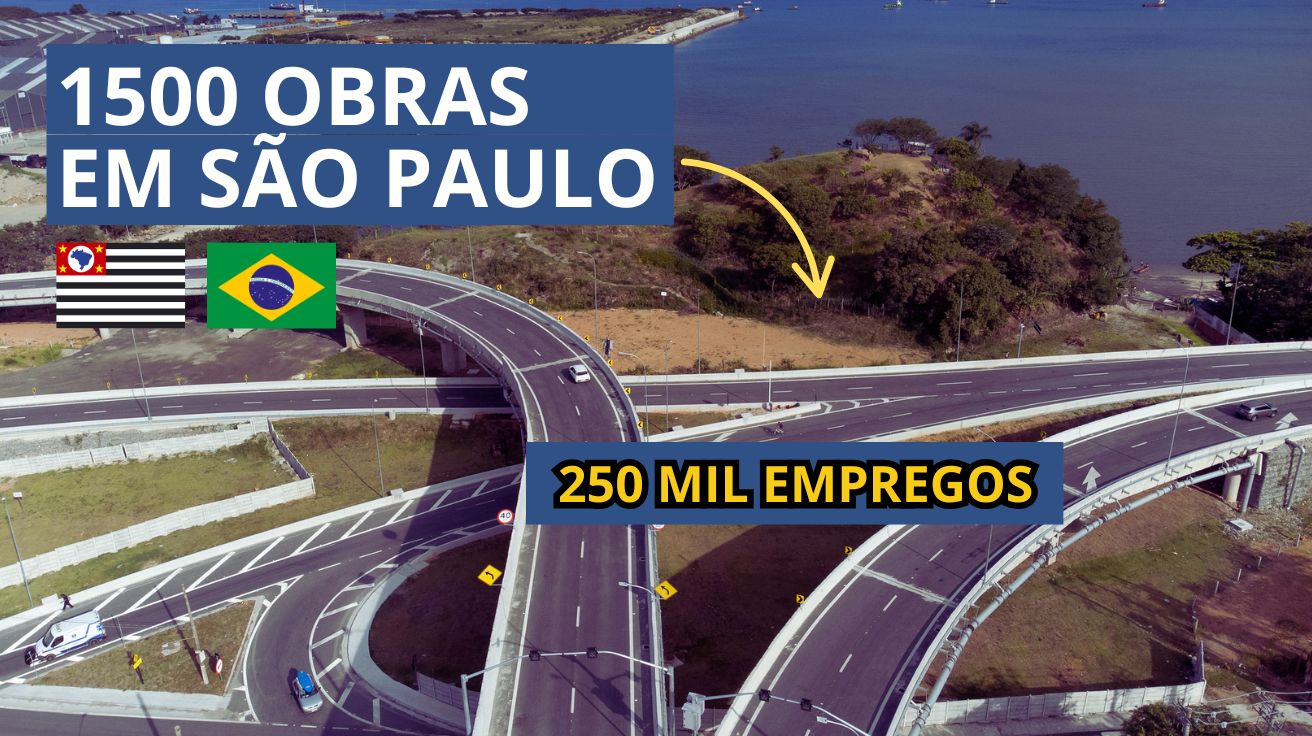


With Billions in Investments and More Than a Thousand Projects Underway, São Paulo Transforms Roads into Modern Ways and Boosts Employment with One of the Largest Infrastructure Initiatives Seen in Brazil, Connecting Regions and Shaping the Future of Mobility.
São Paulo is revolutionizing road infrastructure with the largest roadworks program in the history of Brazil, the São Paulo pra Toda Obra.
With an investment exceeding R$ 30 billion, the project is reforming more than 22,300 km of highways, directly benefiting over 35 million people.
This ambitious plan not only modernizes the roads but also opens up a huge range of job opportunities, with 250 thousand new jobs being created throughout its execution.
-
Friends have been building a small “town” for 30 years to grow old together, with compact houses, a common area, nature surrounding it, and a collective life project designed for friendship, coexistence, and simplicity.

-
Pix in installments, international Pix, and contactless payment without internet: the Central Bank revealed the new features coming to the tool that is already used by almost every adult in Brazil.

-
This small town in Germany created its own currency 24 years ago, today it circulates millions per year, is accepted in over 300 stores, and the German government allowed all of this to happen under one condition.

-
Curitiba is shrinking and is expected to lose 97,000 residents by 2050, while inland cities in Paraná such as Sarandi, Araucária, and Toledo are experiencing accelerated growth that is changing the entire state’s map.


The importance of the project goes beyond mere road renewal. The São Paulo pra Toda Obra not only improves mobility but also transforms the lives of thousands of workers across the State.
With an impressive number of more than 1,500 public and private projects, the program is driving regional growth and offering a new chance for the local economy.
The immediate impact of the program on the job market is huge: the initiative anticipates the creation of 252 thousand job positions, particularly in the interior regions of the State, such as Vale do Ribeira, Franca, Baixada Santista, Itapeva, Sorocaba, and Barretos.
These numbers represent a significant impact on medium-sized cities, such as Araçatuba, with approximately 200 thousand inhabitants.
Modern Infrastructure and Connectivity for the Entire State
The work is not limited to simple road duplication but seeks a complete integration between the interior, the coast, and the metropolitan region.
The São Paulo pra Toda Obra includes projects for resurfacing, constructing urban bypasses, accesses, crossings, and restoring road sections in various strategic areas.
The highways that previously faced significant traffic challenges will now be safer and more efficient for drivers and truckers, with reduced congestion and increased road safety.
Among the main projects, the resurfacing of the Anhanguera-Bandeirantes System stands out, which has already reached 45% of its execution and is expected to be completed by 2026.
This project is a clear example of how the program is positively impacting logistics in the State, promoting reduced travel time and greater traffic flow.
The duplication of highways and the modernization of sections will also benefit the mobility of populations living in more remote areas.
Additionally, large-scale projects, such as the restoration of the Tamoios highway, are already yielding concrete results.
The travel time between São José dos Campos and Caraguatatuba on the São Paulo coast has been drastically reduced from 45 to just 16 minutes, changing the life dynamics of residents and tourists.
This is just one example of how road improvements have a direct impact on people’s daily lives.
The Economic and Social Impact
The program is not limited to promoting the modernization of road infrastructure, but is also generating direct and indirect opportunities for workers in the State.
São Paulo is becoming a true construction site, with thousands of new job positions being generated both directly in the projects and in support companies, such as suppliers, transport companies, construction material companies, and service providers.
Jocélio Braz, an excavator operator at the North Ring Road, shares his experience enthusiastically: “I came to work on the projects in São Paulo to improve my life. These are grand projects that not only alleviate traffic but also offer more job vacancies.”
The program is creating a chain of opportunities that not only involves construction workers but also professionals from technical areas such as surveying, heavy machinery operation, and large-scale project management.
The Role of Concessionaires and State Agencies
The works are executed by the Department of Highways (DER) and by highway concessionaires, with oversight from the State Transport Agency of São Paulo (Artesp).
Efficient management and meeting deadlines are essential to ensure that benefits reach the population quickly.
The program already shows more than 1,500 completed, ongoing, or ordered projects, totaling over 22,300 km of requalified and modernized roads, equivalent to a journey from São Paulo to Japan.
São Paulo pra Toda Obra: More Than an Infrastructure Program
This is the largest road infrastructure program in the State of São Paulo, and its scope is unprecedented.
Over the next few years, more than 30 billion reais will be invested, covering public and granted highways, as well as rural roads.
The program not only improves traffic conditions but also strengthens the local economy and contributes to regional integration, promoting the development of the entire State.
This is the first time more than 1,500 public and private projects complement each other to create a coordinated and positive impact on the São Paulo road infrastructure.
This joint effort between the state government, highway concessionaires, and sector workers reflects São Paulo’s forward-looking vision, which seeks not only to solve current mobility issues but also to ensure sustainable growth for future generations.
The Future of São Paulo Highways
The continuation of the São Paulo pra Toda Obra promises even more investments and advancements in the coming decades.
The program is not limited to solving immediate mobility problems but is also preparing the State for future challenges, with the construction of a transportation network that will meet the growing demand of the population and the market.
The positive impact of the program goes far beyond improving roadways. It is creating a virtuous cycle of development, where improvements in road infrastructure generate more jobs, boost the economy, and promote prosperity throughout the State.
How Do You See the Impact of This Program in Your Region?
Now, it’s your turn! The São Paulo pra Toda Obra is transforming the infrastructure and economy of the State.
Do you believe that this type of investment is the way to solve mobility problems and generate more jobs in Brazil? Leave your comment and share your opinion!







Aqui na região de Ribeirão Preto o anel viário e a Anhanguera possuem apenas 2 pistas para uma circulação intensa de veículos. Precisamos urgente que se construa mais duas pistas adequando à circulação de veículos .