





 Portuguese
  English
  Spanish
  4 min of reading
  0 comments


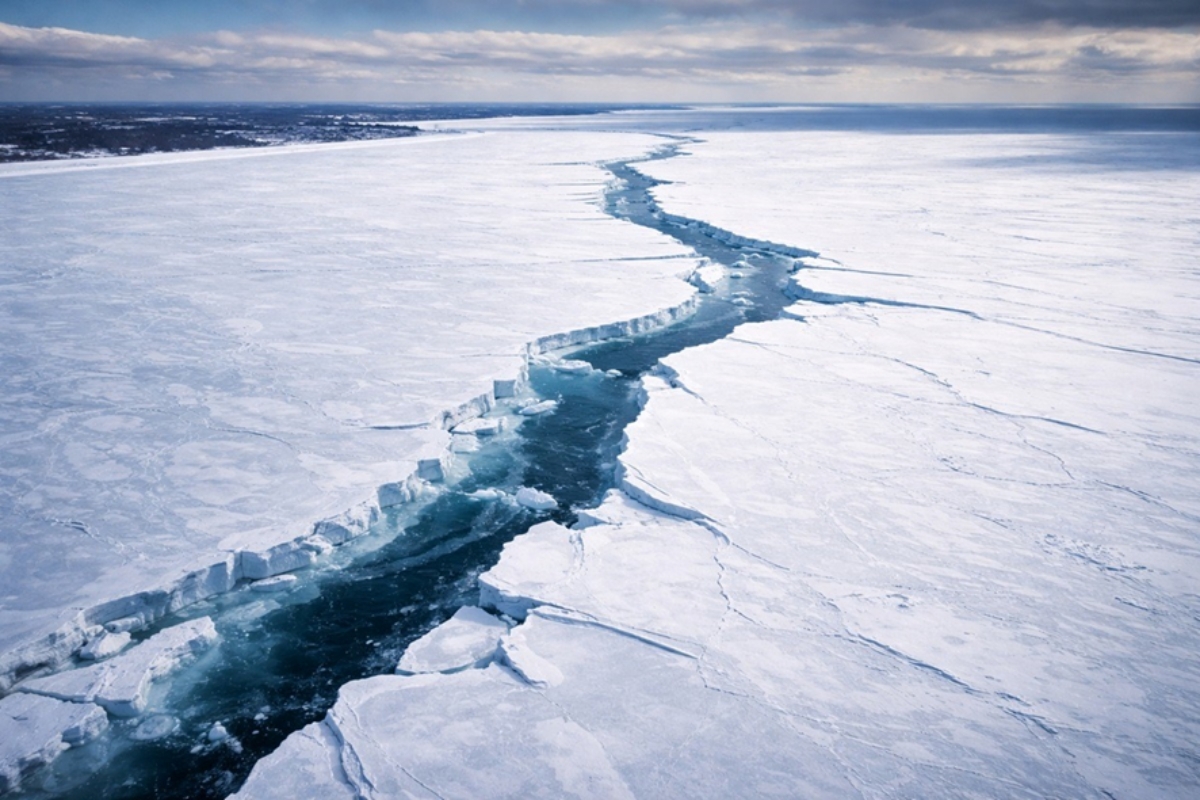
In Lake Erie, weather satellites recorded the opening of a 128 km crack in the ice layer in just 4 hours to monitor the frozen cover, triggering a climate alert and drawing attention from meteorologists and environmental researchers.
An impressive 128-kilometer fracture appeared on the frozen surface of Lake Erie, one of the five Great Lakes of North America. The phenomenon was recorded by satellite on February 8, 2026, between 2 PM and 6 PM.
In less than four hours, the structure that appeared solid and continuous visibly broke apart. The images show how quickly the ice rearranged itself, revealing that even under extreme temperatures, the lake remains active and dynamic.
The event occurs after weeks of intense cold that completely transformed the landscape of the region, located between Port Burwell in Canada and Cleveland in the United States.
-
Friends have been building a small “town” for 30 years to grow old together, with compact houses, a common area, nature surrounding it, and a collective life project designed for friendship, coexistence, and simplicity.

-
This small town in Germany created its own currency 24 years ago, today it circulates millions per year, is accepted in over 300 stores, and the German government allowed all of this to happen under one condition.

-
Curitiba is shrinking and is expected to lose 97,000 residents by 2050, while inland cities in Paraná such as Sarandi, Araucária, and Toledo are experiencing accelerated growth that is changing the entire state’s map.

-
Tourists were poisoned on Everest in a million-dollar fraud scheme involving helicopters that diverted over $19 million and shocked international authorities.


What Happened in Lake Erie and Why the Crack Got So Much Attention
The crack emerged at an unusual time for the lake. Data from the Great Lakes Environmental Research Laboratory shows that the ice cover jumped from less than 2 percent on January 14, 2026, to nearly 85 percent on the 21st of the same month.
By the end of January, the index exceeded 95 percent. This means that Lake Erie was very close to complete freezing, something rare since the start of records in the 1970s.
The detail that caught the most attention was the scale of the crack. It spans 128 kilometers in an area that was already nearly completely frozen.
How the Ice Cover Advanced So Quickly in a Few Weeks

The advance of ice occurred after a prolonged period of extremely low temperatures. Lake Erie is the shallowest of the Great Lakes, which facilitates the accelerated cooling of the water.
This characteristic causes the lake to freeze more frequently compared to the others. Still, exceeding 95 percent coverage is something uncommon.
Since the 1970s, total freezing has occurred only three times. The last was recorded in February 1996. In 2025, 2018, 2015, 2014, and 2011, the lake also came close to complete coverage.
What Explains the Formation of Giant Cracks in the Ice
Cracks of this type are usually associated with what is called thermal stress. Sudden temperature changes cause the ice layer to expand and contract.
This process generates internal stresses that are eventually released in the form of extensive cracks. Strong winds can also fracture the surface and prevent the ice from forming a single, stable sheet.
Even with the visual impact, the presence of the crack does not necessarily mean the collapse of the cover. Lake ice is a dynamic system, constantly influenced by thermal and mechanical forces.
Can It Reach 100 Percent Freeze Still in February
According to meteorological analyses, there is still a possibility for Lake Erie to reach 100 percent ice cover if the intense cold continues and the winds diminish.
On the other hand, the forecast of a moderate rise in temperatures in mid-February could reduce this chance. The scenario directly depends on the persistence of cold air masses.
In other words, the situation could still change in the coming days.
The Direct Impact on the Lake Effect Snow Phenomenon
Lake Erie plays a crucial role in the regional climate during winter. It acts as a meteorological engine through the phenomenon known as lake effect snow.
The process occurs when cold, dry air from the Arctic crosses relatively warmer waters, absorbing moisture and heat. Upon reaching the mainland, this air mass cools rapidly and dumps large volumes of snow in cities like Buffalo, New York, and Erie, Pennsylvania.
If the lake freezes completely, this mechanism practically ceases to function. The ice layer prevents evaporation and drastically reduces the formation of the intense snowfalls associated with the phenomenon.
The 128-kilometer crack is not just an impressive sight from space. It reinforces that Lake Erie remains a natural system in constant transformation, even when it appears completely frozen, and shows how small thermal variations can have regional-scale effects.
What do you think of this phenomenon? Have you ever imagined a lake that is almost completely frozen opening up in a matter of hours? Leave your opinion in the comments.










-

-

-

-

-

-

33 pessoas reagiram a isso.