





 Portuguese
  English
  Spanish
  4 min of reading
  0 comments


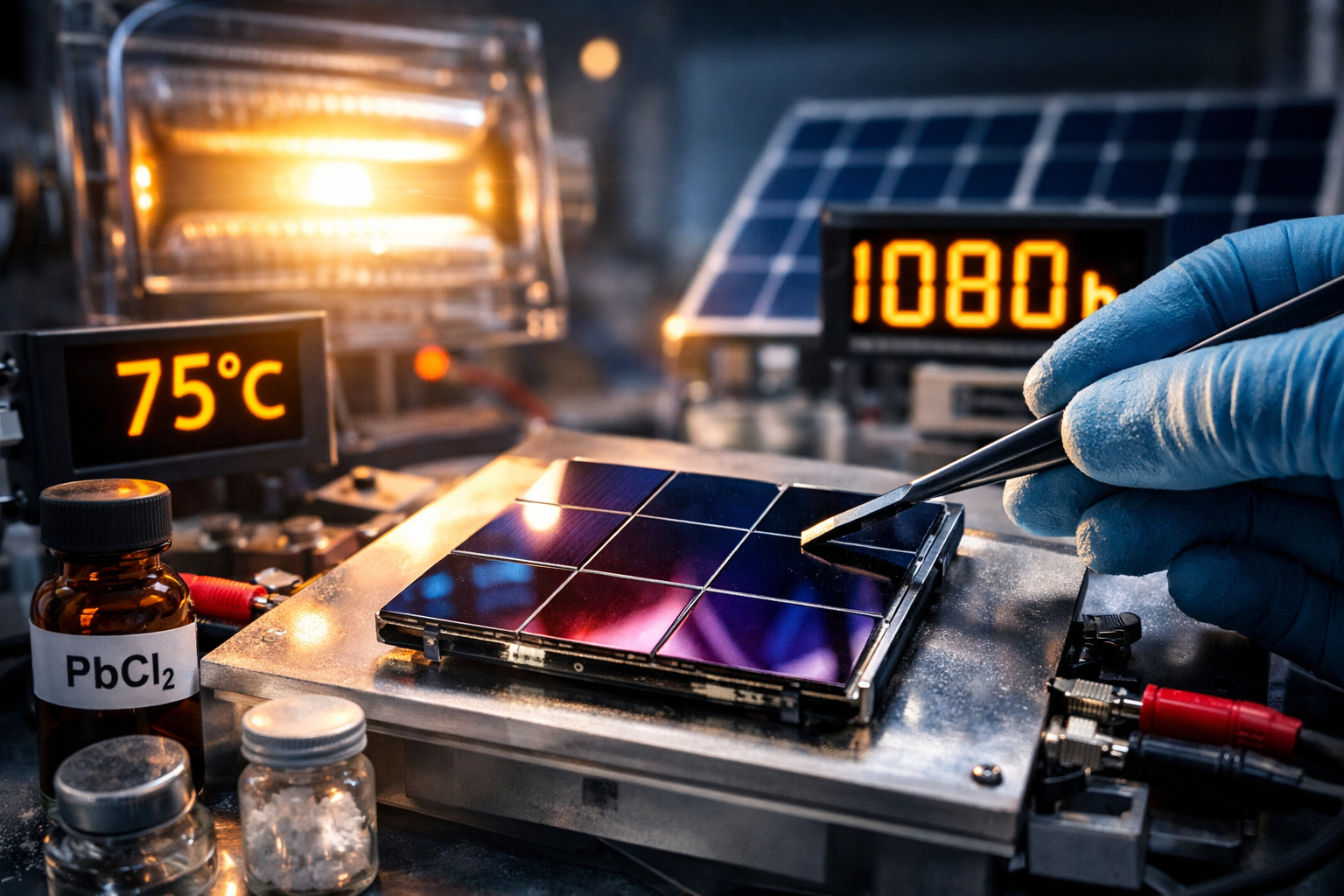
HKUST Adjusted The Vacuum Deposition Of Perovskite And Used PbCl₂ As Co-Source To Organize The Crystals, Increasing Heat And Light Resistance And Approaching Large-Scale Production.
Perovskite lives a paradox. It delivers efficiency that excites any energy engineer, but often loses strength when the crucial test begins: prolonged heat and light exposure. Therefore, a piece of data came out of the laboratory in Hong Kong and caught attention as a warning for the industry. Encapsulated cells maintained 80% of performance after 1,080 hours under heavy stress at 75°C.
And there is another number that doesn’t go unnoticed. In the laboratory, efficiency reached 19.3%.
The Problem That Held Back Perovskite Was Easy To See In Practice: It Even Impresses At First, But It Usually Degrades Under Light And Heat, And That’s Poison For The Product
Theoretically, perovskite seems made for the future of solar energy. In real life, the story complicates when the material needs to maintain performance over long periods.
-
The Brazilian state accelerates industrial competitiveness with a focus on the extraction of strategic minerals to boost the energy transition in Goiás.

-
Seagri’s headquarters invests in solar energy with Neoenergia Coelba and promises to cut electricity costs, highlighting a strategic advance in sustainability and energy efficiency within state public administration.
-
A Canadian retiree creates a hydroelectric system on a real river, generating energy continuously throughout the day and demonstrating how the power of water can supply a house with stability even in a simple structure.

-
Solar Pyramid draws attention by converting solar energy into million-dollar savings and repositioning the City Hall of Curitiba as an example of innovation, sustainability, and intelligent use of public resources.

Intense light and high temperatures accelerate reactions that wear down the active layer. This is where beautiful promises turn into headaches for those thinking about scale, certification, and warranty.
The competition becomes clear. Traditional methods score points for predictability. Perovskite needs to prove it can take hits without losing what it does best.
The Path Chosen By HKUST Changes The Playing Field, Vacuum Deposition, A Dry And Controlled Process, To Form A More Uniform Film That Is Easier To Repeat In An Industrial Environment
Instead of preparing perovskite like painting, the team from the Hong Kong University of Science and Technology, HKUST, focused on vacuum deposition.
In this type of process, the ingredients are evaporated in a controlled environment and form a thin layer on the substrate. This is interesting for the industry because it tends to deliver repeatability and uniformity control, two points that define cost and quality in manufacturing.
However, there was a bottleneck. The crystalline quality of the film still limited performance and stability in vacuum-deposited perovskites. This was the knot the group aimed to untie.
PbCl2 As Co-Source Directs Growth And Aligns Crystals, Changing Resistance To Degradation
The turning point of the method came with the introduction of a co-source of lead chloride, PbCl2, during thermal co-evaporation.
According to the researchers, this addition directs the growth of the crystals and results in perovskite with a wide bandgap and more ordered structure, at 1.67 eV. The film begins to show many grains aligned in the (100) orientation with faces upward.
This type of organization matters because it tends to reduce defects and degradation pathways. The material tends to resist better against the combined attack of light and heat, gaining optoelectronic properties and stability under stress.
The lead author, Dr. SHEN Xinyi, states that the work addresses a central issue of materials that limited vacuum-deposited perovskites, with gains in thermal and photo-chemical stability alongside the advantages of the dry process.
Numbers That Put Pressure On The Market, 19.3% In The Laboratory, 18.35% Certified In MPPT, And 18.5% In 1 Cm², And The Bigger Size Doesn’t Forgive Defects
High efficiency in small samples appears more easily. The challenge begins when the area grows because any imperfection shows up and costs performance.
At this point, the numbers disclosed by the team came with clear messages. In the laboratory, the cell reached 19.3%.
In the performance certified and tracked by the maximum power point, the MPPT, the team reported 18.35% in a device of 0.25 cm².
And for those thinking in scale, the larger area metric weighs heavily. They reported 18.5% in 1 cm², a more demanding size to maintain a homogeneous film and avoid defects.
The Test That Often Brings Down Promises Was Faced Head-On, 1 Sun Without UV Filter, 75°C In Air, 1,080 Hours, And 80% Of Performance Still Standing
Durability is not measured with pretty phrases. It is measured with a rigorous protocol. For that, the team followed the ISOS, a standard used to assess stability in photovoltaics.
The cited test was ISOS L 2, with full-spectrum illumination equivalent to 1 sun, without ultraviolet filter, temperature of 75°C with a variation of 5°C, in air, operating in open circuit.
After 1,080 hours, the encapsulated cells retained 80% of maximum performance. In such conditions, each hour counts as an extra push in wear, the type of scenario that quickly exposes weakness.
Why Does This Impact The Energy Chain Now?
HKUST claims that the advancement brings large-scale production of vacuum-deposited single-junction perovskite cells closer. It also approaches an ambitious target: tandem perovskite cells on silicon.
Tandem works like a layer arrangement where each layer better captures a part of the light. In practice, this requires stable materials and processes that do not become unpredictable when moving from the laboratory to the production line.
There isn’t an official number released yet about the final cost of this route, nor a public timeline for market arrival. Even so, what emerges here is a strong signal for those following the race for more efficiency with sufficient durability to become a product.
Perovskite has regained attention because this time the conversation didn’t stay just on peak efficiency; it touched on the Achilles’ heel: stability under heat and light over prolonged periods.
What do you think holds perovskite back from scaling, cost, durability, or the complexity of manufacturing with consistent quality? Leave your thoughts in the comments, especially if you work in energy, engineering, or the photovoltaic chain.










-

-

2 pessoas reagiram a isso.