





 Portuguese
  English
  Spanish
  5 min of reading
  0 comments


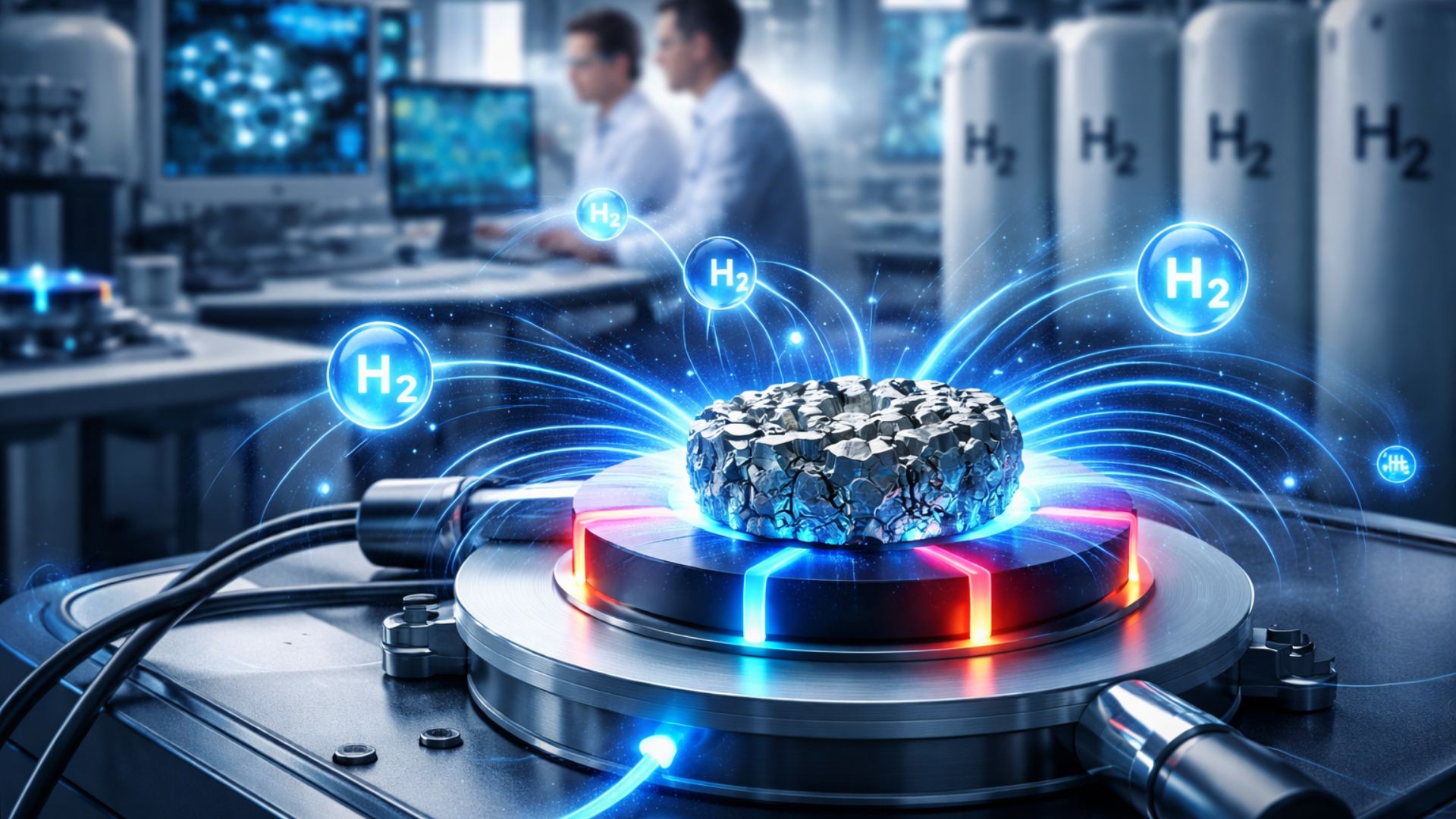
International Research Indicates That Controlling Magnetism in Metallic Alloys Can Increase the Efficiency and Stability of Hydrogen Storage, Opening New Perspectives to Accelerate Renewable Energies.
A recent scientific discovery conducted by researchers from Tohoku University indicates that magnetism may be the decisive factor to overcome one of the biggest technological obstacles of hydrogen: the instability of alloys used for hydrogen storage in solid state.
According to an article published by the Inovação Tecnológica website on February 26, hydrogen produced from renewable sources is considered the cleanest fuel par excellence. It does not emit carbon dioxide during use and can be obtained through water electrolysis using solar or wind energy. However, as soon as it is produced, a relevant technical challenge arises: to store it safely, efficiently, and economically.
As the hydrogen molecule is extremely small, it tends to escape from almost any material, making the use of conventional tanks difficult. This limitation is especially critical in the automotive sector. The new scientific discovery reveals that manipulating the magnetism of metallic alloys can enhance the stability of these materials, making hydrogen storage more reliable and directly contributing to the advancement of renewable energies.
-
The Brazilian state accelerates industrial competitiveness with a focus on the extraction of strategic minerals to boost the energy transition in Goiás.

-
A Canadian retiree creates a hydroelectric system on a real river, generating energy continuously throughout the day and demonstrating how the power of water can supply a house with stability even in a simple structure.

-
Petrobras reaffirms its commitment to the market and ensures that it will carry out the energy transition safely to maintain national sovereignty.

-
Researchers discover a possible hydrogen deposit of up to 46 million tons beneath an ancient coal basin, and the volume could exceed half of the entire global production.


The Technical Dilemma Limiting the Advancement of Hydrogen Storage in Renewable Energies
Solid-state storage has been considered one of the most promising alternatives for the sector. In this model, hydrogen is chemically absorbed by a metallic material, forming hydrides. This approach can offer greater safety and volumetric density compared to pressurized or cryogenic systems.
However, there is a fundamental dilemma that has challenged engineers and scientists for decades. Many metallic alloys exhibit a delicate balance between absorption capacity and structural stability. When the capacity for hydrogen storage is improved, there is usually a loss of thermodynamic stability. When stability is increased, the capacity tends to decrease.
This contradiction has been one of the main obstacles for hydrogen to play a more robust role in the expansion of renewable energies. It was precisely at this point that the new scientific discovery introduced an until-then underestimated variable: magnetism as a determining structural factor.
Magnetism as a Structural Variable in Hydrogen Storage
Historically, magnetism was not considered a central parameter in the development of materials for hydrogen storage. Research prioritized chemical composition, crystalline structure, and classical thermodynamic properties.
The team from Tohoku University used first-principles calculations combined with Monte Carlo simulations to investigate AB-type intermetallic alloys. These materials are known for their rapid hydrogen absorption and good reversibility, desirable characteristics for practical applications.
The results revealed a direct and strong link between magnetic intensity and alloy stability. In alloys with strong magnetism, the formation energy increases significantly, making the material thermodynamically unstable. In alloys with reduced or suppressed magnetism, stability consistently increases.
This scientific discovery suggests that controlling magnetism may allow for the expansion of the range of suitable compositions for hydrogen storage, reducing the historical conflict between capacity and stability.
AB Intermetallic Alloys: Composition, Calculations, and the Numbers of the Study
The researchers focused their analysis on AB-type intermetallic alloys. At site A, combinations with calcium, yttrium, and magnesium were tested. At site B, cobalt or nickel was evaluated.
The incorporation of magnesium proved promising for increasing hydrogen storage capacity. However, in alloys containing cobalt, this same addition intensified magnetic interactions. The strong magnetism increased the formation energy of the alloy, making it unstable.
The computational analysis revealed that in cobalt-based alloys, increasing magnetic intensity was directly associated with structural instability growth. This behavior limited the material’s performance, even when absorption capacity was high.
The identified solution was surprisingly simple from a conceptual standpoint: replacing cobalt with nickel. Nickel-based alloys exhibited much weaker magnetism and, in some specific compositions, practically non-magnetic behavior. This magnetic suppression reduced formation energy and stabilized the structure, even in magnesium-rich alloys.
According to Professor Hao Li, by replacing cobalt with nickel, the alloys became much more stable, even when containing large amounts of magnesium. This allowed the combination of high hydrogen capacity with good thermodynamic stability, an essential condition for practical applications.
How the Scientific Discovery Expands the Potential of Renewable Energies
The impact of this scientific discovery extends beyond the laboratory. Hydrogen is considered a strategic component for global decarbonization, especially in sectors such as heavy transport, steelmaking, and fertilizer production.
According to the International Energy Agency, hydrogen will play a central role in carbon neutrality scenarios by 2050. However, the agency itself emphasizes that reducing costs and overcoming technological challenges related to hydrogen storage is essential to expand its adoption.
By demonstrating that magnetism can be manipulated to stabilize metallic alloys, the research directly contributes to reducing one of the main structural barriers of the sector. The greater the stability of the absorbent material, the higher the operational safety and the lower the need for complex containment solutions.
This strengthens the integration of hydrogen into renewable energy systems, allowing the storage of excess solar and wind generation and using it during periods of low production.


Magnetism as a Tool for Materials Engineering
The incorporation of magnetism as a design criterion represents a paradigm shift in the development of alloys for hydrogen storage. Rather than focusing solely on chemical composition and traditional thermodynamic parameters, researchers are now considering internal magnetic interactions as well.
This approach broadens the field of possibilities. With the use of advanced computational modeling, it becomes feasible to predict which combinations of elements will exhibit reduced magnetism and, consequently, greater stability.
The scientific discovery also reinforces the importance of basic science in advancing renewable energies. Often, structural advancements arise from a detailed analysis of physical properties considered secondary, as was the case here with magnetism. Additionally, controlling magnetism can be applied to other classes of materials, further expanding technological innovation opportunities in the energy sector.
A New Path to Overcome Technological Barriers in Renewable Energies
The advancement presented by researchers at Tohoku University signals a path to reduce barriers that still limit the growth of hydrogen as an energy vector.
By balancing capacity and stability through the control of magnetism, the scientific discovery offers a clear strategy to optimize hydrogen storage. This solution does not rely on radical changes in infrastructure but instead on improvements in material design.
In a global scenario that demands acceleration of the energy transition, every incremental improvement can generate significant impacts. Strengthening hydrogen storage technologies enhances the reliability of energy systems based on renewable energies, reduces operational risks, and broadens the range of industrial applications.
From this new understanding of the role of magnetism, researchers and engineers have an additional tool to develop more efficient, safe, and economically viable materials. This marks a relevant technical step that can bring hydrogen closer to its full potential as a clean fuel of the future.









-

-

-

-

-

-

25 pessoas reagiram a isso.