





 Portuguese
  English
  Spanish
  5 min of reading
  1 comment


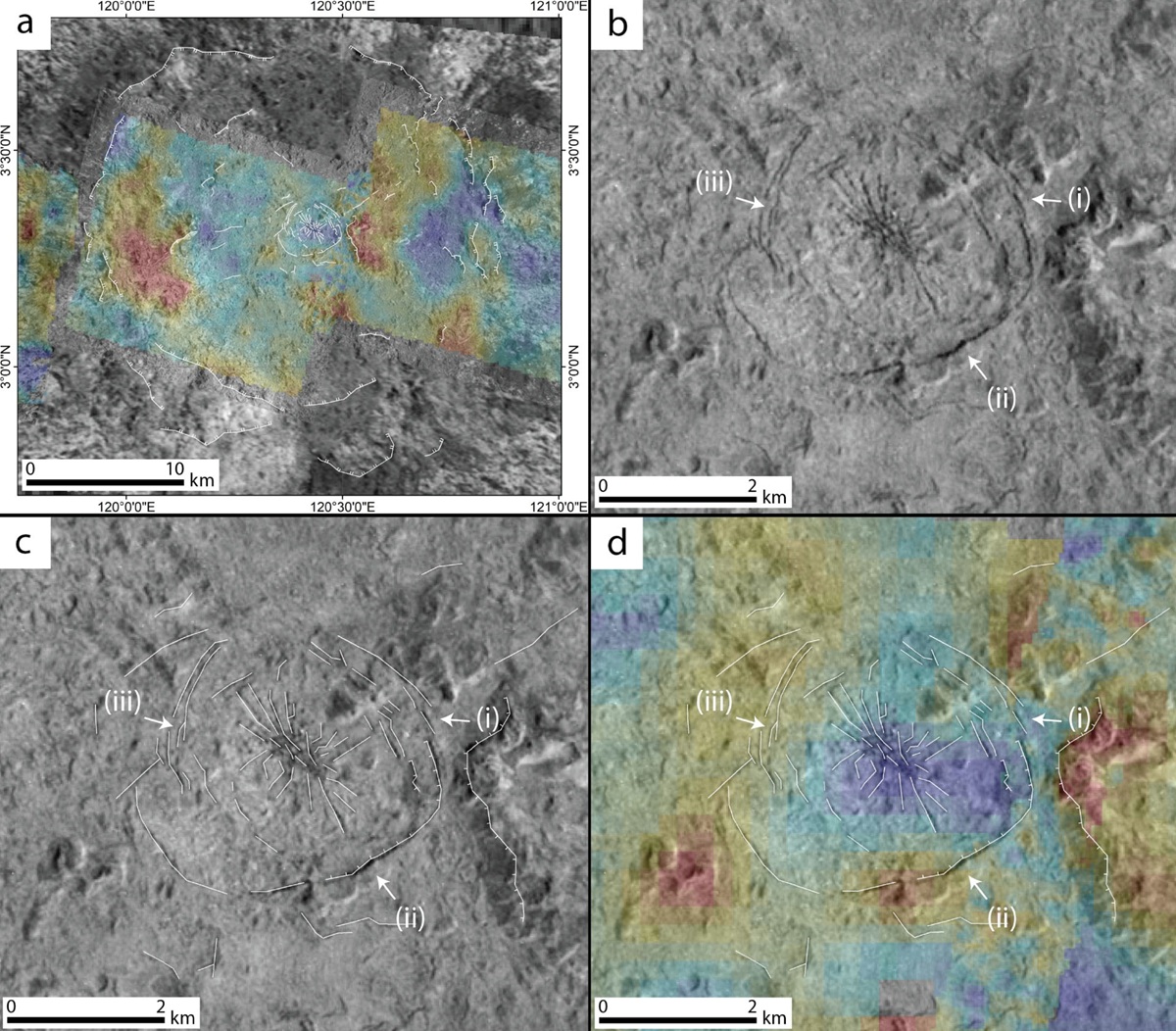

Spider-Shaped Structure At The Center Of The Manannán Crater On Europa May Have Originated After Impact, With Brine Eruption And Radial Formation Analogous To Lake Stars Observed In Earth’s Icy Environments
Europa, Jupiter’s icy moon, hosts a spider-shaped structure at the center of the Manannán crater that may have formed after an impact and brine eruption, according to planetary researchers, as it is one of the most promising environments in the search for habitability beyond Earth.
Europa is classified as an ocean world and ranks among the main scientific targets in the investigation of potentially habitable environments beyond Earth, due to the confirmed presence of a subsurface ocean beneath its icy crust.
The surface of Europa displays various formations associated with brine flows in its ice, interpreted as some of the most accessible bodies of liquid water in the Solar System, which increases scientific interest in these structures.
-
Motorola launched the Signature with a gold seal from DxOMark, tying with the iPhone 17 Pro in camera performance, Snapdragon 8 Gen 5 that surpassed 3 million in benchmarks, and a zoom that impresses even at night.

-
Satellites reveal beneath the Sahara a giant river buried for thousands of kilometers: study shows that the largest hot desert on the planet was once traversed by a river system comparable to the largest on Earth.

-
Scientists have captured something never seen in space: newly born stars are creating gigantic rings of light a thousand times larger than the distance between the Earth and the Sun, and this changes everything we knew about stellar birth.

-
Geologists find traces of a continent that disappeared 155 million years ago after separating from Australia and reveal that it did not sink, but broke into fragments scattered across Southeast Asia.

A central example of this interest is the asterisk-shaped formation located at the center of the Manannán crater, originally identified from images obtained by the Galileo mission of NASA in 1998.
Planetary researchers are now proposing a new hypothesis for the origin of this structure, based on detailed morphological analyses and preliminary analog modeling, comparing it to seasonal formations observed in Earth’s icy environments.
According to the new interpretation, Europa’s structure may have formed through a process similar to the so-called lake stars, dendritic patterns found in ponds and frozen lakes on Earth during certain seasonal conditions.
Hypothesis Based On Impact And Brine Eruption
“This spider-like structure may have formed from the eruption of melted brines following the impact of Manannán,” stated Dr. Elodie Lesage, a researcher at the Institute for Planetary Sciences, while describing the proposed mechanism.
According to the researcher, the hypothesis suggests that the impact would have ruptured layers of ice, allowing subsurface brines to rise and spread radially across Europa’s surface crust.
“This means it may inform us about the properties of the subsurface and the composition of the brine at the time of the impact,” Lesage added, highlighting the geophysical value of the observed formation.
The team responsible for the study also has prior experience in analyzing the so-called Martian spiders, branched structures observed in the regolith near the south pole of Mars.
These formations on Mars emerge when dust and sand are eroded by gas released beneath a seasonal layer of dry ice, creating branched patterns similar to trees viewed from above.
Comparison With Lake Stars On Earth
Although visually similar, researchers emphasize that the mechanism on Europa differs from that on Mars, as it would be associated with impacts and the dynamics of subsurface liquids, and not with the sublimation of dry ice.
“Lake stars on Earth are branched radial patterns that form when snow falls on frozen lakes,” explained Dr. Lauren McKeown from the University of Central Florida and the NASA Jet Propulsion Laboratory.
According to McKeown, the weight of the snow creates fractures in the ice, allowing liquid water to rise, melt the snow, and spread in an energetically favorable manner, generating well-defined dendritic patterns.
“On Europa, we believe that a subsurface brine reservoir may have erupted after an impact and spread through the porous surface ice,” stated the researcher.
The scientists informally named the formation on Europa Damhán Alla, an Irish term for “spider,” as a way to differentiate it from similar structures observed on Mars.
Field And Laboratory Experiments Under Extreme Conditions
To test the hypothesis, the team conducted field experiments observing natural lake stars in Breckenridge, Colorado, as well as laboratory simulations using ice analogous to that of Europa.
The laboratory experiments were conducted in a cryogenic chamber, using liquid nitrogen-cooled ice simulators to reproduce extreme temperature conditions.
“We circulated water through these simulants under different temperatures,” McKeown said, highlighting that similar patterns formed even below minus 100 degrees Celsius.
The results indicated that comparable mechanisms could occur even in extremely cold environments, reinforcing the plausibility of the process on Europa after a significant impact.
In addition to the physical experiments, researchers numerically modeled the behavior of a brine pool beneath the icy surface after the impact, even creating an illustrative animation of the process.
Observational Limitations And Future Perspectives
Direct observations of the region remain limited to images obtained by the Galileo mission, which restricts more detailed analyses of texture, relief, and depth of the formation.
The team’s expectation is that higher-resolution images will be obtained with NASA’s Europa Clipper mission, which is scheduled to arrive at the Jupiter system in April 2030.
“While the lake stars have provided valuable information, the conditions on Earth are very different from those on Europa,” emphasized McKeown, citing differences in pressure and temperature.
The researcher highlighted that Earth has a nitrogen-rich atmosphere, whereas Europa has an extremely low-pressure environment and severe temperatures, which requires caution in comparisons.
The study combined field observations and laboratory experiments to better simulate the real surface conditions of Europa, aiming to reduce these comparative limitations.
Implications For Habitability And Future Missions
Although the primary focus has been geomorphological, the results offer relevant clues about subsurface activity and possible habitable environments beneath the ice crust.
“Using numerical modeling of the brine reservoir, we obtained constraints on the potential depth of the reservoir,” explained Lesage, citing up to 6 km below the surface.
According to the researcher, the estimated lifespan of this reservoir may reach several thousand years after the impact, extending the temporal window of astrobiological interest.
“This is valuable information for future missions seeking habitable environments within ice crusts,” concluded Lesage, reaffirming the relevance of the data obtained.
The complete results of the study were published in the scientific journal Planetary Science Journal, consolidating the hypothesis as a new line of investigation into Europa and its internal processes.







Just another hoax. There is no so-called “global ocean” … i mean come on, we’re not THAT gullible.