





 Portuguese
  English
  Spanish
  4 min of reading
  2 comments


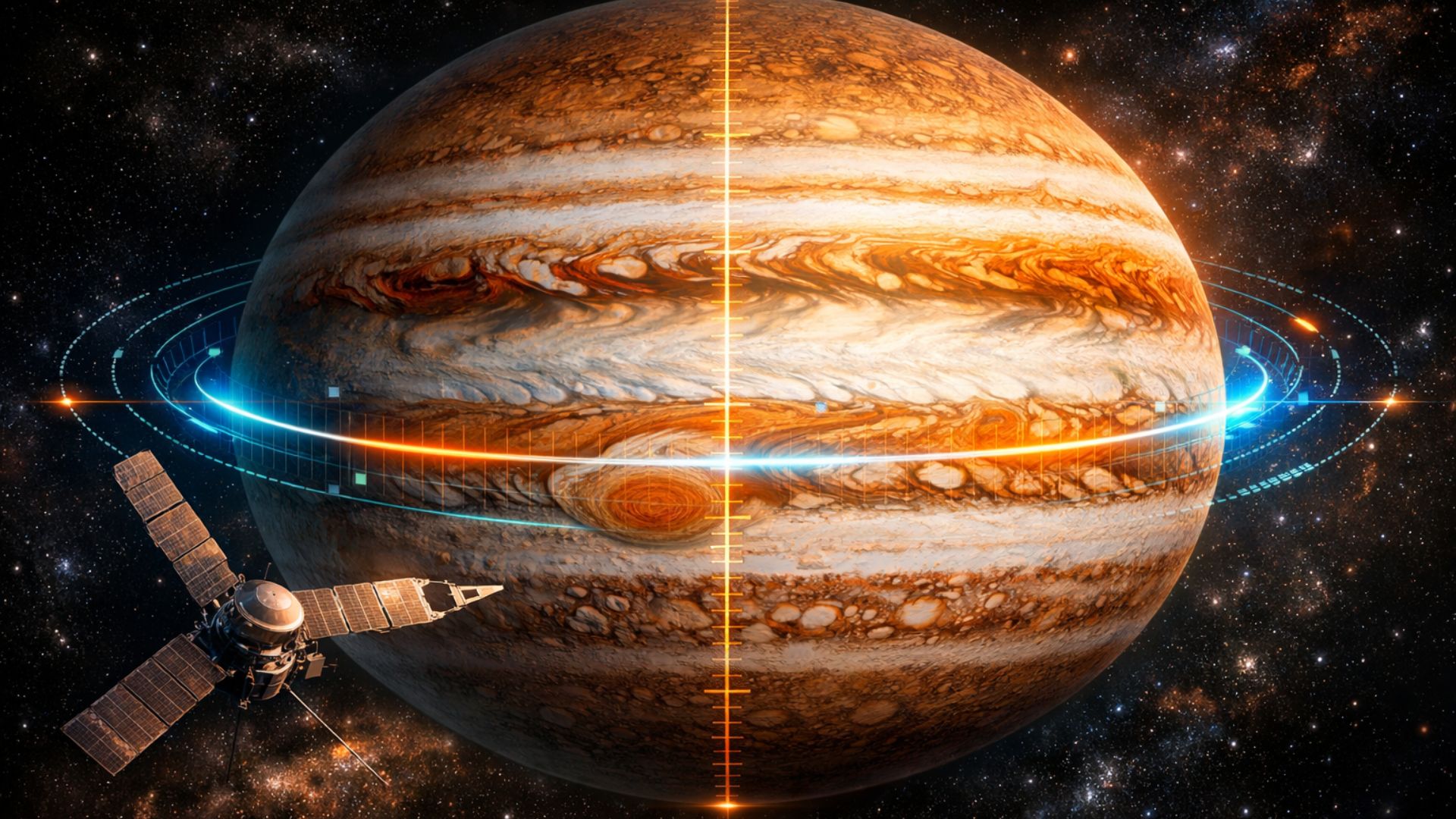


New Analysis Based on Recent Data from the Juno Probe Indicates Revision in Jupiter’s Dimensions and Refines Parameters Used for Decades in Planetary Studies and Scientific Models.
A new analysis based on data from the Juno probe indicated that Jupiter is slightly smaller and flatter than the references adopted for decades for the largest planet in the Solar System.
The difference, measured in a few kilometers, leads to a revision of values used in scientific tables and reference materials, in addition to improving models used in the study of the planet’s internal structure.
The results were presented in a study published in the journal Nature Astronomy, based on measurements taken during specific passes of Juno in relation to Earth and Jupiter.
-
Motorola launched the Signature with a gold seal from DxOMark, tying with the iPhone 17 Pro in camera performance, Snapdragon 8 Gen 5 that surpassed 3 million in benchmarks, and a zoom that impresses even at night.

-
Satellites reveal beneath the Sahara a giant river buried for thousands of kilometers: study shows that the largest hot desert on the planet was once traversed by a river system comparable to the largest on Earth.

-
Scientists have captured something never seen in space: newly born stars are creating gigantic rings of light a thousand times larger than the distance between the Earth and the Sun, and this changes everything we knew about stellar birth.

-
Geologists find traces of a continent that disappeared 155 million years ago after separating from Australia and reveal that it did not sink, but broke into fragments scattered across Southeast Asia.

This type of observation allowed reducing uncertainty margins present in previous estimates, which were mainly based on data collected by missions such as Pioneer and Voyager, conducted during the 1970s and 1980s.
Revision of Dimensions Redefines Parameters Used for Decades
According to the study, Jupiter has an equatorial radius 4 kilometers smaller and a polar radius 12 kilometers smaller than the values previously accepted.
The difference reinforces the characterization of the planet as a significantly flattened body at the poles, due to its rapid rotation.
In practice, this means that the equatorial diameter is about 8 kilometers smaller than previously estimated.
The diameter between the poles has already been reduced by approximately 24 kilometers.
These numbers will now be integrated into databases used by researchers and scientific institutions as standard references.
The authors point out that, although the changes are small on an absolute scale, precision is a central factor in planetary studies.

Models that describe gravity, rotation, and mass distribution of Jupiter depend directly on these geometric parameters.
Therefore, updates become necessary when new, more detailed measurements become available.
Radio Occultation Technique Improves Measurement Accuracy
To reach the new estimates, scientists used the method of radio occultation.
In this technique, signals emitted by the probe pass through the atmosphere of the planet before being captured by antennas on Earth.
As they pass through layers with different densities, these signals undergo measurable variations, which serve as a basis for calculations about the shape and size of the planet.
The analysis of these deviations allows for estimating the outline of Jupiter even in the absence of a visible solid surface.
According to the researchers, the method is especially useful on planets with thick and complex atmospheres, as is the case with Jupiter.
Under these conditions, dense clouds hinder direct observations of the planet’s interior.
Moreover, the study considered the influence of so-called zonal winds, intense and persistent atmospheric currents.
These winds can alter the planet’s mass distribution and influence its observable shape.
By incorporating these effects, the calculations aim to more accurately represent the observed structure.
Impact of New Measurements on Planetary Studies

Experts in planetary science point out that modest adjustments in radius values can affect broader interpretations of the composition and internal functioning of Jupiter.
Models that combine data on gravity, rotation, and atmosphere need to maintain coherence among themselves.
In this context, geometric precision becomes a relevant element.
These revisions also have implications for the study of exoplanets.
In observations made outside the Solar System, the size of giant planets is often estimated using indirect methods, such as transiting in front of the host star.
Having more precise parameters for a nearby gas giant, like Jupiter, helps to calibrate comparisons and reduce uncertainties in analyses of distant worlds.
Another aspect highlighted by researchers is the role of long-duration missions.
Juno was launched in 2011 and started orbiting Jupiter in 2016.
Since then, it has accumulated data over several years.
This prolonged period allowed for observing the planet from different angles and conditions.
As a result, there was an expansion in latitude coverage and improvement in the statistical quality of the measurements.
Relationship between Jupiter and the Formation of the Solar System
Jupiter occupies a central position in theories about the formation of the Solar System.
The planet is considered one of the first to form and exerts strong gravitational influence over other bodies.
According to the authors of the study, refining basic parameters such as equatorial and polar radius contributes to models that investigate mass distribution and the planet’s internal processes.
These models are used to reconstruct conditions present during the early phases of the Solar System.
During that period, the gas and dust disk was still forming.
A more precise characterization of Jupiter serves as a point of comparison to test hypotheses about the growth of giant planets.
It also allows for analyzing its interaction with the surrounding environment.
As new measurements continue to adjust consolidated values, researchers assess how much such revisions can influence interpretations about the origin and evolution of the planets in the Solar System and of planetary systems observed in other regions of the galaxy.







😮😮😮😮 e agora 🤔
Eu queria ser um mosquitinho para ir voando pra lá e poder analisar de perto essa descoberta!
Terrível descobrir uma coisa que vc acha que era grande e depois de anos descobre que é menor 😑
Conversei com um rapaz por anos, relacionamento online,na chamada de vídeo ele era fascinante e grande, quando conheci de verdade, fiquei perplexa, além de ser sem conteúdo,o bastão era pequeno 🙄