





 Portuguese
  English
  Spanish
  3 min of reading
  0 comments


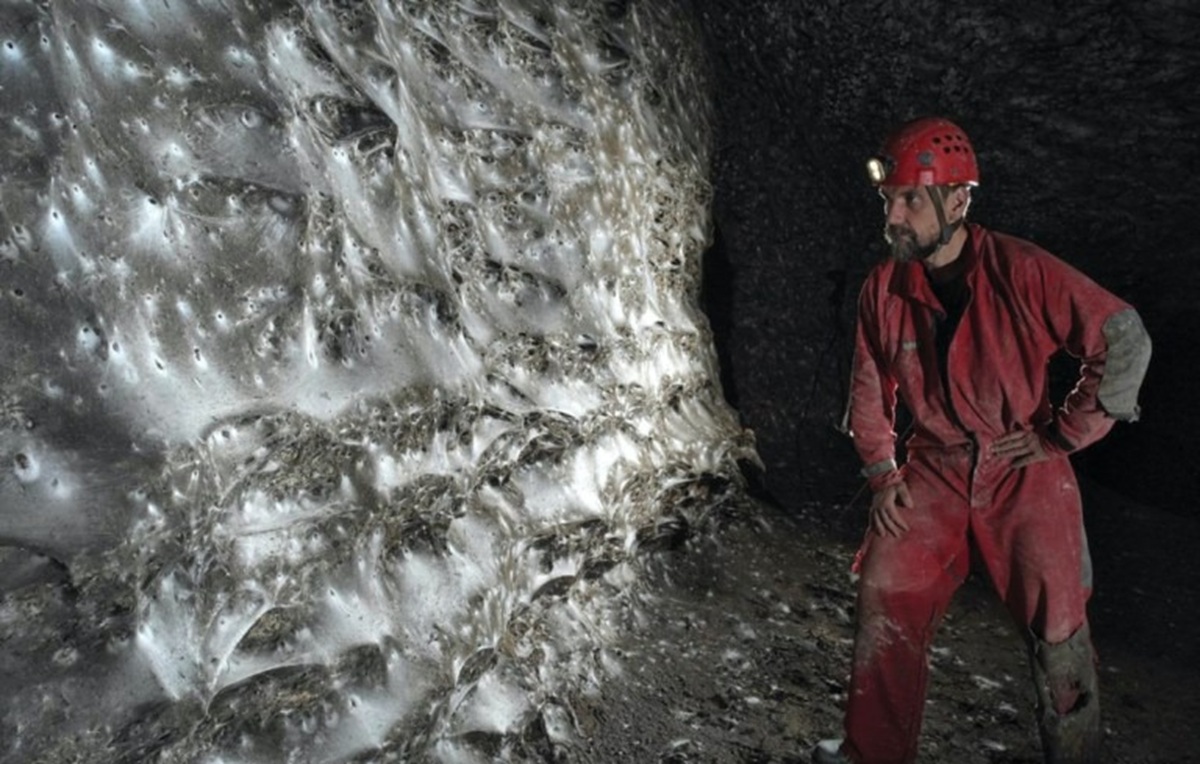
Researchers Identify in the Sulfur Cave a Web of 106 m² That Houses 111 Thousand Spiders, Revealing a Unique Phenomenon of Cooperation Between Normally Solitary Species in a Dark and Sulfur-Rich Environment
Researchers documented what they consider the largest spider web ever recorded, located inside the Sulfur Cave, on the border between Albania and Greece. The structure impresses with its size, the number of arachnids, and the unusual behavior of the species involved.
The web occupies 106 square meters — about 1,140 square feet — in a narrow and dark passage near the entrance of the cave. There, more than 111,000 spiders live in a large web formed by thousands of individual funnel-shaped webs.
The numbers show that the colony includes 69,000 individuals of Tegenaria domestica and more than 42,000 of Prinerigone vagans.
-
After decades of failed attempts, Brazil is once again looking to space with an orbital rocket measuring 12 meters, weighing 12 tons, costing R$ 189 million, and scheduled for launch in 2026, in a new race to finally achieve autonomous access to orbit.

-
The Earth will plunge into a few minutes of darkness in broad daylight in August 2026, when a total solar eclipse transforms the sky into one of the most impressive astronomical phenomena in recent years.

-
How the terraforming of Mars can transform the planet: artificial aerosols can increase the temperature by up to 35°C in 15 years, creating conditions for liquid water.

-
Scientists drilled nearly 8,000 meters into the ocean floor above the fault that caused the 2011 tsunami in Japan and discovered that a layer of clay 130 million years old was responsible for making the wave much worse than any model had predicted.


Researchers from the Hungarian Sapientia University of Transylvania, in Romania, claim that this is the first documented case in which these two widely distributed species exhibit colonial behavior. Normally, they do not form colonies, and according to the study, it would be expected that funnel weavers (T. domestica) would prey on P. vagans.
An Unprecedented Colony
The website Live Science reported that the discovery first occurred in 2022, when speleologists from the Czech Speleological Society explored the Vromoner canyon.
Following this expedition, scientists returned to the site in 2024 to collect samples for analysis by lead author István Urák, who later conducted his own investigation inside the Sulfur Cave.
DNA analyses confirmed the dominant presence of the two species.
The researchers emphasize that the cohabitation and cooperation between them within a single web, and at such high density, represent a unique phenomenon. They wrote that the study shows the “first documented case of colonial web formation in these species.”
The cave environment seems to influence this behavior. The study suggests that the lack of light impairs the spiders’ vision, which may disrupt typical predatory instincts and allow the two species to coexist without conflict.
Sulfur-Powered Ecosystem
The Sulfur Cave was formed from the action of sulfuric acid generated by the oxidation of hydrogen sulfide present in the groundwater. This same compound sustains a peculiar ecosystem that feeds the colony.
The spiders’ diet mainly depends on non-biting mosquitoes. These mosquitoes consume white microbial biofilms — viscous secretions produced by sulfur-oxidizing bacteria that thrive in the environment. This entire cycle exists thanks to a sulfur-rich stream that runs through the cave and is fed by natural springs.
The dark space is also filled with hydrogen sulfide, an essential element for the survival of microbes, mosquitoes, and consequently, the spiders. The analyses led to additional discoveries: the sulfur-rich diet generated biological changes in the spiders.
According to the study, the microbiomes of these arachnids show lower diversity compared to those of individuals of the same species living outside the cave. Molecular data also show that the cave-dwelling spiders are genetically different from their external relatives, indicating strong adaptation to the dark and sulfurous environment.
The researchers continue to collect information about the inhabitants of the Sulfur Cave in a follow-up study. The current research was published in the journal Subterranean Biology.





-

-

-

-

5 pessoas reagiram a isso.