





 Portuguese
  English
  Spanish
  5 min of reading
  0 comments


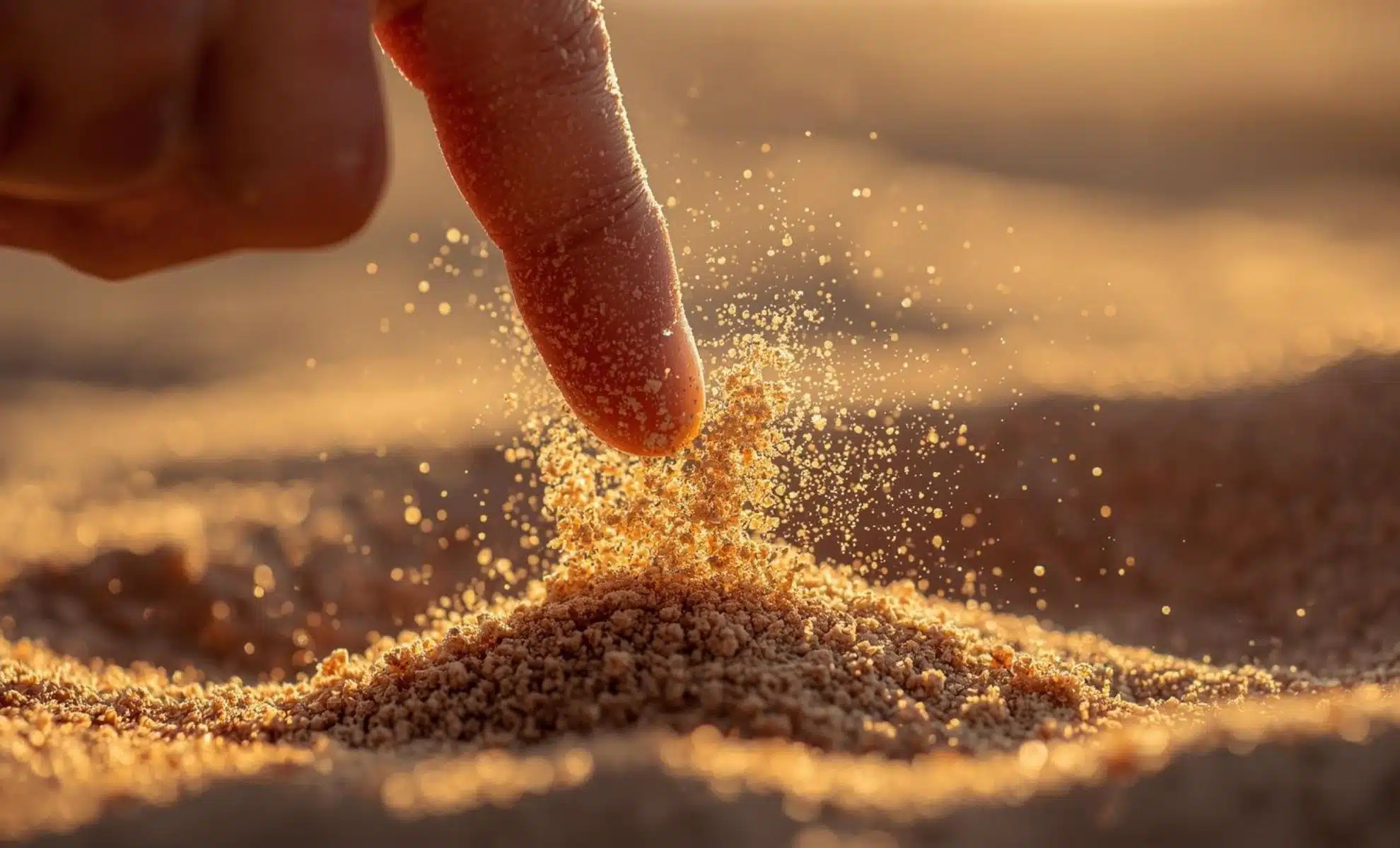
Research Presented At The IEEE International Conference On Development And Learning 2025 Shows That Volunteers Were Able To Feel Objects Buried Under Dry Sand Up To 6.9 Centimeters Away With 70.7% Accuracy, Performance Close To The Physical Limit Forecasted By Granular Models And Superior To The 40% Accuracy Obtained By Robotic Systems With Tactile Sensors And LSTM Algorithms
Twelve participants in London were able to feel objects buried under dry sand without touching them, achieving 70.7% accuracy and an average distance of 6.9 centimeters, according to data presented in September 2025 and published in IEEE Xplore.
The research was conducted by scientists from Queen Mary University of London and University College London. The experiment aimed to systematically measure the human ability to feel objects without direct contact, exploring the physical limits of force propagation in granular media.
In the study, participants slid their index finger over dry sand, following paths delineated by LED lights. In some attempts, a small cube was buried seven centimeters deep. In others, the object was absent.
-
Motorola launched the Signature with a gold seal from DxOMark, tying with the iPhone 17 Pro in camera performance, Snapdragon 8 Gen 5 that surpassed 3 million in benchmarks, and a zoom that impresses even at night.

-
Satellites reveal beneath the Sahara a giant river buried for thousands of kilometers: study shows that the largest hot desert on the planet was once traversed by a river system comparable to the largest on Earth.

-
Scientists have captured something never seen in space: newly born stars are creating gigantic rings of light a thousand times larger than the distance between the Earth and the Sun, and this changes everything we knew about stellar birth.

-
Geologists find traces of a continent that disappeared 155 million years ago after separating from Australia and reveal that it did not sink, but broke into fragments scattered across Southeast Asia.

The instruction was to stop the movement as soon as the presence of an object became noticeable, before any contact. No participant touched the cube in attempts considered successful.
Feeling Objects At A Distance In Granular Media Was Measured With Humans And Robots
The data documented in the proceedings of the IEEE conference indicate that volunteers correctly identified the object in 70.7% of the attempts. The average detection distance was 6.9 centimeters, with a median of 2.7 centimeters.
Physical models of force propagation in granular media predicted a maximum distance of approximately seven centimeters. Human performance remained within the range predicted by theoretical calculations.
The researchers emphasized that the experience does not announce a new sense, but rather highlights that one of the oldest senses can operate in a range that has never before been systematically tested.
Robotic Experiment Reaches 7.1 Centimeters But With 40% Accuracy
A robotic arm equipped with a tactile sensor and LSTM long-term memory algorithm was subjected to a parallel experiment. The system detected objects at an average distance of 7.1 centimeters.
The robotic median was six centimeters, surpassing the human median of 2.7 centimeters. Despite the greater distance, the system presented frequent false positives, reducing overall accuracy to 40%.
According to the researchers, the robot was able to detect objects slightly further than human participants, but the drop in accuracy compromised performance compared to the 70.7% achieved by volunteers.
The disparity between range and accuracy was recorded in the materials presented at the IEEE International Conference on Development and Learning 2025.
Mechanoreceptors Explain How Humans Can Feel Objects Without Contact
The mechanism described in the study does not involve extrasensory perception or magnetic sensitivity. The explanation lies in the mechanoreceptors present in the tips of human fingers.
As the finger moves over the sand, it displaces grains in front of it. The presence of a buried object alters the pattern of this displacement. The modified resistance and vibratory profile travel back through the granular column to the finger.
The brain interprets this altered profile as the proximity of an object. Thus, the ability to feel objects emerges from reading mechanical variations in the granular medium.
The investigation was inspired by shorebirds like sandpipers and sandpipers, which locate buried prey by detecting mechanical disturbances in the sediment.
Controlled Conditions Limit Generalization Of Results
The researchers noted that the experimental conditions were rigorously controlled. The sand used was dry and uniform. The finger movements were slow and unidirectional.
The shape of the object remained consistent across all attempts. It is still unknown whether the effect persists in wet sand, with mixed debris, or under irregular movement.
It was also not tested whether non-cubic objects produce detectable patterns with the same effectiveness. These variables remain unmapped systematically.
Debate On Terminology After Public Coverage
After the September 2025 conference, news reports classified the finding as a hidden seventh sense or remote touch. The authors of the technical paper did not use this terminology.
The summary describes the discovery as an undocumented tactile ability in humans, quantifying range and accuracy, without claiming a new sensory modality.
Elisabetta Versace stated that it is the first time remote touch is studied in humans and that this modifies the conception of the receptive field in living beings, including humans.
The distinction has implications for neuroscience and engineering. If it were a new sense, it would be necessary to locate a specific anatomical basis and dedicated neural pathways.
If it is an unmeasured capacity of the existing tactile system, the question becomes why this ability was not quantified before and how the brain extracts signals from noise so efficiently.
Suggested Applications Include Archaeology And Planetary Exploration
The team mentioned potential applications in archaeology, where buried artifacts could be located without damage from direct excavation.
Possibilities were also cited in planetary and underwater exploration, allowing for the detection of subterranean features on Mars or at the bottom of the ocean without direct contact.
Zhengqi Chen stated that the discovery could guide the development of robots capable of performing delicate operations, such as locating artifacts without damaging them or exploring granular terrains.
Currently, there are no operational tools based on this principle. The tested robotic system showed a 40% success rate, considered insufficient outside the lab.
Engineers have yet to determine whether the discrepancy between humans and robots reflects hardware limitations, machine learning architecture, or fundamental differences between biological and artificial perception.
The study did not assess whether training increases the ability to feel objects, whether there is significant individual variation, or whether sensitivity decreases with age.
These questions remain open. According to the records from the November 2025 conference, they are priorities for future investigations.
By demonstrating that humans can feel objects under sand at distances close to the predicted physical limits, the experiment establishes an empirical milestone. The ability, previously unmeasured, now integrates into the formal investigative field of tactile neuroscience and robotic engineering.








Seja o primeiro a reagir!