





 Portuguese
  English
  Spanish
  6 min of reading
  1 comment


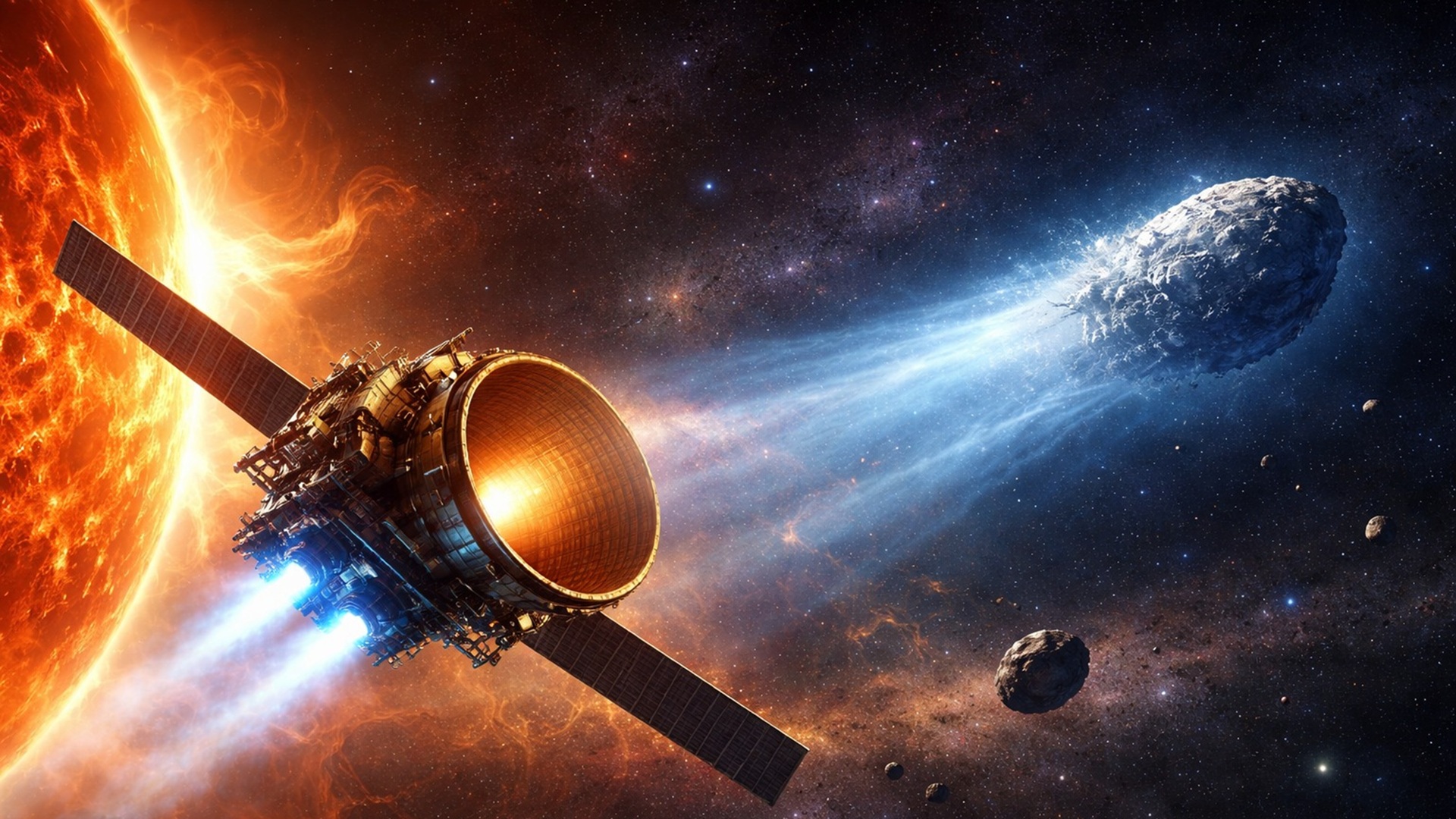


Mission Plan to Intercept the Interstellar Object 3I/ATLAS Proposes Use of Gravitational Assist from Jupiter and an Oberth Maneuver at Just 0.015 Astronomical Units from the Sun, Allowing a Spacecraft to Travel More Than 700 Astronomical Units and Possibly Reach the Comet Around 2085
A space mission proposal suggests that a spacecraft could travel more than 700 astronomical units to intercept the interstellar comet 3I/ATLAS, using gravitational maneuvers and the Oberth effect to achieve speeds capable of pursuing the object.
The proposal aims to directly explore 3I/ATLAS, an interstellar object currently moving away from the Sun at over 61 kilometers per second.
The plan involves a complex trajectory that utilizes gravitational assist and a close approach to the Sun to dramatically increase the speed of the spacecraft.
-
End of the stove: new technology from Xiaomi promises to retire the old stove with a smart pot that prepares up to 16 servings in 24 minutes and has 10 automatic levels controlled by an app.

-
If Ormuz closes, the world freezes: the 1,200 km Saudi Petroline transports oil from the Gulf to the Red Sea, operates near 7 million barrels/day, and becomes a geopolitical weapon in the crisis with the US.

-
Scientists restore seagrass meadows in the open sea.

-
Scientists find about 1 million giant live eggs hatching in an active underwater volcano, discover a natural furnace on the ocean floor, and reveal one of the most unlikely nurseries ever seen in the ocean.

If executed, the mission would represent one of the longest and most challenging journeys ever planned for space exploration.
The interception of 3I/ATLAS could occur only after decades of travel, depending on the final speed achieved by the spacecraft.
Mission Plan to Intercept 3I/ATLAS Predicts Extreme Trajectory and Decades-Long Journey
The mission concept to reach 3I/ATLAS involves a strategy deemed risky but technically feasible. Space researchers propose using a sequence of gravitational maneuvers and a solar assist to accelerate the spacecraft.
The trajectory would begin with the launch of the spacecraft from Earth, followed by a journey to Jupiter. At that point, the planet’s gravity would be used to adjust the speed and prepare the spacecraft for the necessary solar approach.
This procedure is crucial because a spacecraft launched directly from Earth would be moving too fast to approach the Sun properly.
By using Jupiter to decrease its speed, the spacecraft can enter solar orbit on the correct trajectory.
After this stage, the spacecraft would perform a very close approach to the Sun to execute the maneuver that would allow it to gain enough speed to chase 3I/ATLAS.
The Oberth Effect as a Central Mechanism to Achieve Necessary Speeds for Encountering 3I/ATLAS
The central element of the proposed mission is the use of the so-called Oberth effect, a concept developed by aerospace engineer Hermann Oberth. The principle consists of leveraging the gravitational field of a massive object to increase the efficiency of a rocket burn.
When a spacecraft approaches a massive body like the Sun, it naturally accelerates due to gravity. If a rocket burn occurs at the point of closest approach, called periapsis, the resulting speed increase is significantly greater.
According to T. Marshall Eubanks, a former NASA scientist and one of the study’s authors, almost all launches utilize the Oberth effect to some extent. He cited as examples missions that perform translunar injection burns at perigee to take advantage of this principle.
Despite this, the researcher claims he has not found records of an application as extreme as proposed. The plan calls for a large rocket burn exactly at the point of closest approach during a solar flyby.
This maneuver would be responsible for providing the necessary speed for the spacecraft to reach 3I/ATLAS, something that would be virtually impossible without such a massive energy boost.
Approach at Just 0.015 AU from the Sun Exposes Spacecraft to Temperatures Above 1,370 °C
For the maneuver to work, the spacecraft would need to approach the Sun at a distance of just 0.015 astronomical units. This proximity is far greater than any other spacecraft has experienced during previous missions.
In this region, the spacecraft would be inside the solar corona, where temperatures could exceed 1,370 °C, equivalent to about 2,500 °F. These conditions are similar to those faced by NASA’s Parker Solar Probe.
To withstand this extreme environment, the vehicle would need to have a highly specialized thermal shield. The structure would likely use advanced materials such as carbon composites and aerogel.
Technologies of this kind are already employed in modern solar probes, but the mission would require even more robust performance. The survival of the spacecraft during the solar maneuver would be one of the main technical challenges of the proposal.
Gravitational Assist from Jupiter Will Be Essential to Position Spacecraft Towards the Sun
Another critical element of the plan to reach 3I/ATLAS is the use of gravitational assist from Jupiter. This type of maneuver uses the gravity of a planet to alter the speed and trajectory of a spacecraft.
Although often used to accelerate spacecraft, in this case, the main function would be to reduce the spacecraft’s initial speed. This adjustment would allow the vehicle to approach the Sun on the correct trajectory.
Without this step, a spacecraft launched from Earth would have excessive speed to perform the planned solar approach. Jupiter’s gravity would help reposition the spacecraft and prepare it for the crucial moment of the mission.
After completing this sequence of maneuvers, the spacecraft would perform the solar assist and begin the long chase of 3I/ATLAS in deep space.
Journey to the Interstellar Comet May Last Between 30 and 50 Years
After completing the Oberth solar maneuver, the spacecraft would pursue 3I/ATLAS on a journey that could last decades. The encounter with the interstellar object could occur only around the year 2085.
Calculations indicate that, with a speed variation of 8.2 kilometers per second, the spacecraft could reach the comet in approximately 50 years. If the Oberth maneuver produces even higher speeds, this time could be reduced to around 30 years.
The mission would represent a long technological and scientific marathon, requiring decades of planning. Even so, researchers consider the project an extraordinary opportunity to study an object originated outside the solar system.
The study describing the technical details of the proposal has been made available on the arXiv platform, where the calculations and architecture of the mission are presented.
Risks and Scientific Debate on the Best Strategy to Reach 3I/ATLAS
Despite the scientific potential of the mission, some researchers point out risks in the proposed strategy to reach 3I/ATLAS. One of the main problems is that the spacecraft would be chasing the object long after its passage through the inner solar system.
Adam Hibberd, a researcher in the field, stated that for future interstellar objects, an Oberth solar maneuver should be avoided whenever possible. He claims that there are mission architectures that could intercept these objects more quickly.
These alternatives would involve probes already positioned in space, capable of reacting quickly when a new interstellar object is detected. In this scenario, the encounter could occur near perihelion, reducing travel time.
Even with these limitations, there is a strong expectation that missions to explore interstellar objects will become increasingly important.
For Eubanks, when the technological capability becomes available, there will be great interest in directly exploring these bodies.
The advancement in detecting objects coming from outside the solar system could also influence the future of these missions. If many new objects are discovered, similar missions may become more common.
In this context, the proposal to intercept 3I/ATLAS could represent a starting point for the development of new techniques for interstellar exploration. The experience gained could guide future strategies for reaching visitors from other regions of the galaxy.







Por que não foi criado um plano para exploração enquanto ele estava próximo, e com meses de antecedência antes do ponto mais próximo e agora que tá se distanciando querem fazer tal feito