





 Portuguese
  English
  Spanish
  4 min of reading
  0 comments


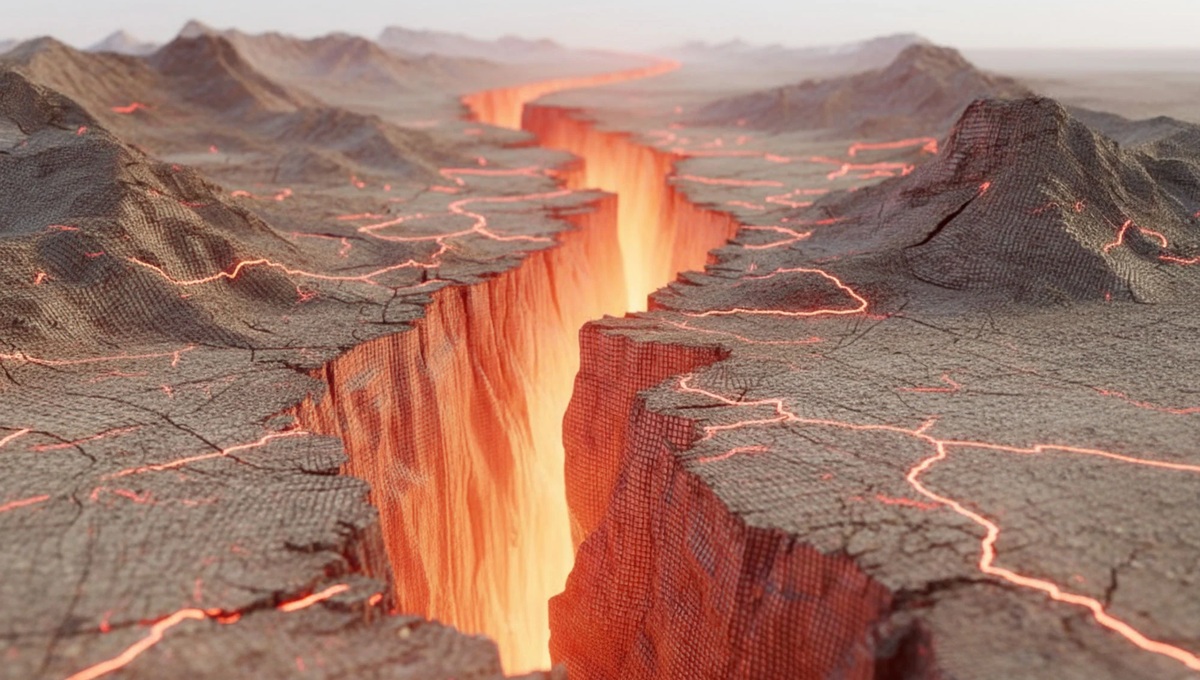
Three-Dimensional Model Based on Over 20 Magnetotelluric Stations Identifies High and Low Resistivity Zones Beneath the Sea of Marmara, Area Without Major Earthquake for More Than 250 Years, and Points to Critical Sections of the Northern Anatolian Fault with Tension Accumulation Near Istanbul.
A new three-dimensional model of the subsurface beneath the Sea of Marmara shows how variations in rock resistance can trigger a major earthquake along the Northern Anatolian Fault, a region that has not ruptured for over 250 years and is considered the likely epicenter of the next major earthquake.
Turkey is situated in one of the most seismically active areas in the world, where the Eurasian, African, Arabian, and Anatolian tectonic plates interact. This complex geological configuration has resulted in numerous devastating events throughout history.
One of the most significant episodes was the 1939 Erzincan earthquake, which resulted in over 30,000 deaths. Since then, researchers have noted that destructive major earthquakes appear to progress westward along the Northern Anatolian Fault.
-
Motorola launched the Signature with a gold seal from DxOMark, tying with the iPhone 17 Pro in camera performance, Snapdragon 8 Gen 5 that surpassed 3 million in benchmarks, and a zoom that impresses even at night.

-
Satellites reveal beneath the Sahara a giant river buried for thousands of kilometers: study shows that the largest hot desert on the planet was once traversed by a river system comparable to the largest on Earth.

-
Scientists have captured something never seen in space: newly born stars are creating gigantic rings of light a thousand times larger than the distance between the Earth and the Sun, and this changes everything we knew about stellar birth.

-
Geologists find traces of a continent that disappeared 155 million years ago after separating from Australia and reveal that it did not sink, but broke into fragments scattered across Southeast Asia.
Many scientists point out that the section beneath the Sea of Marmara is the most likely location for the next major earthquake. This section has not recorded a major magnitude event for over 250 years, which raises concerns about the continuous accumulation of tension.
Despite decades of study, the detailed structure of the fault in this area remained poorly understood. This limitation made it difficult to accurately identify where a major earthquake could initiate and which measures would be most effective in reducing impacts.
Major Earthquake and the Construction of the First Electromagnetic 3D Model
To fill this gap, a team led by Dr. Yasuo Ogawa from the Tokyo Institute of Technology, in partnership with Dr. Tülay Kaya-Eken from Boğaziçi University, conducted a detailed investigation of the region beneath the Sea of Marmara.
The study was published in the journal Geology and presents the first complete three-dimensional model of the analyzed subsurface area. The work offers new insights into the physical processes that control how and where a major earthquake may form.
The three-dimensional model of electrical resistivity beneath the Northern Anatolian Fault was developed from magnetotelluric data collected by over 20 previously installed stations in the region.
The magnetotelluric stations register subtle changes in the Earth’s electric and magnetic fields caused by subsurface structures. These data were processed through 3D inversion to reconstruct the electrical resistivity to depths of tens of kilometers below the seabed.
Mapping of Fragile and Blocked Zones Associated with Major Earthquake
The analysis revealed a complex pattern of zones with high and low electrical resistivity. Resistivity tends to decrease in the presence of fluids, such as water, making these areas mechanically weaker.
In contrast, high resistivity zones indicate stiffer and more resistant structures. According to the researchers, these structural differences are key to understanding how a major earthquake may occur in the region.
Ogawa noted that the observed resistive anomalies indicate regions of tension accumulation. These results help clarify the ongoing fault mechanics processes acting beneath the Sea of Marmara.
Based on the model, the team suggests that future seismic events may initiate at the boundaries between weaker and stronger crustal sections or along the edges of high resistivity zones.
Implications for Forecasting and Mitigation of Major Earthquake
The results bring researchers closer to answering where and how a major earthquake may occur along the Northern Anatolian Fault. Identifying blocked and highly deformed zones provides more precise parameters for risk analysis.
According to Ogawa, the data can be used to estimate the location and potential magnitude of future large earthquakes. This information has direct implications for disaster prevention and mitigation strategies.
The three-dimensional model helps enhance the ability to predict more vulnerable areas. By identifying critical regions, authorities and scientists can target planning efforts based on detailed geophysical evidence.
Historical Context and Scientific Advancement Regarding Major Earthquake
The historical progression of major earthquakes along the fault reinforces the relevance of the new model. The absence of significant rupture beneath the Sea of Marmara for over 250 years increases apprehension about the potential for a major earthquake.
The study titled “3D Electromagnetic Imaging of Highly Deformed, Fluid-rich Weak Zones and Blocked Section of the Northern Anatolian Fault Beneath the Sea of Marmara” was published on December 8, 2025.
The research was conducted by Tülay Kaya-Eken, Yasuo Ogawa, Yoshiya Usui, Takafumi Kasaya, M. Kemal Tunçer, Yoshimori Honkura, Naoto Oshiman, Masaki Matsushima, and Weerachai Siripunvaraporn.
The work was funded by the Japan International Cooperation Agency and the Japan Science and Technology Agency. According to the authors, ongoing studies may help reduce human losses and damage when the next major earthquake strikes the fault.
By integrating magnetotelluric measurements and three-dimensional modeling, the team has established a new benchmark for structural detail. This scientific advancement enhances understanding of where tensions are concentrated and how they may evolve into significant seismic rupture.
Thus, the model provides a more robust foundation for future analyses. Although it does not eliminate uncertainties, the study represents a decisive step in understanding the mechanisms that can lead to a major earthquake beneath the Sea of Marmara.








-

Uma pessoa reagiu a isso.