





 Portuguese
  English
  Spanish
  5 min of reading
  2 comments


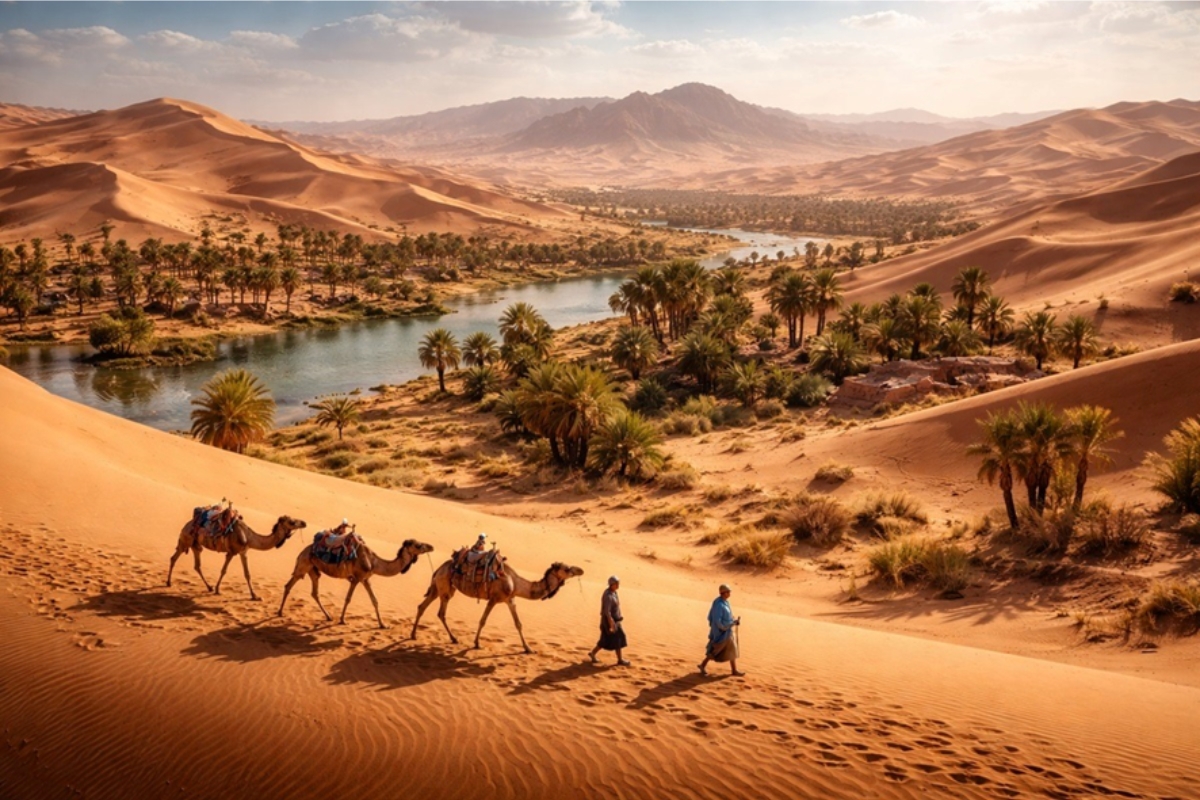


In The Sahara In Northern Africa, Researchers Analyzed Climatic Records Of Up To 10 Thousand Years To Understand Rainfall Up To 20 Times Greater Than Current, Explain Desertification And Reveal A Green Past That Changed Human Occupation And The Landscape Of The Planet.
What is now known as the largest hot desert in the world was once a completely different territory. Where extreme heat, dust, and water scarcity currently prevail, there were savannas, prairies, permanent lakes, and human communities that lived off hunting, gathering, and later, animal husbandry.
This impressive transformation occurred over thousands of years and draws attention for showing how natural changes in the climate were able to profoundly alter an entire region of the planet. Recent studies help to understand when this happened, how it occurred, and what factors were involved.
The green landscape of the past contrasts sharply with the current reality of the Sahara, which today records between 35 and 100 millimeters of rainfall per year. At certain times, this volume was dozens of times greater, sustaining a biodiversity comparable to that of the current fertile regions of Africa.
-
Tourists were poisoned on Everest in a million-dollar fraud scheme involving helicopters that diverted over $19 million and shocked international authorities.

-
Hidden beneath the dense forest of the Sierra Nevada, Betoma emerges in a neighbor of Brazil as the greatest archaeological discovery of the century, revealing a colossal ancestral city covering over 18 km², with 8,334 stone structures and the potential to rewrite the history of South American civilizations.

-
Goodbye iron: new technology from Xiaomi promises to revolutionize the way we iron clothes with 500 kPa steam, continuous flow of 120 g/min, heating in 65 seconds, and six smart modes for different fabrics.

-
Rio Pardo, the most mysterious city in Rio Grande do Sul: untouched Pampas castle, the missing treasure of the Devil Boy, bride’s saint, invisible tunnels, and a 200-year curse today.
Period Of The Green Sahara Transformed The Desert Into Savannas And Fertile Areas
Between about 5 thousand and 10 thousand years ago, the Sahara experienced a period known as the Green Sahara or Humid Sahara. During this time, the region received intense rains brought by seasonal monsoon winds, which kept the soil fertile for much of the year.
Permanent lakes spread across the territory and supported a wide variety of plants and animals. Hunters and gatherers inhabited the region, exploring abundant natural resources, something difficult to imagine when observing the current landscape.
Estimates indicate that rainfall was up to 20 times more intense than recorded today, creating ideal conditions for human and animal life in areas that are now completely inhospitable.

Scientific Studies Analyzed Sediments And Fossils To Reconstruct The Ancient Climate
Researchers from Stockholm University, in collaboration with scientists from Columbia and Arizona universities, analyzed marine sediments in northern Africa to identify ancient precipitation patterns.
According to the data, annual precipitation in the Western Sahara may have been up to 2 thousand millimeters greater than it is today. The vegetation was similar to that found today in southern Senegal, an area integrated into the Sahel.
Other studies based on fossils, pollen grains, and archaeological records reinforce this climatic reconstruction, showing that the Sahara housed complex ecosystems interconnected by water pathways.
The Sahel Region Helps Understand What The Vegetation Of The Ancient Sahara Was Like
The Sahel is a transitional strip between the Sahara Desert and the African savanna, with an average width of 500 to 700 kilometers and an approximate length of 5,400 kilometers. This region spans several countries, from the Atlantic Ocean to the Red Sea.
Experts believe that animals currently living in the Sahel, such as wildebeests and gazelles, also inhabited areas much further north during the wet period. In some regions, the landscape may have been similar to that of the Serengeti in Tanzania and Kenya.
Fossil evidence shows the presence of crocodiles, elephants, and hippos in areas that are currently desert. Rock paintings depicting giraffes and fishing objects indicate a way of life entirely different from the present.
Changes In The Earth’s Orbit And Albedo Explain The Beginning Of Desertification
The end of the Green Sahara is linked to natural changes in the relationship between the Earth and the Sun. About 9 thousand years ago, the planet received more solar energy during the summer, which strengthened the monsoons and increased rainfall.
Over time, this solar radiation decreased. Vegetation began to recede, the soil became more exposed, and albedo increased, reflecting more solar light. This process further reduced rainfall and accelerated desertification.
According to experts, this cycle occurs at approximate intervals of 20 thousand years, which explains why the Sahara has gone through green phases in other periods, such as about 125 thousand years ago.


Scientific Debate Discusses Whether The Change Was Rapid Or Gradual
There are divergences regarding the speed with which the Sahara transformed into desert. One theory suggests that the change occurred abruptly, in just a few centuries, constituting one of the most dramatic climatic transitions on Earth.
Another study, based on sediments from Lake Yoa in northern Chad, suggests that desertification was gradual and may have intensified about 2,700 years ago, continuing to this day.
This data indicates that human populations abandoned areas in the process of aridity long before complete desertification, adapting their ways of life as the climate changed.
Human Influence On Pastoralism Also Entered The Climatic Debate
Recent research raises the hypothesis that humans may have contributed to the advancement of aridity through pastoralism. The removal of vegetation for livestock raising would have increased albedo and reduced monsoon rains.
However, there is no consensus. Some experts argue that light and moderate grazing may even favor the regeneration of vegetation, just as occurred naturally with large wild animals that inhabited the region.
According to experts, the main drivers of desertification were already in action due to natural causes, and human influence may have been just an additional factor.
The case of the Sahara draws attention for showing how natural cycles and human actions can profoundly shape the planet. The possibility of the region returning to green in thousands of years exists, but the influence of current climate changes adds an element of uncertainty that makes this debate even more relevant.
Do you think the Sahara can really return to being green in the future, or has human action altered this cycle forever? Share your opinion in the comments.
The scientific, historical, and archaeological information presented in this article is based on productions and analyses published by the History Channel, internationally recognized for its documentaries and educational content on history, climate, ancient civilizations, and environmental transformations of the planet.









Este cambio de la vegetación pudiera haber dado origen al relato bíblico de la perdida del paraíso, a lo largo de generaciones se hubiera transformado un lejano recuerdo en el relato de todos conocido.
Como ponen. períodos de 9 años y 125
anos y 2,7 años querrán decir miles de años.
ese error hace incomprensible el articulo