





 Portuguese
  English
  Spanish
  4 min of reading
  0 comments


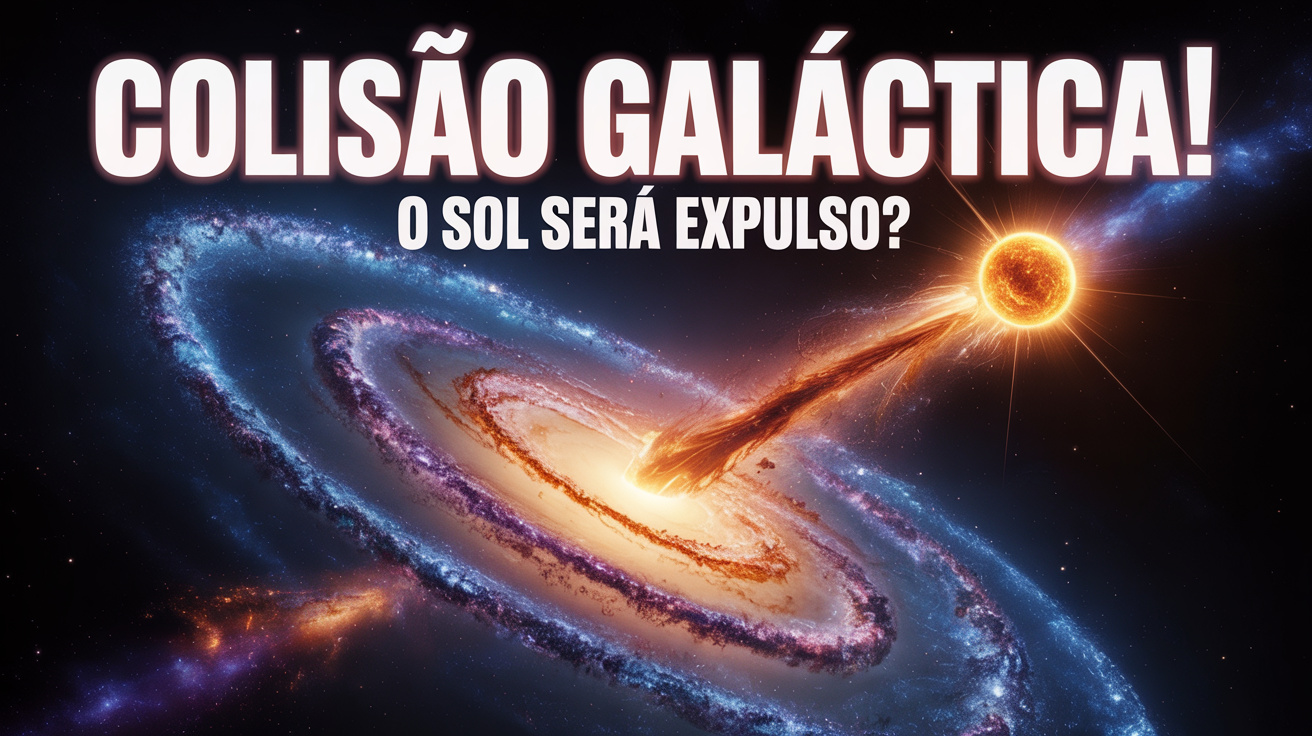
Simulations Show That The Milky Way And Andromeda Will Collide In About 4.5 Billion Years, And The Sun May Drastically Change Position In The New Galaxy.
The collision between the Milky Way and the Andromeda Galaxy is not science fiction. Computational models developed by teams associated with NASA and the European Space Agency indicate that the two largest galaxies in the Local Group are on a collision course and should begin to interact gravitationally more intensely in about 4.5 billion years.
The impact will not be an instant explosion as seen in movies. It is a slow gravitational process that could take billions of years until complete merger. Still, the consequences for the Solar System could be profound, including the possibility of the Sun being displaced to a completely different region of the resulting galaxy.
Milky Way And Andromeda Are Approaching At Over 400 Thousand Km/h
Spectroscopic observations show that Andromeda is approaching the Milky Way at about 110 kilometers per second, equivalent to over 400 thousand km/h.
-
Motorola launched the Signature with a gold seal from DxOMark, tying with the iPhone 17 Pro in camera performance, Snapdragon 8 Gen 5 that surpassed 3 million in benchmarks, and a zoom that impresses even at night.

-
Satellites reveal beneath the Sahara a giant river buried for thousands of kilometers: study shows that the largest hot desert on the planet was once traversed by a river system comparable to the largest on Earth.

-
Scientists have captured something never seen in space: newly born stars are creating gigantic rings of light a thousand times larger than the distance between the Earth and the Sun, and this changes everything we knew about stellar birth.

-
Geologists find traces of a continent that disappeared 155 million years ago after separating from Australia and reveal that it did not sink, but broke into fragments scattered across Southeast Asia.
The current distance between the two galaxies is approximately 2.5 million light-years. Although it seems immense, in cosmological terms, it is relatively small.
Simulations indicate that the first major gravitational encounter could occur in about 4 to 5 billion years, when the spiral structures will begin to deform due to intense gravitational interaction.
What Happens When Two Galaxies Collide?

Unlike what the term “collision” suggests, individual stars rarely collide directly. This happens because the distance between stars is immense.
What really happens is a massive gravitational rearrangement:
- The galaxies pass through each other.
- Spiral arms are distorted.
- Great waves of star formation may be triggered.
- Central black holes eventually merge.
The final merger will result in a new elliptical galaxy, sometimes informally called “Milkomeda”.
The Sun May Be Launched To Another Region Of The New Galaxy
One of the most intriguing points of the simulations is the fate of the Solar System. Models indicate that there is a significant probability of the Sun migrating to a more external orbit in the resulting galaxy. In some extreme scenarios, the Solar System could be displaced to much more distant peripheral regions from the galactic center.
The chance of the Sun being completely ejected into intergalactic space is considered low, but not impossible in more extreme simulations.
This orbital redistribution occurs because, during the merger, the gravitational field of the two galaxies experiences significant disturbance.
Will Earth Still Exist When This Happens?
Interestingly, the galactic collision will occur approximately at the same time the Sun is entering the red giant phase.
Models of stellar evolution indicate that in about 5 billion years, the hydrogen in the solar core will be depleted. The Sun will expand drastically, possibly engulfing Mercury, Venus, and possibly Earth.
This means that the planet’s fate may be more closely tied to solar evolution than to galactic collision.
Formation Of New Stars During The Merger
When galaxies interact, large clouds of gas collide and compress interstellar material. This process can trigger intense star formation.
Observations of other galaxies in the process of merging show bursts of star birth known as “starbursts.”
Therefore, while some regions may become chaotic, others may see a significant increase in the creation of new stars.
The Role Of Supermassive Black Holes

At the center of the Milky Way, there is a supermassive black hole known as Sagittarius A*. Andromeda also has its own central black hole.
Over time, these two gravitational giants should come closer and eventually merge, forming an even larger black hole.
This event would release a huge amount of gravitational energy in the form of gravitational waves but would not pose a direct threat to the Solar System, given the immense distance involved.
How Do Scientists Simulate Events That Will Take Billions Of Years?
The simulations use supercomputers to model gravitational interactions between billions of particles representing stars, gas, and dark matter.
These models incorporate:
- Current observational data.
- Radial velocity of Andromeda.
- Estimated mass of the galaxies.
- Distribution of dark matter.
From these variables, future scenarios are projected with different probabilities.
Does The Collision Pose An Immediate Risk?
No. The event will occur on a timescale of billions of years. Even when the galaxies begin to interact, the probability of a direct collision between the Sun and another star is extremely low.
The impact is primarily gravitational and structural on a galactic scale.
The possible merger between the Milky Way and Andromeda reinforces a fundamental idea of modern cosmology: the Universe is in constant transformation.
Galaxies are born, collide, merge, and evolve over billions of years. What we see today as stable structures is merely a temporary moment on the cosmic scale.
The Cosmic Future Of Humanity
If humanity still exists within billions of years, it will face challenges long before the galactic collision. The evolution of the Sun will likely be the determining factor for the habitability of Earth.
Still, the simulation of the galactic merger offers a fascinating perspective on the large-scale destiny of the Solar System.
In about 4.5 billion years, the night sky may look radically different, with Andromeda occupying a large part of the sky before the complete merger.
The event is not just a future astronomical spectacle but also a reminder that even entire galaxies are subject to the laws of gravity and cosmic transformation. And on a universal scale, 4.5 billion years is merely the next chapter.








-

-

-

8 pessoas reagiram a isso.