





 Portuguese
  English
  Spanish
  3 min of reading
  0 comments


Scientists Reveal Greek Stellar Catalog from the Dawn of Astronomy
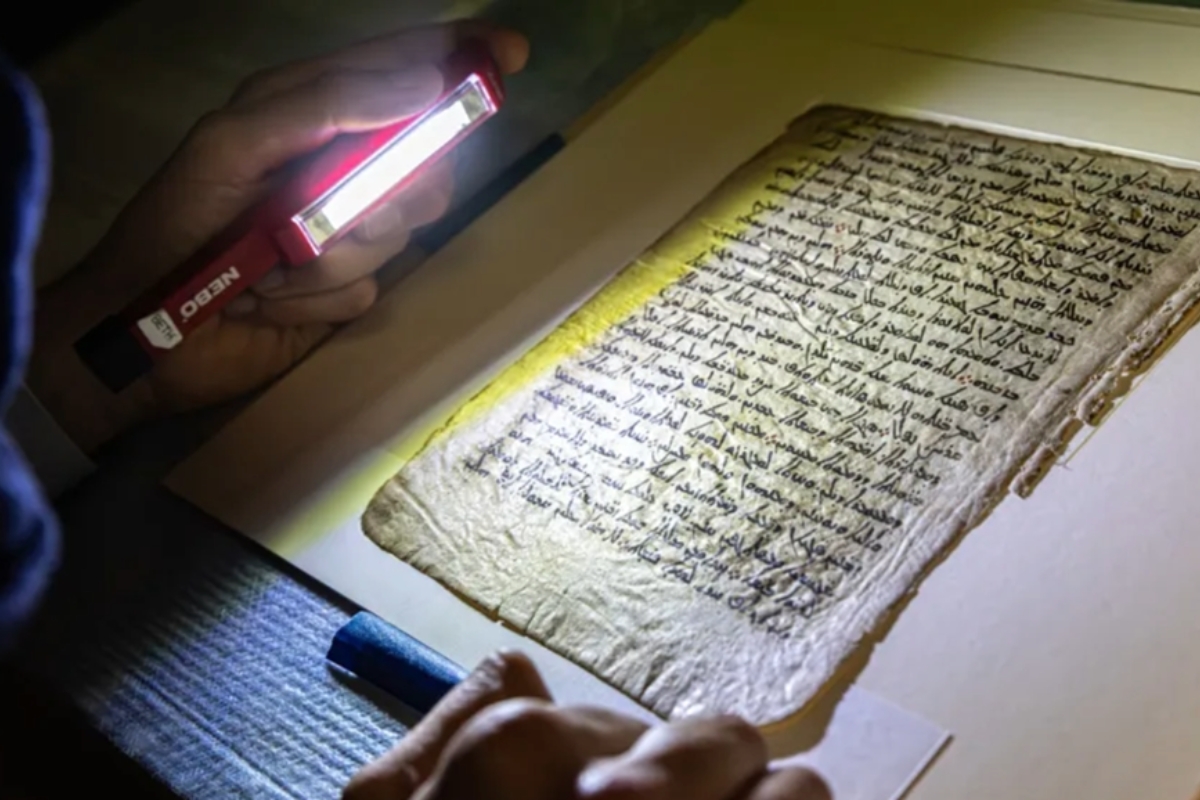
At the heart of the SLAC National Accelerator Laboratory in California, the past and future collided spectacularly. What appeared to be just an ancient religious manuscript on animal skin revealed itself, under the bombardment of high-powered X-rays, as one of the most valuable treasures of ancient astronomy: the lost stellar catalog of Hipparchus of Nicaea, dated to around 150 B.C.
How an Atomic Accelerator Revealed a Lost Star Map from 1,500 Years Ago
The document in question is the Codex Climaci Rescriptus, a palimpsest. In the Middle Ages, parchment was an expensive, scarce material accessible only to a few. Therefore, it was common for monks to scrape off ancient texts to reuse goat or sheep skin. In this case, a monastic treatise from the 9th or 10th century was written over a Greek poem and astronomical coordinates that had not been seen for nearly a millennium and a half.
The team, led by physicists Minhal Gardezi and Uwe Bergmann from the University of Wisconsin-Madison, used SLAC’s infrastructure to “look through” the surface layer. The result was the visualization of bright orange scribbles on computer screens, Greek letters forming an appendix to the poem “Phenomena” by Aratus of Soli.
-
A nutritionist reveals that the real villain of your breakfast is not butter or eggs, but rather the excess of white bread, cookies, and refined sugar that you consume every day without realizing the damage it causes.

-
The Android as we know it has its days numbered after a new rule from Google that could end free APKs and completely transform the system by 2027.

-
Archaeologists use satellite technology and find a mysterious structure of 500 m² buried up to 6 meters beneath an ancient city in Egypt.

-
Supercomputer calculates when humanity may disappear from Earth, predicts a scorching supercontinent, temperatures of up to 70 degrees, and a planet moving towards becoming uninhabitable.


The Science Behind X-rays
How is it possible to read something that has been scraped off? The answer lies in basic chemistry. Even though the ink has been removed from the surface, its mineral residues, such as calcium and iron, have penetrated deeply into the fibers of the parchment.
The researchers designed focused X-rays, which can be a million times more intense than those used in dental offices. This radiation excites the atoms of the metals present in the ancient ink, causing them to emit infrared light (fluorescence). By mapping this chemical response, scientists can accurately reconstruct the original text with millimeter precision, without damaging the fragile millennia-old leather.
Hipparchus: The Father of Modern Astronomy
The discovery is monumental because almost nothing remains of Hipparchus’ original works. He is credited as the inventor of trigonometry and the first to create a systematic catalog of stars.
The coordinates found in the manuscript show impressive accuracy for the time. More than that, they helped resolve a historical controversy: did Ptolemy, the famous Roman-Egyptian astronomer, plagiarize Hipparchus? The analysis of the data revealed that Ptolemy used Hipparchus’ work as a basis but expanded upon it. As Victor Gysembergh, a historian at CNRS, defines: “This is not plagiarism; it is science: the progressive construction of knowledge”.
What’s Still to Come?
The use of particle accelerators to read ancient documents is just beginning. In previous experiments, the same technology revealed that Archimedes was already flirting with concepts of calculus nearly two thousand years before Isaac Newton.
Now, the team plans to digitize the rest of the codex and apply artificial intelligence algorithms to clean the “noise” from the images and extract every possible stellar data. For the science of 2026, these orange scribbles are not just poetry; they are the DNA of Western scientific thought.









Seja o primeiro a reagir!