





 Portuguese
  English
  Spanish
  5 min of reading
  0 comments


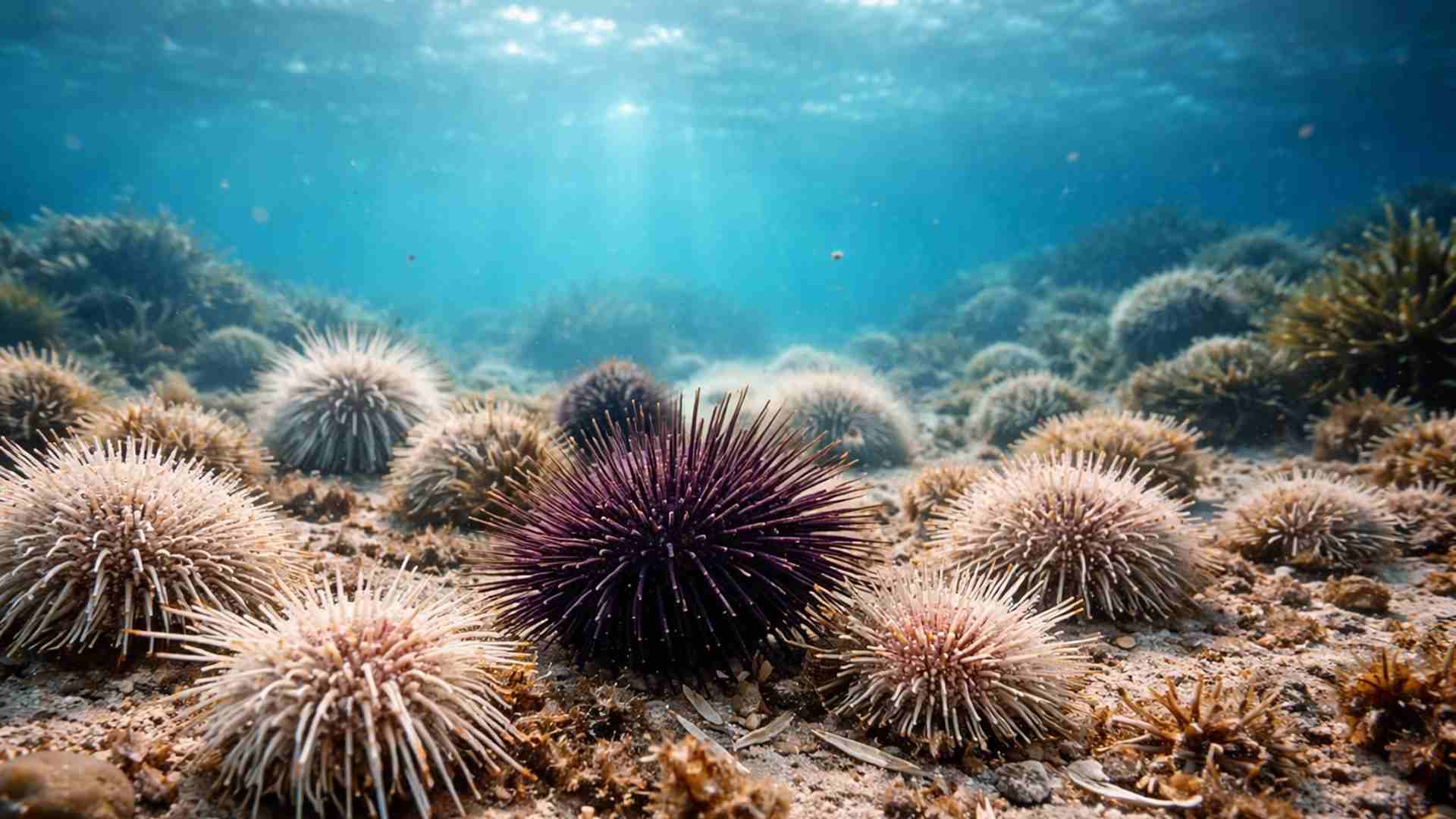
Study Published in 2025 Documents a Mass Mortality Event That Reduced Sea Urchin Populations of Diadema africanum in the Canary Islands by Up to 99.7% Between 2022 and 2023, with Impacts Also Recorded in Other Oceans and Signs of Local Reproductive Collapse
Sea urchins of the genus Diadema are dying on a global scale, and a study published on October 17, 2025, details a mass mortality event that affected the Canary Islands and Madeira between 2022 and 2023, drastically reducing key populations and raising uncertainties about ecological impacts and recovery.
Ecological Role of Sea Urchins in Marine Ecosystems
Sea urchins help to build and maintain marine habitats similarly to the role of large terrestrial herbivores on continental landscapes. By grazing on algae and seagrasses, they limit the excessive growth of these organisms and favor the persistence of slower-growing species, including corals and calcifying algae.
Various animals depend on urchins as a food source, including marine mammals, fish, crustaceans, and starfish. This role places them as central elements in the trophic dynamics of reefs and rocky substrates.
-
With a cost per shot close to zero, the DragonFire laser could change naval warfare in 2027 and provide British ships with nearly unlimited defense against drones.

-
A British startup creates tires that generate electricity in electric vehicles when passing over potholes, speed bumps, and cracks.

-
Scientists have created robots made with living cells that have their own nervous system, swim on their own, explore the environment, and self-organize without any genetic engineering, and now they want to do the same with human cells.

-
Students create a solar-powered ambulance that operates without a plug, without fuel, and still keeps medical equipment running in remote areas.

When their populations increase excessively, as occurs after predator reductions due to overfishing, urchins can degrade reefs and seabeds, creating areas known as “urchin barrens,” with loss of ecological complexity.
Mass Mortality Event in the Canary Islands and Madeira
A study published in the journal Frontiers in Marine Science reports a global wave of sea urchin deaths observed over the past four years, which has reached the Canary Islands. According to the authors, although the total ecological impacts are not yet known, the effects are likely to be significant.
The work documents the spread and impacts of a mass mortality event that severely affected populations of Diadema africanum in the Canary Islands and Madeira throughout 2022 and 2023.
Species of the genus Diadema have also been observed dying in other regions approximately during the same period, including the Caribbean, Mediterranean, Red Sea, Arabian Sea, and the western Indian Ocean.
Distribution and Population History of Diadema africanum
The genus Diadema includes eight species distributed across warm tropical and subtropical seas worldwide. The species D. africanum has historically thrived in rocky reefs off West Africa and the Azores, between depths of five and 20 meters.
In the Canary Islands, the population of this species has been increasing since the mid-1960s. Researchers attribute this increase to predator reduction caused by overfishing and to global warming.
In parts of the archipelago, high densities have contributed to the formation of “urchin barrens,” leading to attempts at biological control between 2005 and 2019, which ultimately failed.
Onset and Progression of the Outbreak Recorded in 2022
In February 2022, researchers observed widespread deaths of D. africanum near the islands of La Palma and Gomera, in the western Canary Islands, for the first time. In the following months, the outbreak advanced towards the eastern part of the archipelago.
The affected urchins became less active, exhibited unusual movements, ceased to respond to stimuli, and then lost tissue and spines before dying.
These symptoms had already been observed in previous events. In 2008 and again in 2018, diseases caused an estimated 93% mortality rate of D. africanum individuals in Tenerife and La Palma, as well as 90% of the populations in Madeira.
Differences Between the 2022 Event and Previous Outbreaks
The outbreak that began in 2022 exhibited distinct characteristics from previous episodes. After the 2008 event, many populations had recovered, in some cases rapidly. However, this pattern did not repeat itself.
Instead, a second wave of mass mortality hit the Canary Islands throughout 2023, further amplifying the population decline and complicating signs of natural recovery.
Monitoring Methodology and Data Collection
To assess the impact of the decline, researchers monitored populations of D. africanum at 76 sites across the seven main islands of the archipelago, between the summer of 2022 and the summer of 2025, comparing the results with historical data.
They also collected reports from professional divers about the relative abundance of the species at their usual sites in 2023 and during the period between 2018 and 2021.
Additionally, traps were used to collect dispersing larvae at four points along the eastern coast of Tenerife in September 2023, the annual peak of spawning. In January 2024, scientists quantified newly settled juveniles at these same locations.
Population Decline and Risk of Local Extinction
Analyses indicated that the current abundance of D. africanum in the Canary Islands has reached the lowest recorded level. Several populations are approaching local extinction.
Since 2021, there has been a 74% reduction in La Palma and a 99.7% reduction in Tenerife. The mortality event of 2022-2023 affected the entire population of the species in the archipelago.
Reproductive Interruption and Immediate Consequences
The authors concluded that, following the 2022-2023 event, effective reproduction of D. africanum has virtually ceased on the eastern coast of Tenerife. Only negligible numbers of larvae were captured, and no early juveniles were observed in the analyzed shallow rocky habitats.
This scenario indicates a severe compromise of the species’ natural replenishment capacity, exacerbating the observed decline and hindering population recovery in the short term, a situation that concerns local scientists.
Possible Causes and Uncertainties About the Pathogenic Agent
Reports from other regions suggest that the event recorded in the Canary Islands is part of a broader marine pandemic, with relevant consequences for these essential reef herbivores.
There is still no confirmation on which pathogen is causing the deaths. In other regions of the world, similar events involving Diadema have been associated with scuticociliates of the genus Philaster, unicellular parasitic organisms.
In previous outbreaks in the Canary Islands, mortality was linked to amoebas such as Neoparamoeba branchiphila and occurred after episodes of strong southern swells and unusual wave activity, conditions also observed in 2022.
Without confirmed identification of the agent, it is not possible to determine whether the disease arrived from the Caribbean by currents or maritime transport, or if climate changes played a direct role in the process.
Future Perspectives and Global Reach of the Phenomenon
The researchers state that it is still unclear how this pandemic will evolve. So far, populations of Diadema in Southeast Asia and Australia appear to have not been affected.
Despite this, the possibility of the disease re-emerging and expanding to other regions cannot be ruled out, keeping the mortality of sea urchins as an open question for global marine science.








-

2 pessoas reagiram a isso.