





 Portuguese
  English
  Spanish
  5 min of reading
  0 comments


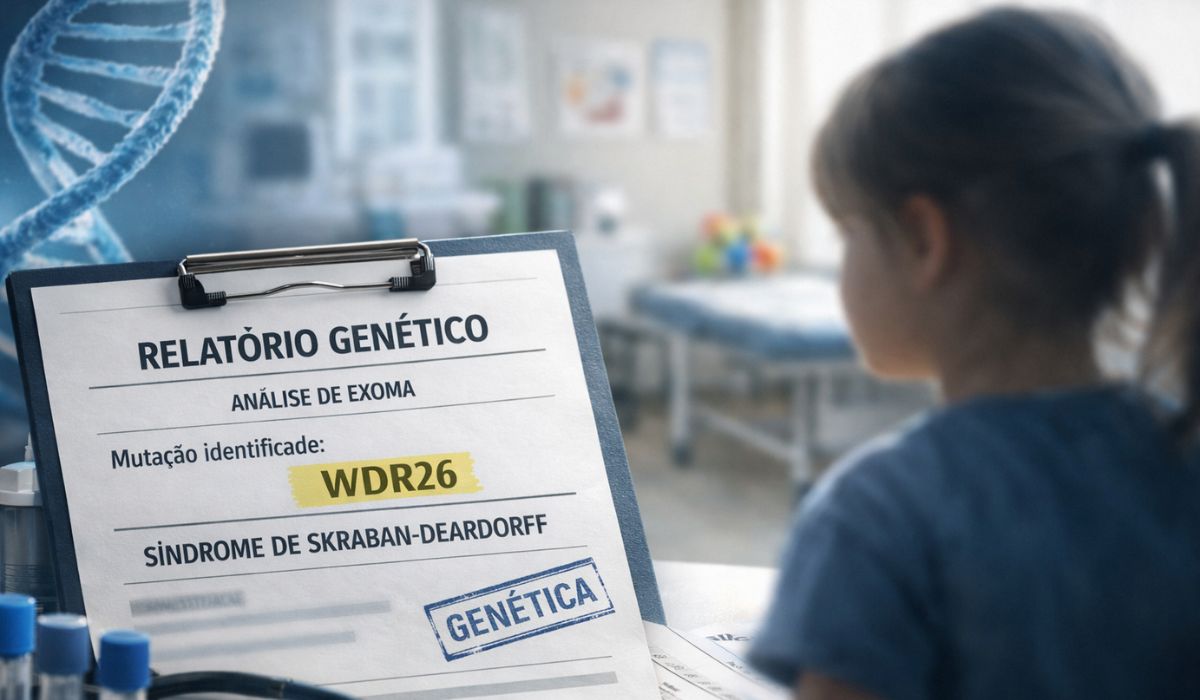
A Very Rare Genetic Diagnosis, Years of Research, and the Therapy Routine of a 6-Year-Old Show How Early Signs, Specialized Exams, and Access to Health Influence the Follow-Up of Little-Known Syndromes.
At 6 years old, Heloísa received the diagnosis of Skraban-Deardorff syndrome, a genetic condition linked to the gene WDR26 and associated with neurodevelopmental alterations.
The confirmation came after years of assessments, clinical hypotheses, and attempts to access a broader genetic test, completed in October 2025, according to her mother, Marianna Luvizotti Padilha, 30.
As a baby, Heloísa smiled and was affectionate, but some signs caught the family’s attention: little interest in picking up objects, irregular sleep, and a body described by her mother as “floppy” for her age.
-
Motorola launched the Signature with a gold seal from DxOMark, tying with the iPhone 17 Pro in camera performance, Snapdragon 8 Gen 5 that surpassed 3 million in benchmarks, and a zoom that impresses even at night.

-
Satellites reveal beneath the Sahara a giant river buried for thousands of kilometers: study shows that the largest hot desert on the planet was once traversed by a river system comparable to the largest on Earth.

-
Scientists have captured something never seen in space: newly born stars are creating gigantic rings of light a thousand times larger than the distance between the Earth and the Sun, and this changes everything we knew about stellar birth.

-
Geologists find traces of a continent that disappeared 155 million years ago after separating from Australia and reveal that it did not sink, but broke into fragments scattered across Southeast Asia.

A resident of São José dos Pinhais (PR), Marianna states that, at first, she heard from professionals that this could be expected, as each child would have their own pace.
As the months passed, the delays became more evident.
The girl did not sit up, did not communicate like other children, and showed agitation in crowded environments, along with repetitive movements, according to her mother’s report.
The Search for Answers Since the First Year of Life
The investigation began in the first year.
After persistent efforts from the family, Heloísa was referred for physical therapy and underwent an MRI that indicated periventricular cystic leukomalacia, a lesion in the brain’s white matter that, according to medical literature, is associated with motor impairments and can appear in cases of neurological risk.
In light of this finding, the medical team raised the possibility of cerebral palsy, according to her mother.
At another point during the follow-up, the diagnosis of level 3 autism with support was also made, in line with clinical assessments at the time.

As therapies progressed, the family sought a definitive explanation for the set of signs.
Marianna reports that between 2021 and 2025, she attempted to conduct the exome genetic test five times through her health insurance, with requests denied.
The test was finally performed in October 2025.
Diagnosis of Skraban-Deardorff Syndrome and the Gene WDR26
The test result revealed a little-known name outside specialized circles: Skraban-Deardorff syndrome.
The condition is related to alterations in the gene WDR26, located on chromosome 1, in a region known as 1q42, described in scientific papers on the subject.
Upon receiving the confirmation, Marianna expressed mixed feelings at the same time.
“I felt a mix of relief and guilt. Relieved because at least we would have a more targeted treatment and more realistic expectations, but I was flooded with guilt, as if I could have prevented all of this,” she said.
In most cases described in scientific publications, the variants associated with the syndrome appear spontaneously, without a family history, a point typically discussed by geneticists when explaining such cases.
What Medicine Has Registered About the Ultrarare Syndrome
The syndrome was first described in medical literature in 2017, when an initial group of patients began to be assembled and compared by researchers.
Since then, new reports have been published, and subsequent studies have compiled clinical information from dozens of individuals, which helps refine the recognition of the condition and guide conduct.
Even so, due to it being a rare condition, the numbers vary according to the criteria used.
Some outreach texts cite “fewer than 40” described cases, while more recent scientific reviews gather clinical data from larger groups, suggesting that more patients have been identified over the years, although not all are detailed in articles with the same level of information.
Diagnosis is usually confirmed through genetic tests.
The complete exome sequencing analyzes regions of the DNA responsible for encoding proteins and can identify variants associated with diseases.
In situations where there is a suspicion of loss of a chromosomal fragment in the area where WDR26 resides, doctors may also resort to tests that detect deletions and duplications in the genome, depending on the case assessment.
In clinical reports already published, the syndrome appears associated with global developmental delay, intellectual disability, motor delay, hypotonia, epileptic seizures in some patients, and significant speech difficulties, with occurrences of non-verbal individuals.
Scientific works also describe behavioral traits that may overlap with characteristics of the autism spectrum and signs of hyperactivity, as well as physical characteristics observed by some authors.
Therapy Routine and Medical Follow-Up at 6 Years
Today, Heloísa is followed by a pediatric neurologist, orthopedist, and ophthalmologist and participates in therapies, according to her mother.
Marianna reports that her daughter’s cognitive development is equivalent to that of an 18-month-old baby, which influences her autonomy and daily communication.
“She knows how to communicate in her own way, but unfortunately, we live in a society that is not prepared for people with disabilities. We have to fight with schools, health plans, in public and private places to guarantee our children’s rights,” she stated.
The mother also mentions that emotional pressure accompanies the routine of appointments.
“I always think I could be doing more. I think about the future, about what it will be like when I’m not here,” she reported.
Even with limitations described by the family, Marianna says she relies on everyday advancements to continue with her care.
“She surprises me every day, even with all the limitations. The love she gives us, her purity and her smile are priceless,” she said.
When a diagnosis like this arrives, it does not change the history of delays but can help organize the follow-up by giving a name to the condition and allowing doctors to compare the case with descriptions already recorded in studies.
In rare diseases, specialists often emphasize that genetic confirmation can also guide decisions regarding therapies, symptom monitoring, and the need for multidisciplinary teams, according to each child’s development.







Seja o primeiro a reagir!