





 Portuguese
  English
  Spanish
  5 min of reading
  1 comment


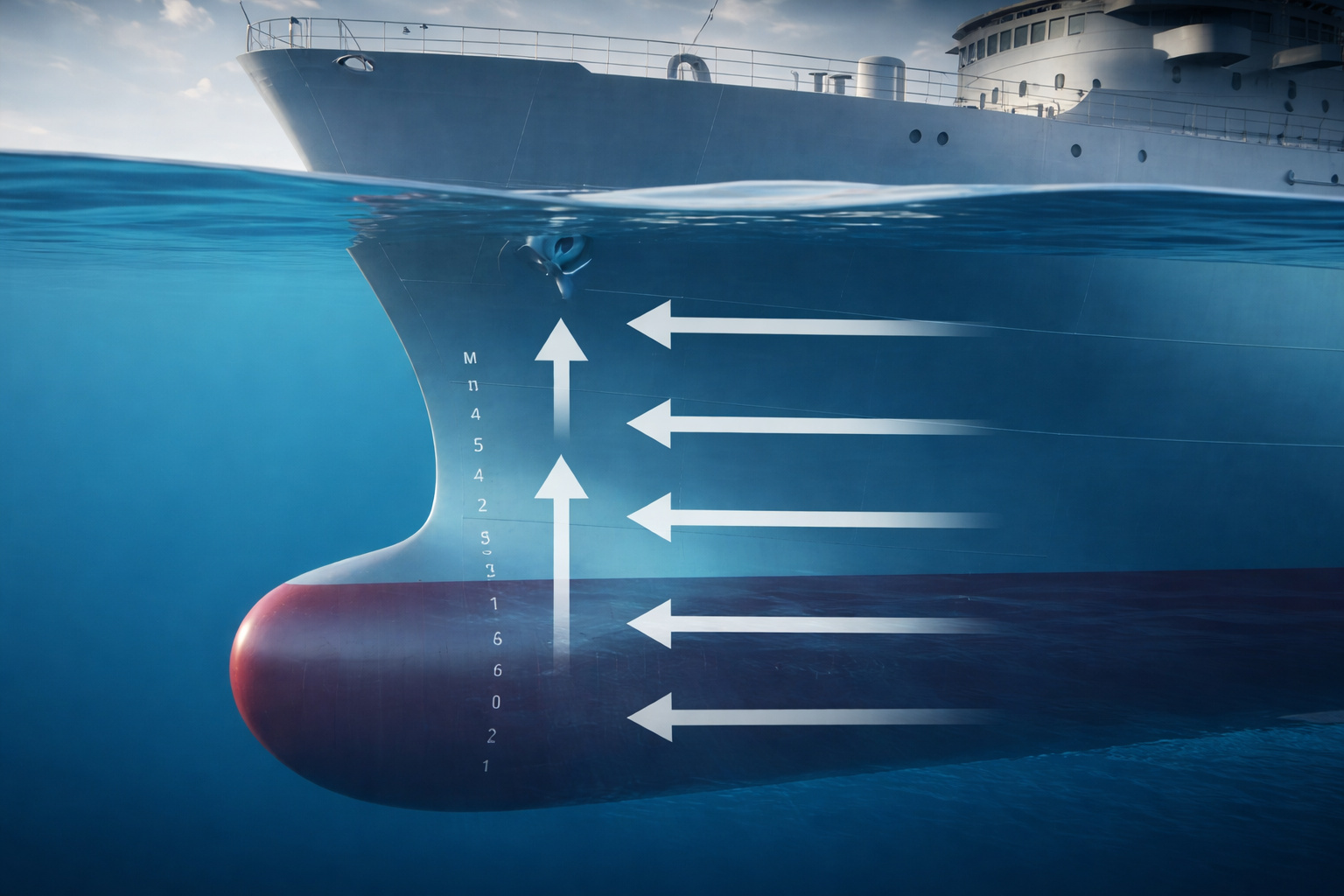


How The Physics Of Buoyancy, Water Pressure And Microscopic Naval Engineering Decisions Explain Why Metallic Giants Don’t Float Because They Are Light, But Because They Maintain An Invisible Balance With The Ocean
Giant ships made entirely of steel cross entire oceans every day without sinking, even weighing up to 200 thousand tons when fully loaded. At first glance, this seems to defy common logic, as a simple piece of metal immediately sinks when thrown into water. However, what keeps these vessels afloat is not lightness, nor magic, but a precise set of physical laws that act invisibly beneath the surface.
First of all, it is commonly believed that ships float because “the weight distributes” or because “there is air inside the hull.” Although these ideas make intuitive sense, they do not fully explain the phenomenon. In practice, size alone does not make anything float, and the internal air is just part of a much deeper mechanism involving volume, density, and pressure.
To understand what really happens, we need to go back more than 2,000 years in time, to Ancient Greece. It was there that Archimedes formulated the principle that governs all buoyancy known today. According to this law, every body submerged in a fluid experiences an upward vertical force equal to the weight of the fluid it displaces. In other words, it is not the weight of the object that directly matters, but the weight of the displaced water.
-
Friends have been building a small “town” for 30 years to grow old together, with compact houses, a common area, nature surrounding it, and a collective life project designed for friendship, coexistence, and simplicity.

-
This small town in Germany created its own currency 24 years ago, today it circulates millions per year, is accepted in over 300 stores, and the German government allowed all of this to happen under one condition.

-
Curitiba is shrinking and is expected to lose 97,000 residents by 2050, while inland cities in Paraná such as Sarandi, Araucária, and Toledo are experiencing accelerated growth that is changing the entire state’s map.

-
Tourists were poisoned on Everest in a million-dollar fraud scheme involving helicopters that diverted over $19 million and shocked international authorities.


When a ship is placed in the sea, it only sinks until it displaces an amount of water whose weight is exactly equal to its own total weight. At this point, equilibrium occurs: gravity pulls down, while buoyancy pushes up. That is why, technically, the ship is not floating on the water, but rather partially submerged, supported by forces acting in opposite directions.
Why Steel Sinks, But Steel Ships Don’t

The difference between a steel ball and a steel ship lies in the occupied volume. The ball is compact, displaces little water, and thus buoyancy cannot overcome its weight. On the other hand, the ship has a hollow hull, with a huge internal volume, which displaces millions of liters of water even though it is made from the same material. Thus, the average density of the whole remains less than that of water.
In simple terms, the ship “tricks” the water. It presents itself as a large and voluminous body, forcing the ocean to push a mass of water so heavy that it ends up supporting tons of steel. That is exactly why ships do not float because they are light, but because they displace more water than they weigh.
Moreover, buoyancy does not rely solely on buoyancy, but also on stability. A ship is designed so that its center of gravity is below the center of buoyancy. Thus, when the vessel tilts due to waves, the water itself repositions the buoyant force and pushes the hull back to its original position, creating a natural corrective effect.
Stability, Pressure, And The Invisible Role Of Water


Another fundamental point is that buoyancy exists only because water pressure increases with depth. The bottom of the hull experiences greater pressure than the upper part, and this difference generates a net upward force. Without this pressure variation, there simply would be no buoyancy.
Therefore, it is incorrect to imagine the ship resting on the surface as if it were on a solid platform. In reality, it is submerged in a field of pressures, balanced exactly at the point where the total weight is compensated by the force exerted by the water. It is almost as if the ocean is carrying the ship on “invisible shoulders.”
The safety of these vessels is high because naval engineers calculate every curve of the hull, every internal compartment, and every ballast tank with extreme precision. The ballast tanks, for example, can be filled or emptied to adjust the height, balance, and stability according to the cargo being transported.
When water enters where it shouldn’t, the scenario changes. The average density of the ship increases, the center of gravity rises, and buoyancy becomes insufficient. It is at this moment that balance is lost, and sinking becomes possible. Thus, the real danger is not the steel, but the uncontrolled influx of water.
Interestingly, the same principle explains how submarines and even the human body work. Submarines control their depth by adjusting the amount of water in the ballast tanks, while people float more or less depending on the amount of air in their lungs. The mechanism is always the same: control of average density.
When observing a cargo ship crossing the ocean, what you see is just the final result of a constant negotiation between weight, shape, and pressure. Millions of liters of water quietly push a structure of hundreds of meters, obeying simple yet relentless physical laws. What seems impossible is, in fact, pure engineering applied intelligently.
In the end, ships do not float the way you think. They do not defy gravity; they coexist with it in perfect balance. Floating, in this case, is not staying on the surface, but overcoming gravity using knowledge, calculation, and shape.
After understanding that even a giant of steel only stays afloat because it constantly negotiates with invisible forces, what other things from our daily lives seem simple, but actually operate in a completely different way than they appear?









Sem contar aqueles da pirataria que transportam petróleo de paiseco para ditadores a preço de ****.