





 Portuguese
  English
  Spanish
  7 min of reading
  0 comments



From the Collision Between Sisal Rope and Lotus Silk, a Rarified Natural Fiber Fabric Arises, Resulting from Artisan Production That Defies Logic.
How is it possible that the same nature can produce, at the same time, a rough rope that anchors a warship and a rarified fabric that costs over 1,000 and seems to be made of mist? On one side, colossal machines crush tons of sisal leaves to extract a tiny fraction of fiber. On the other, artisans kneeling in water break stalk by stalk of lotus, pulling out invisible threads to weave a single scarf.
This brutal contrast between industrial scale and manual delicacy reveals much about how we transform natural chaos into order. While sisal becomes the backbone of ropes that hold the world, lotus transforms into a rarified fabric, so fragile and labor-intensive that each centimeter carries someone’s lifetime. To understand how these two extremes arise from the same land, we must go back to the beginning, to the environments that test the limits of biology.
Where It All Begins: The Sisal Desert and the Water of the Lotus

In the arid regions of northern Tanzania, in areas like Tanga and Morogoro, nature does not make it easy. It rains only three or four months a year, with about 700 millimeters of precipitation, and the rest of the time the sun cracks the red soil, opening deep fissures. Most plants would succumb in weeks. It is precisely here that sisal thrives.
-
The lost continent beneath Europe: separated from North Africa about 240 million years ago, comparable in size to Greenland, Greater Adria was crushed over 40 million years and left geological marks from the Alps to the Balkans.

-
A cold front advances through the South this Saturday and reaches the Southeast on Easter Sunday with heavy rain and a drop in temperature, while the North and Northeast face the risk of storms and flooding throughout the holiday.

-
Brazil is about to inaugurate the largest maritime surveillance system in its history, with radars, infrared cameras, and autonomous sensors installed on Ilha Grande to monitor the entire Brazilian coast in real time.

-
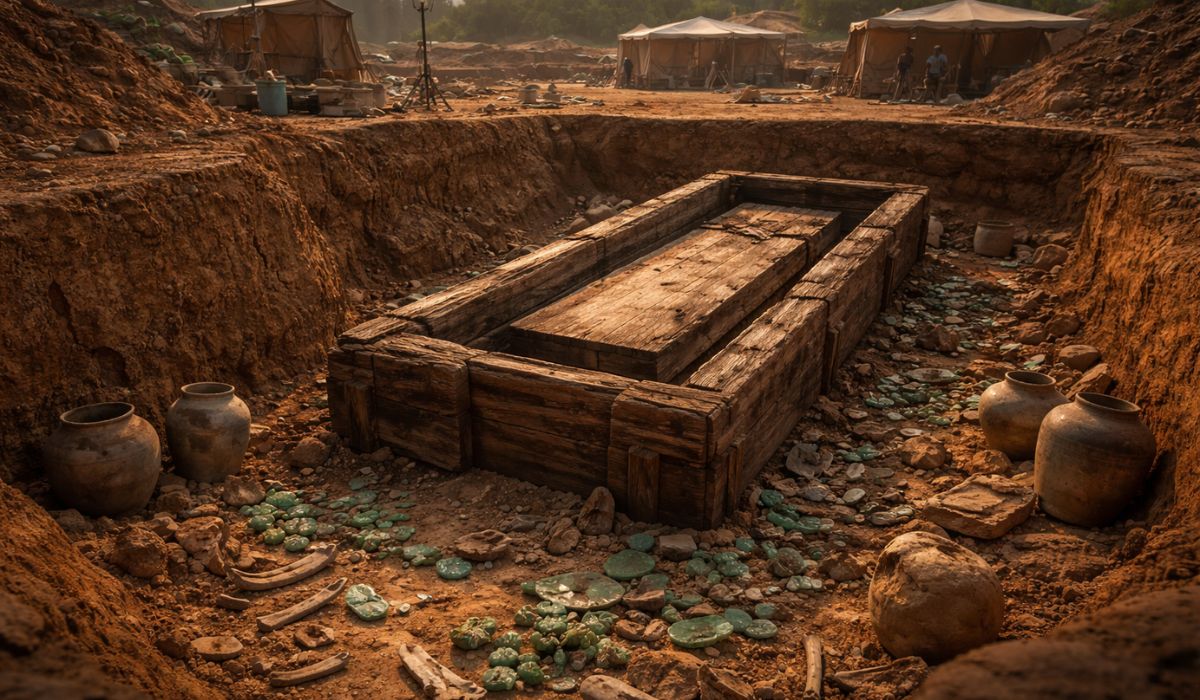
Archaeologists discover in China a 5,000-year-old tomb with over 350 artifacts, nearly 200 jades, and signs of intentional destruction, in a discovery that could be the gateway to a lost prehistoric kingdom.

Sisal is a survivor. Its roots plunge meters below the surface in search of moisture that seems non-existent. The harder life is for the plant, the more resilient the fiber becomes.
Extreme scarcity turns into raw material for ropes that support gigantic loads. What would be a death trap for other species becomes a factory of resilience.
Now imagine the absolute opposite. Instead of dry land, there are quiet and humid lakes in Vietnam and Myanmar. Water is not a detail; it is the world itself. Floating on this water is the lotus, a plant revered for millennia as a sacred symbol.
Inside its submerged stalks lies the secret of the rarified fabric that only a few artisans can produce.
However, the lotus comes at a high price. The harvest can only occur at peak growth, between May and August, and in the early morning hours. If the midday sun hits the cut stalks, the sap dries, the fiber hardens, and the magic disappears.
While sisal can survive weeks in the field, lotus behaves like an organism on a countdown. You either act at the right moment, or you lose everything.
Sisal: Tons Crushed to Generate Raw Power

Walking through a sisal plantation is like entering a vegetable army. The leaves look nothing like common foliage. They are rigid green blades, over a meter long, heavy as lead bars soaked in water and fiber.
The harvest is not done with delicate scissors but with heavy machetes. Workers do not uproot the plant.
Sisal is a living factory that can produce for about ten years. The outer, older, and tougher leaves are cut, and the heart of the plant remains untouched to keep generating fiber. The sound in the fields is repetitive and violent, steel against plant, leaves falling to the ground in sequence.
In a single day, a worker can cut down and stack over a ton of leaves, in intense heat. In large farms, this multiplies to tens of tons moved daily. Mountains of green material follow by truck to the factory in a logistics effort that seems like a war endeavor.
When these sisal leaves reach the industry, nature makes way for heavy engineering. The leaves are aligned on conveyor belts and pushed into decorticators, where steel rollers crush the material with crushing force while high-speed drums shred the pulp. The noise is deafening, the ground vibrates, the plant is literally torn apart.
A modern production line can consume about 20 tons of leaves per hour. The scary number is another: about 96% of everything that enters becomes immediate waste, leaving only 4% of usable fiber.
It’s like demolishing an entire building just to keep a few copper wires from the walls. It is from this resilient minority that the ropes capable of anchoring ships will be born.
Lotus: The Origin of the Rarified Fabric That Seems Made of Mist

If sisal is raw power, lotus is absolute precision. Upon leaving the mud and reaching the artisans’ hands, it enters a process that is at the exact opposite of the industry.
There are no giant machines, conveyor belts, or metal rollers here. The main tool is the tips of human fingers.
The artisan takes a stalk about twenty centimeters long, makes a small cut, and bends it without fully separating the parts.
With a gesture that borders on the impossible, he gently separates the halves, and between them, almost invisible filaments appear, like damp spider webs connecting both sides. There are about ten fibers at a time, thin and ready to snap at any carelessness.
These filaments are then placed on a wet wooden table. With the palm of his hand, the artisan rolls the threads, twisting and joining everything into a single continuous thread.
Water is essential to keep the fiber alive, elastic, and pliable. If it dries, the thread breaks. There’s no way to abruptly speed up this gesture nor to delegate it to a machine without losing the essence of the material.
In terms of productivity, the clash with the sisal industry is almost absurd. A skilled worker, focused all day, can produce about 200 meters of thread.
This barely fills a small spool. To make a single neck scarf, between 7,000 and 10,000 lotus stalks are needed.
This means that, for each scarf, the same gesture is literally repeated thousands of times: breaking stalks, pulling fibers, twisting threads. If the movement is too strong, the thread breaks. If it’s too slow, the fiber dries.
It’s a routine that transforms the result into a truly rarified fabric. The value does not come from a logo; it comes from the lifetime borrowed for the fiber.
Industrial Power Against Infinite Patience
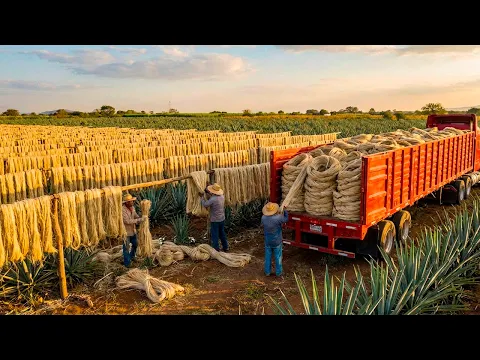

While sisal undergoes mechanical massacre, lotus demands almost monastic delicacy. In the sisal field, the violence is visible: machetes, trucks, machines vibrating the ground, tons of leaves being crushed.
In the lotus lake, the activity is almost silent. It’s the kind of work where you can hear the breath of the one producing the rarified fabric thread by thread.
Sisal can accept stock. Thousands of leaves can be piled up waiting for the machine. The lotus is unforgiving. The stalk has a window of just a few hours between cutting and extracting the fiber. If it travels too long, if you wait too long, it dies.
While sisal operates on the logic of moving mountains, lotus operates on the logic of transporting a living organ for transplant.
After shredding, the surviving sisal fibers are washed to remove the acidity of the sap, spread out in drying fields under the sun, and left there for two to three days until they reach a moisture content of about 12 percent. If they stay too moist, they rot on the ship. If they dry out too much, they break during spinning.
In the next phase, the fiber is combed by cylinders with steel teeth in high rotation, aligned and compacted into bales of 25 kilograms.
Remember that ton of initial leaves? About 40 kilograms of useful fiber remain from it. The rest was lost along the way.
On the other hand, the lotus thread, once formed, goes to the handloom. The weaver stretches the delicate threads, adjusting the tension with his own body. Every few centimeters, a thread breaks. Hundreds of small corrections are needed per day.
In a whole workday, the result can be less than a meter of fabric. To complete a scarf, several consecutive days of work are needed. That’s why this rarified fabric does not exist in industrial quantities. It is, by definition, scarce.
What’s More Valuable: Ground Tons or Human Time Woven in Silence?
At the end of the chain, sisal transforms into ropes that, for a long time, were the primary technology for tying the physical world. Before nylon and synthetic polymers, it was sisal that held ships, loads, and structures.
Twisted in multiple layers, with strands spinning in opposite directions, it gains an internal stability that prevents unraveling even under tons of tension.
Meanwhile, the lotus thread takes the opposite path. It reaches the consumer in the form of a scarf or unique piece, light, breathable, stain-resistant, and with a texture that cannot be compared to other fabrics.
The price above 1,000 is not an arbitrary exaggeration. It is the direct reflection of a chain in which every centimeter has been touched, twisted, and corrected by human hands over days.
In the contrast between sisal and lotus, a clear idea emerges. Sisal is the working hero, cheap, produced by the millions, replacing plastics in various applications, and returning to the earth when its work is done.
Lotus is proof that true luxury lies not in shine but in time accumulated. One wins through monumental scale; the other, through the rarity of gestures repeated thousands of times.
Both showcase something powerful: nature does not generate waste on its own; it generates possibilities. What we do with sisal and lotus is a choice. We transform one into brute force that holds ships and the other into a rarified fabric that almost no one will hold in their hands.
In both cases, what connects everything is our ability to take wild chaos and transform it into order, whether with a hundred-ton press or with the wet palm of an artisan.
And you, be honest: what impresses you more, the sisal rope born from crushed tons to anchor ships or the rarified lotus fabric, which depends on thousands of patient gestures for a single scarf to exist?





-

Uma pessoa reagiu a isso.