





 Portuguese
  English
  Spanish
  3 min of reading
  0 comments


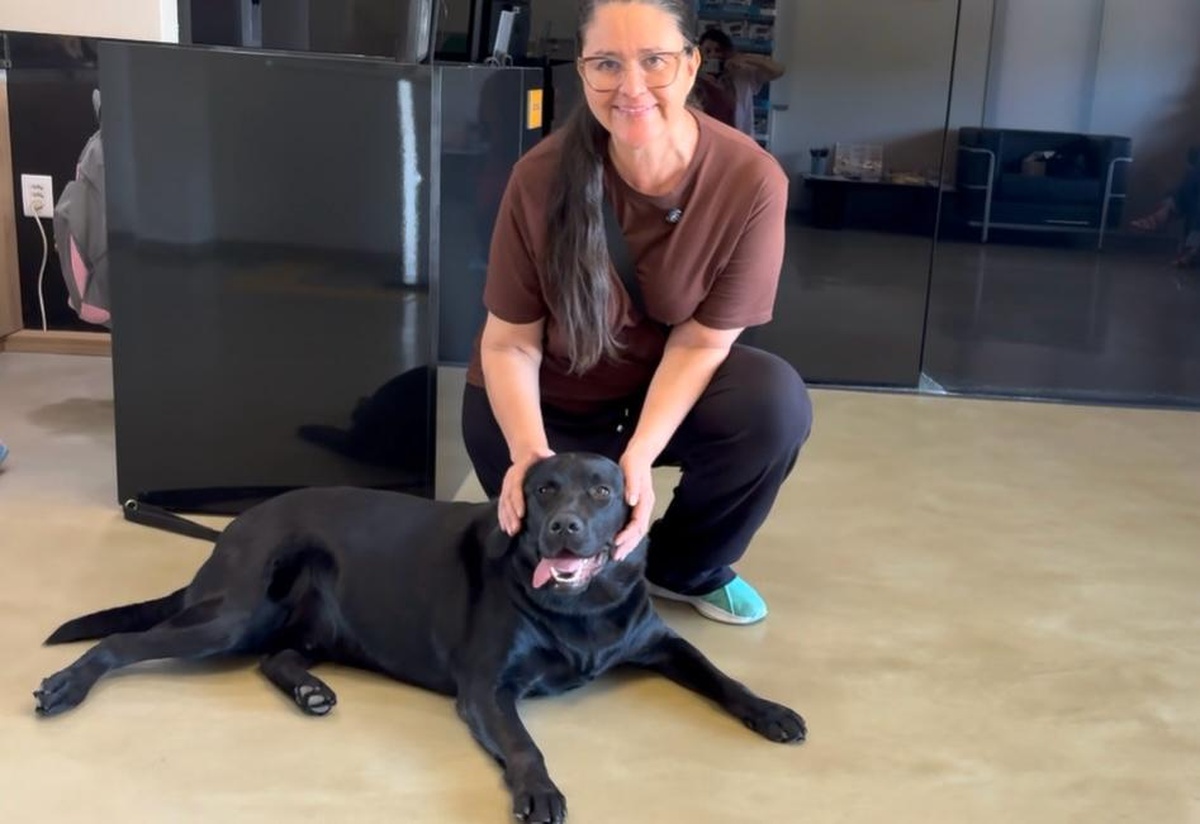
Understand How Volunteers Structure the Behavioral Base of Assistance Dogs and Enable the Free Program of Instituto Adimax
First of all, fostering families represent the foundation for the training of an assistance dog in Brazil. Before the technical training, the puppy learns coexistence, boundaries, and social adaptation. For this reason, Instituto Adimax, a Latin American reference in the segment, has structured a model based on responsible volunteering. Currently, according to institutional data released in 2024, more than 100 assistance dogs have been delivered for free in different regions of the country.
Moreover, as explained by Fabiano Pereira, the technical manager of the Institute, the process begins early. As soon as they reach about three months of age, the puppies are sent to volunteering families. For about a year, consequently, the dogs are exposed to urban routine. During this period, they learn to use elevators, visit supermarkets, wait in lines, remain calm in restaurants, and cope with loud noises and intense movements.
Therefore, this stage builds the emotional and behavioral foundation essential for the future function. In addition, confidence, self-control, and adaptability are developed progressively. If a failure occurs during this phase, the later technical performance may be compromised. For this reason, according to Instituto Adimax itself, the commitment of volunteers is considered decisive.
-
Friends have been building a small “town” for 30 years to grow old together, with compact houses, a common area, nature surrounding it, and a collective life project designed for friendship, coexistence, and simplicity.

-
This small town in Germany created its own currency 24 years ago, today it circulates millions per year, is accepted in over 300 stores, and the German government allowed all of this to happen under one condition.

-
Curitiba is shrinking and is expected to lose 97,000 residents by 2050, while inland cities in Paraná such as Sarandi, Araucária, and Toledo are experiencing accelerated growth that is changing the entire state’s map.

-
Tourists were poisoned on Everest in a million-dollar fraud scheme involving helicopters that diverted over $19 million and shocked international authorities.


How the Socialization and Training Cycle Works
Initially, the dog stays with the fostering family for approximately 12 months. During this period, all expenses are covered by Instituto Adimax, including food, vaccinations, veterinary assistance, and hygiene. Still, as Fabiano Pereira emphasizes, finding committed volunteers remains a constant challenge.
Subsequently, after completing the social coexistence cycle, the animal returns to the headquarters of the Institute, located in Salto de Pirapora (SP). Then, a technical phase of four to six months begins. In this phase, the dogs are specifically trained to act as guide dogs and assistance dogs.
Consequently, after training, the animals are assigned to people with visual impairments who meet the program’s criteria. According to institutional information updated until 2024, the delivery of the guide dog is completely free for the selected candidates.
Volunteers’ Testimonials Reinforce Social Impact
At the same time, testimonials from fostering families highlight the human impact of the program. Dalete Souza, a resident of Sorocaba (SP), states that she is on her tenth socialized dog. Currently, she is with the labrador Café. According to her, some dogs are already assisting individuals with disabilities, including a child on the autism spectrum.
On the other hand, Hidelma Ferreira describes the delivery of the dog Pantera as an emotionally significant moment. Still, according to her testimony, the feeling of mission accomplished prevails. Thus, volunteering gains concrete meaning by promoting autonomy, mobility, and independence to those who receive the animal.
Structure and Mission of Instituto Adimax
Founded with a social purpose, the Instituto Adimax operates on an area of 15,000 square meters. The structure includes a maternity ward, kennels, veterinary clinic, surgical center, release area, and training spaces. Furthermore, there is a hotel to welcome future guardians with visual impairments.
Currently, according to institutional data, 53 employees make up technical, administrative, and social assistance teams. In addition to the Assistance Dog Program, the institution maintains another 10 social programs aimed at inclusion and support for people in vulnerable situations.
Therefore, being a fostering family does not require prior experience in training, but it requires time, responsibility, and commitment. Applications are made directly through the official website of the Institute, in the section dedicated to fostering families.
Thus, from the arrival of the puppy at the volunteering home until the free delivery to the final beneficiary, each stage follows rigorous technical criteria. In this way, the program maintains a focus on transparency, social responsibility, and compliance with good institutional practices, aligning social impact and animal welfare.
The application is made directly on the website, in the guide dog section.










-

2 pessoas reagiram a isso.