






 Portuguese
  Spanish


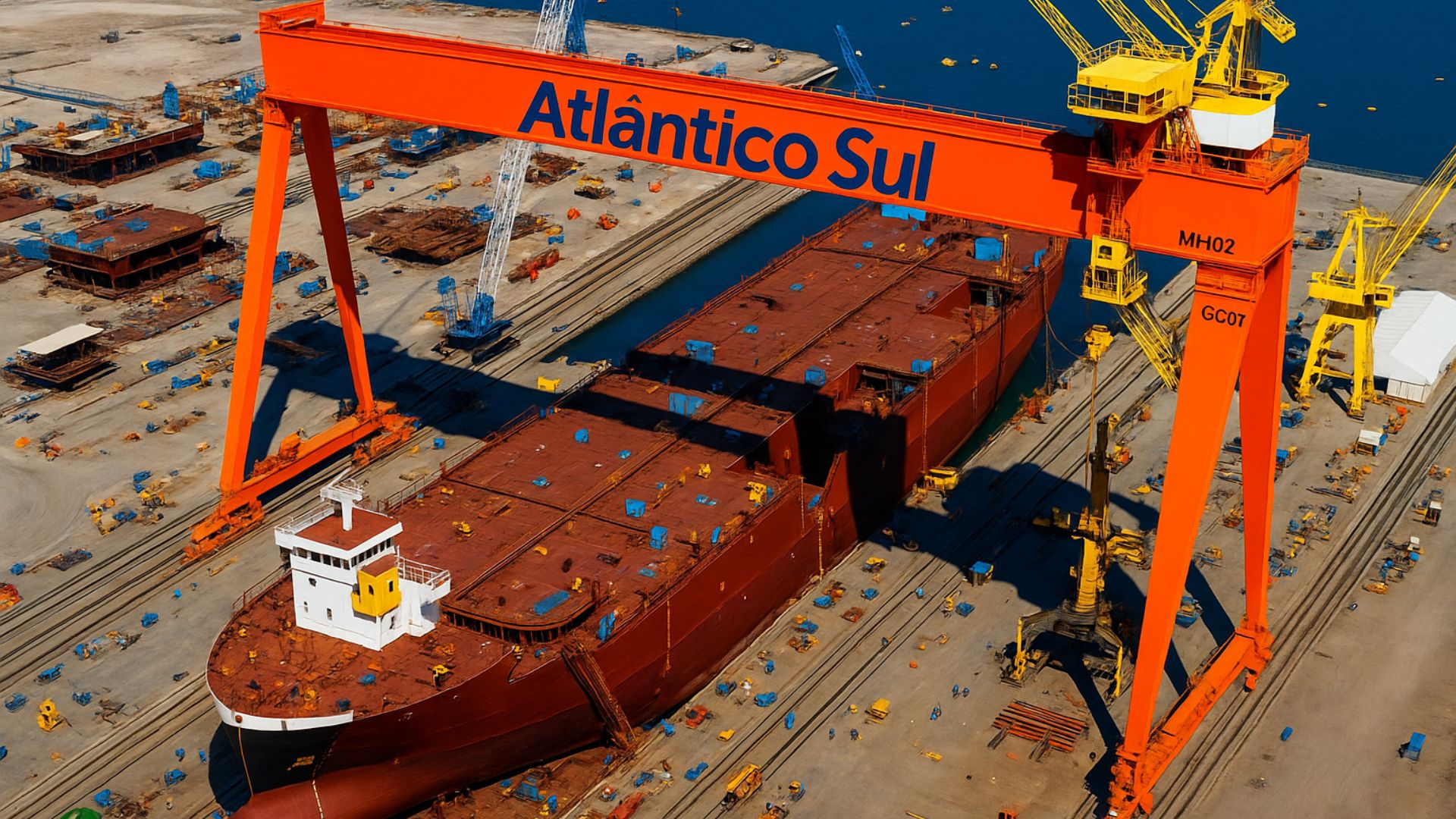

With 1.5 million square meters and the capacity to build two platform ships simultaneously, the Atlântico Sul Shipyard has become a symbol of the resurgence of the Brazilian shipbuilding industry and a reference in large-scale ship construction.
The history of Atlântico Sul Shipyard (EAS) began as part of an ambitious public policy: the Modernization and Expansion Program for the Transpetro Fleet (Promef), launched to reduce Brazil’s dependence on international shipbuilding and strengthen national ship production.
Located in the industrial complex of Suape, in Ipojuca (PE), the shipyard was founded with state support and significant financial contributions from the National Bank for Economic and Social Development (BNDES), Petrobras, and private investors. The goal was clear: to create infrastructure capable of competing with international giants and boosting the Brazilian shipbuilding industry.
In operation since September 2008, the EAS was born as the first virtual shipyard in the country, a concept where the infrastructure is established with a robust order book, ensuring scale from the outset. This model allowed the shipyard to launch based on signed contracts, primarily with Transpetro, a subsidiary of Petrobras.
-
The FLIP: A 108-Meter Ocean Laboratory That Stood Vertically for 60 Years, Dismantled in 2023

-
North Korean Fiasco: Launch of the Largest Warship Ends in Sinking

-
While giant ships still burn heavy fuel and the maritime sector races against climate targets, Maersk and Vale are starting to bet on ethanol as a new route to reduce emissions at sea.

-
China begins construction of the world’s largest LNG ship, a 344-meter giant capable of supplying 4.7 million homes for a month, carrying 271,000 m³ of gas, and placing QatarEnergy in the largest naval order ever recorded in world history.


A Colossus of the Brazilian Shipbuilding Industry


The grandeur of the largest shipyard in the Southern Hemisphere is impressive: with a total area of 1.5 million m², the Atlântico Sul Shipyard has installed capacity for simultaneous construction of two FPSOs (Floating Production Storage and Offloading), platforms that produce, store, and transfer oil at sea.
Its industrial park features two gantry cranes of 1,500 tons each, two assembly lines, and two docks. The steel processing capacity is 160,000 tons per year, positioning it as one of the largest and most complete shipyards in operation on the planet.
In addition to its physical structure, the shipyard was designed to prioritize local content, meaning the use of materials, labor, and services from Brazil in its projects. This guideline, set by the National Petroleum Agency (ANP), boosted the Brazilian economy and generated thousands of direct and indirect jobs.
The First Fruits: Suezmax Ships and the Historic Turnaround
The major milestone for the shipyard occurred in May 2010, with the launch of the João Candido, the first Suezmax-type ship built by EAS. With 71% local content, the large ship represented the rebirth of complex shipbuilding in Brazil. Its delivery was celebrated as a symbol of the national capacity to compete in the sector.
Next came the Zumbi dos Palmares, delivered in May 2013 with 74% local content, and the Dragão do Mar, completed in December of the same year with 65%. All were part of the first batch of 10 Suezmax ships, contracted in 2007, which provided economic viability for the shipyard’s construction.
With these projects, the Atlântico Sul Shipyard consolidated its strategic position in the production of large vessels, essential for transporting crude oil, operating on international routes with capacities exceeding 150,000 tons.
Growth Focused on Oil Tankers and National Technology
Over the years, the EAS expanded its operations with new contracts signed with Transpetro and other Petrobras subsidiaries. Currently, the shipyard has in its portfolio the construction of 22 of the 49 oil tankers planned in Promef, including:
- 5 Aframax (68% local content)
- 4 additional Suezmax (73%)
- 3 Aframax DP (73%)
Aframax ships are essential for operating in medium-sized commercial ports, while Aframax DP (Dynamic Positioning) vessels have advanced autonomous navigation systems, allowing them to operate more safely in sensitive areas.
This diversity of vessels enhances the shipyard’s know-how, reinforcing its contribution to the Brazilian shipbuilding industry with the application of national technology and a high rate of productive integration.
Atlântico Sul Shipyard in the Pre-Salt Era: Drillships and FPSOs
With the advancement of pre-salt exploration, the EAS also began to work on the construction of drillships, essential for drilling underwater wells at great depths. Six of these units were contracted to operate in Brazilian offshore, all headed for Petrobras.
Among them, the Sonda Copacabana stands out, with delivery projected for the first quarter of 2016, and the Grumari, scheduled for delivery in the third quarter of the same year. The remaining drillships were planned to be completed by the end of 2018.
In addition to drillships, the EAS also participated in large projects for FPSO platforms. An emblematic example was the P-62, delivered in December 2013 after the completion of the integration between hull and modules. With 63% local content, the P-62 started operating in the Roncador field, in the Campos Basin, with the capacity to process 180,000 barrels of oil per day.
An Expanded Legacy with the P-55, One of the Largest in the World
Another significant project was the semi-submersible platform P-55, completed at the Rio Grande Shipyard 1 in September 2013, but with decisive participation from the EAS. The unit, weighing 52,000 tons and capable of producing 180,000 barrels per day, is the largest of its kind ever built in Brazil and one of the largest in the world.
The P-55 is an icon of naval engineering and symbolizes the capacity of the Brazilian industry to build structures of the highest performance and technical complexity. The project was developed with 79% local content, reinforcing national leadership in offshore projects.
Atlântico Sul Shipyard and the Challenges of the Brazilian Shipbuilding Industry
Despite its modern structure and relevant history, the Atlântico Sul Shipyard also faced typical challenges of the Brazilian shipbuilding industry, marked by demand fluctuations, dependence on government contracts, and changes in the political-economic scenario.
The slowdown in Petrobras’ investments and the shrinkage of pre-salt projects directly impacted production. Furthermore, the advance of Asian shipbuilding and high production costs in Brazil generated additional competitive pressures.
Even in the face of these adversities, the shipyard has sought portfolio diversification, administrative restructuring, and greater insertion in the international market.
The Strategic Importance of the Largest Shipyard in the Southern Hemisphere
The largest shipyard in the Southern Hemisphere is not just a large industrial unit — it is a strategic infrastructure for national sovereignty and the oil and gas chain in Brazil. With it, the country ensures greater autonomy in maritime logistics, support for offshore production, and the generation of qualified jobs in engineering, welding, metallurgy, and project management.
Moreover, the presence of the EAS in the Northeast contributed to regional development, with technology transfer, local workforce training, and stimulation of the metalworking sector in Pernambuco.
Perspectives for the Future of Shipbuilding in Brazil
The resumption of Brazilian shipbuilding depends on incentive policies for the base industry, sustainable contracts with energy sector operators, and greater integration among national shipyards.
The Atlântico Sul Shipyard is well-positioned to participate in this recovery, especially with Petrobras’ new investments in the pre-salt, local content requirements, and the need to replace the fleet of ships and platforms in the coming years.
The sector is also beginning to pay more attention to sustainable technologies, hybrid vessels, and energy efficiency solutions, which could create new opportunities for the EAS to adapt to the global energy transition.
The Atlântico Sul Shipyard represents a milestone in Brazilian shipbuilding, combining technical capacity, state-of-the-art infrastructure, and leadership in major oil and gas projects. Its creation was a bold and strategic step that strengthened the national industry and positioned Brazil among countries capable of producing large vessels and platforms.
Even with challenges, its contribution to the economy, job creation, and industrial autonomy is undeniable. The future of the shipyard depends on collaboration among government, companies, and industrial policies that ensure predictability and constant innovation.





Your blog is a testament to your dedication to your craft. Your commitment to excellence is evident in every aspect of your writing. Thank you for being such a positive influence in the online community.