





 Portuguese
  English
  Spanish
  5 min of reading
  0 comments


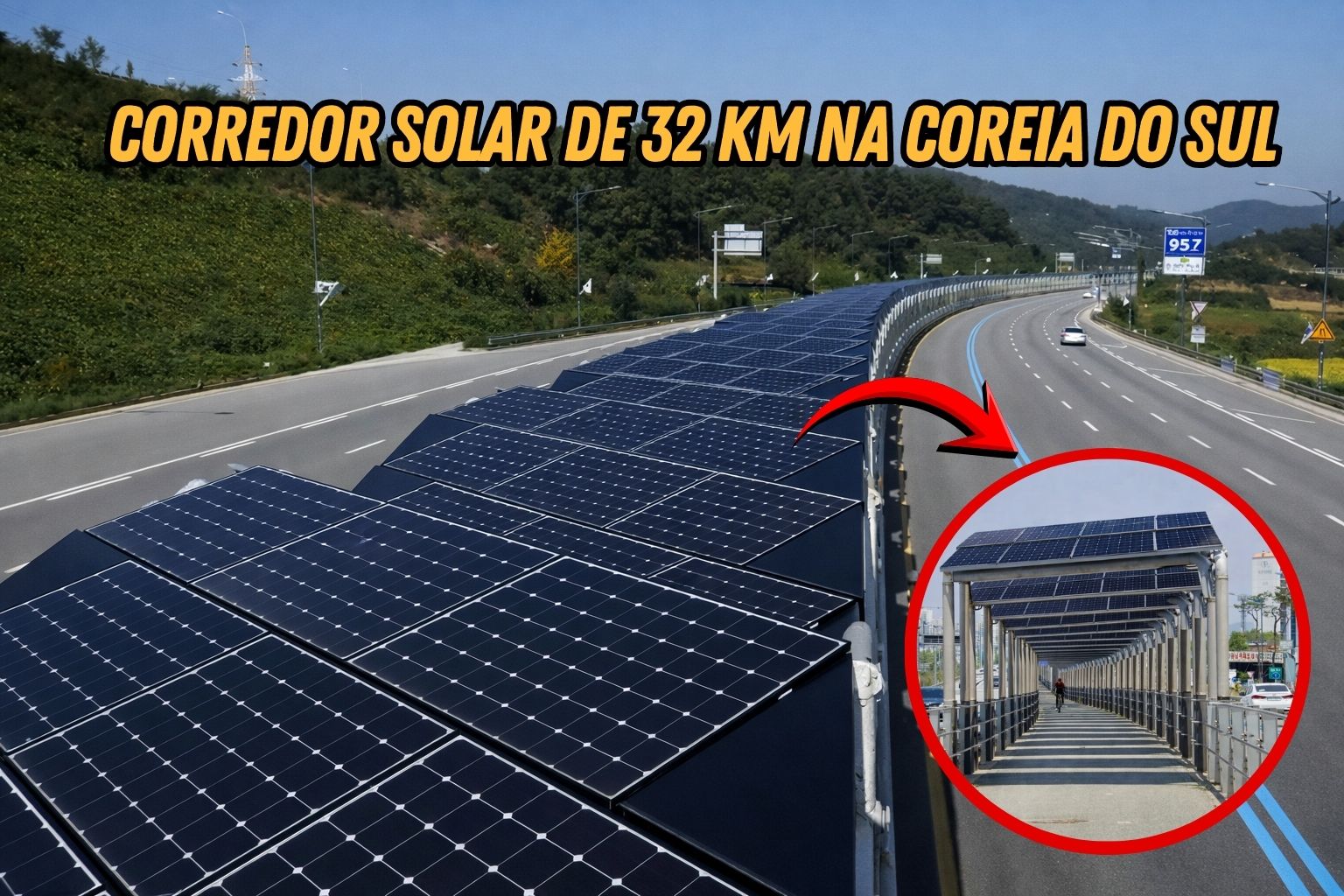
32 km Solar Corridor in South Korea Combines Protected Bike Path, Highway, and Photovoltaic Generation, Uniting Energy and Mobility in the Same Infrastructure.
Between the cities of Daejeon and Sejong, in South Korea, there is a project that seems to have come out of a futuristic urban planning book: a highway with cars on the sides, an exclusive bike path in the center, and a continuous cover of solar panels along 32 kilometers. The structure was installed over the past decade as part of the urban development of Sejong, a city planned to be the new administrative center of South Korea, hosting ministries and federal agencies since 2013.
What many call an “urban solar tunnel” combines three layers that are rarely seen together: motorized transportation, active mobility, and photovoltaic energy generation. In practice, the asphalt and bike path are no longer just transit infrastructure and instead serve a productive function, generating electricity during the day while protecting cyclists from the sun and rain.
Where It Is and How the Solar Corridor Works
The corridor runs along the Daejeon → Sejong axis, in an almost straight line that crosses urban areas and planned expansion zones. The bike path runs in the central median, physically separated from the cars by side barriers, while the cover of solar panels follows the entire route, providing shade and turning the airspace above the highway into distributed generation.
-
Seagri’s headquarters invests in solar energy with Neoenergia Coelba and promises to cut electricity costs, highlighting a strategic advance in sustainability and energy efficiency within state public administration.
-
Solar Pyramid draws attention by converting solar energy into million-dollar savings and repositioning the City Hall of Curitiba as an example of innovation, sustainability, and intelligent use of public resources.
-
Europe records strong euro economy with solar energy in March and sparks curiosity about which country leads growth that redefines the energy market and reduces costs.

-
Piauí reaches a historic milestone in energy transition: State records nearly 160,000 households powered by solar energy and leads growth in the Northeast.

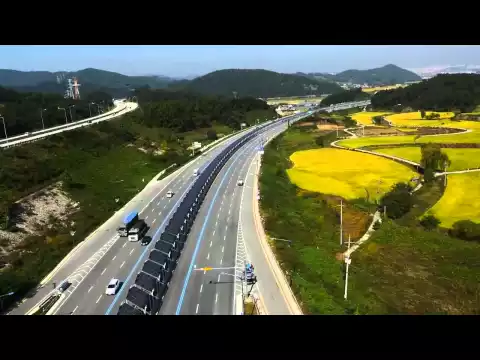

Sejong, being a recently built city with a technological focus, was the ideal environment for the implementation of this type of solution. The presence of ministries, universities, and technology centers stimulated the development of a clean energy and alternative mobility-oriented infrastructure, featuring continuous bike networks, wide avenues, and reduced reliance on cars for intra-urban trips.
Energy Generated in the Same Place It Is Consumed
An important factor of this project is the concept of distributed generation: the electricity produced by the solar panels can be used to power public systems, urban lighting, mobility structures, and even be reinjected into the grid as needed. South Korea imports a significant portion of its energy, has limited land available for large ground-mounted solar plants, and faces strong pressure to reduce emissions.
Transforming roadways and circulation areas into solar infrastructure addresses three problems simultaneously: lack of space, transmission losses, and urban integration. Although the exact generation varies with equipment updates, South Korean studies and reports classify the section as part of a national strategy to increase renewable participation and reduce pressure on the matrix based on imported fuels.
The Role of the Protected Bike Path in the System
The covered central bike path is not a secondary detail — it is the secret of the project. By placing the cyclist in the center and the cars on the sides, South Korea breaks a global pattern where bicycles are often tolerated rather than prioritized. Covering the bike path with photovoltaic panels reduces exposure to the sun during the summer, decreases the incidence of rain and wind, and creates a safer, more predictable, and comfortable environment.

In a country with dense cities, variable weather, and frequent commutes for study and work, this transforms leisure cycling into a real urban transportation means, especially for public servants who travel daily to Sejong.
The choice is consistent with a larger set of investments that include dedicated corridors, bike parking, integration with public transport, and connection with administrative hubs.
The Urban and Political Context That Enabled the Project
This solution did not arise from a viral video, but from a structured public policy. South Korea has been building a strategy of smart cities, green growth, and electric mobility since the late 2000s. Within this strategy, Sejong was planned as a model administrative city, concentrating ministries that previously were located in Seoul.
When Sejong began to receive state structures, between 2012 and 2014, the government needed to simultaneously address logistics, transportation, and energy. The response was to create an urban ecosystem where mobility and energy coexist in the same infrastructure, something almost nonexistent in Western cities. The combination of:
- Recent urban planning
- Presence of the central government
- Demand for intercity mobility
- National renewable policy
- Lack of space for traditional solar farms
produced the ideal environment for the emergence of the solar corridor.
Urban Advantages Beyond Photovoltaic Generation
The corridor stands out not only for its solar aspect. It also reduces pressure on public transport and private vehicles. Protected bike paths tend to:
- Increase the modal share of bicycles
- Reduce congestion
- Decrease emissions from daily transport
- Encourage physical activity
- Reduce urban noise
- Integrate administrative and university areas
The shade of the panels also reduces some of the radiation on the pavement, potentially lowering local temperatures and delaying the wear of the asphalt, although in-depth studies are still underway.

Why Such Structures Are Still Rare in the World
The South Korean model is rare because it requires factors that almost never coexist: a young city, centralized planning, high density, limited free space, and external energy pressure. In countries where cities are old, fragmented, full of heritage restrictions, and automotive lobbying, the adoption of this model faces strong resistance.
Even European countries with a strong cycling culture, such as the Netherlands and Denmark, still do not combine bike paths with solar generation over long distances. There are experimental projects, such as small-scale solar bike paths, but nothing comparable to the Daejeon–Sejong corridor in length and integration.
What This Corridor Represents for the Future of Cities
Looking at this project, one can see a new urban paradigm: infrastructure that serves not only to circulate but also to produce, shelter, protect, and supply. The South Korean corridor is a functional prototype of a city where mobility and energy are two sides of the same coin.
The logic is simple: if billions of square meters of streets, parking lots, and highways are exposed to the sun every day, why not turn them into energy capture? If bicycles can circulate safely without competing for space with cars, why not place dedicated corridors at the center of the system instead of on the edges? This is the challenge that Sejong throws to the world.
A Glimpse of What the 21st Century May Hold
The South Korean solar corridor between Daejeon and Sejong is not just a beautiful infrastructure in aerial images — it is a real urban laboratory, demonstrating that clean energy and active mobility can coexist in the same physical space, without sacrificing efficiency or scale.
Instead of talking about the future, it shows the future already happening: 32 kilometers of solar panels, a planned administrative city, a protected central bike path, and a country that needs to generate energy where consumption occurs.
While the world discusses theoretical alternatives for climate and urban crises, Sejong places one of them on the street — literally.









Seja o primeiro a reagir!