





 Portuguese
  English
  Spanish
  8 min of reading
  2 comments


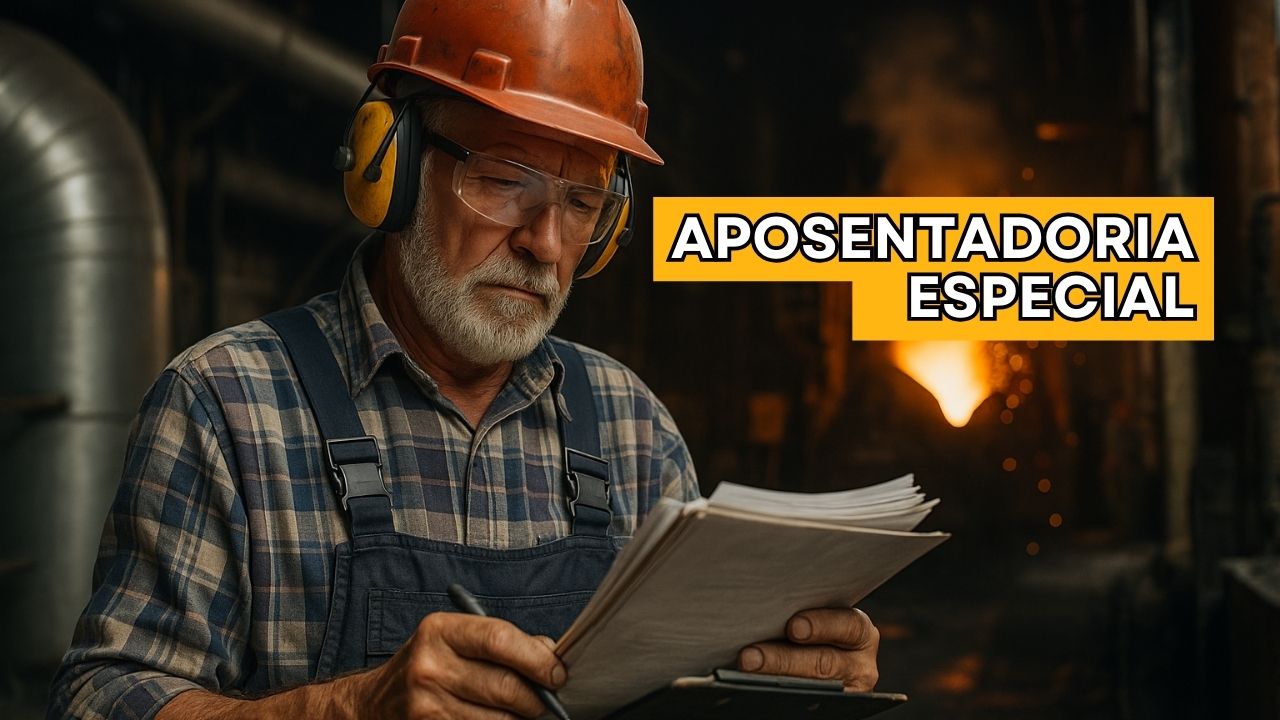


Far From Over, Special Retirement Changed with the Pension Reform. Understand Special Time at INSS, Who Works in Hazardous Activities, and How to Use PPP and LTCAT to Prove Your Right.
Special retirement is one of the topics that generate the most fear and confusion among workers exposed to risks. Many people have heard that special retirement has ended, that INSS no longer grants this type of benefit or that the pension reform would have “erased” special time at INSS. None of this is true. What has changed are the rules for access, calculations, and proof requirements, especially for those in hazardous, dangerous, or strenuous activities.
In this guide, we will organize everything you need to know. You will understand why special retirement continues to exist after the pension reform, how special time works at INSS, who qualifies for hazardous activities, and how PPP and LTCAT have become central documents in proving your right. In the end, you’ll be able to look at your own professional trajectory with more clarity and know if it’s worth pursuing the benefit.
What Is Special Retirement
Special retirement is a benefit from INSS intended for those who work exposed, habitually and permanently, to harmful agents that jeopardize health or physical integrity.
-
The noise law will no longer be in effect at 10 PM starting in June with a new rule valid during the 2026 World Cup.

-
The Chamber opens a debate on driver’s licenses at 16 years old as part of a reform that includes around 270 proposals to change the Brazilian Traffic Code and may redesign rules for licensing, enforcement, and circulation in the country.

-
The new Civil Code could revolutionize marriages in Brazil with “express divorce” and changes that could exclude spouses from inheritance.
-
Banco do Brasil sues famous influencer for million-dollar debt and intensifies debate on delinquency, risks of seizure, and direct impact on Gkay’s credibility.


In simple terms, it is early retirement for those performing activities considered heavier, precisely because the wear on the body is greater.
These agents can be physical, chemical, or biological, isolated or combined. This includes intense noise, heat, cold, humidity, radiation, toxic chemicals, viruses, bacteria, and fungi, among others.
In many of these environments, the worker is in hazardous activities for long periods, which sustains the right to special retirement.
Beyond hazardousness, there are also situations where there is a risk of accidents or sudden death. This is where danger comes into play. The focus is not so much on wear over time, but rather exposure to serious and immediate risk, such as high-voltage electricity, explosives, flammable materials, or physical violence.
There is also a third group: arduousness, linked to activities that cause excessive physical and mental strain, even without a specific chemical or physical agent.
Who Is Entitled to Special Retirement


In general, those entitled to special retirement are those who prove they worked exposed to harmful agents or in hazardous, dangerous, or strenuous activities for the minimum time required by law.
It is not the “job title” that generates the right, but rather the work environment combined with the special time at INSS that is duly proven.
Among the main examples of hazardous exposure are professionals dealing with noise above legal limits, extreme heat, chemical products such as hydrocarbons, heavy metals, mineral dust, and biological agents in hospital or laboratory settings.
In these situations, the person remains in hazardous activities for years, slowly and progressively damaging their health.
In cases of danger, occupations like high-voltage electricians, security guards, firefighters, workers with flammable or explosive materials, or constant risk of physical violence are included.
As for arduousness, activities such as bus drivers and conductors, truck drivers and helpers, underground workers, and sugarcane cutters in tough and exhausting shifts stand out.
In all cases, the central point is the same: proving the special time at INSS based on technical documents, such as PPP and LTCAT, reports, and other records. Without this, the recognition of special retirement becomes much more difficult.
Special Retirement Before the Pension Reform
Before the pension reform, which took effect on November 13, 2019, special retirement was much simpler.
It was enough to complete the special activity time, and there was no requirement for a minimum age or points. The time varied depending on the risk level of exposure:
For most professions, the minimum time was 25 years of special activity. In more serious situations, with higher risks, this time could be 20 or even 15 years. The calculation was also more favorable.
The average was based on the 80 percent highest contributions, discarding the 20 percent lowest, and there was no previdential factor. In practice, many called this benefit full retirement.
Those who completed all requirements before the pension reform have what is called acquired right. This means that even if the retirement application is made today, the insured can still use the old rules, as long as they prove they completed the special time at INSS by November 12, 2019.
How the Pension Reform Changed Special Retirement
With the pension reform, the classic rule of special retirement solely based on contribution time was abolished for those who had not met the requirements by November 2019.
In its place, two new modalities emerged, both maintaining the logic of special time at INSS for 25, 20, or 15 years, but adding an extra requirement.
The first is the points transition rule. Here, the worker still needs to fulfill 25, 20, or 15 years of special activity, depending on the risk level, but now also needs to achieve a minimum score: 86, 76, or 66 points.
This score is the sum of age and all contribution time, including both common time and special time at INSS. Thus, someone who worked a few years in common activity and then in hazardous activities can use both periods to calculate points.
Example: a person who worked 5 years in common activity and 25 years in special activity has 30 years of contributions. If they are 56 years old, they will have 86 points (30 plus 56), reaching the score required for many situations of special retirement after the pension reform.
The second is the definitive rule with a minimum age. In this modality, the insured person needs to once again fulfill 25, 20, or 15 years of special activity, and additionally reach a minimum age ranging from 60, 58, or 55 years, depending on the risk level.
For most professions exposed to lower-risk hazardous activities, the standard is 25 years of special activity plus 60 years of age.
An important point is that, in the rules for special retirement, there is no difference in requirements between men and women. The special time at INSS and the minimum age are the same, which makes the analysis even more sensitive for female workers who have always been in harmful environments.
Hazardous Activities, Danger, and Arduousness in Practice
In theory, the legislation refers to hazardous activities, danger, and arduousness. In practice, this translates to very tough work routines. In hazardous environments, the problem is daily contact with excessive noise, toxic chemicals, dust, radiation, or biological agents.
Over the years, these agents cause slow and progressive harm to health, which justifies special retirement.
In cases of danger, the focus is on exposure to situations where a mistake or accident can be fatal in seconds. This includes those working with high voltage, flammable materials, explosives, or armed security.
The risk is of sudden death, not wear over decades, and this is also recognized in the analysis of special time at INSS.
As for arduousness, the emphasis is on intense, physical and mental wear resulting from activities in exhausting shifts, often under strong sun, heavy loads, or constant pressure. Bus drivers and conductors, truck helpers, underground workers, and those in heavy planting are some examples.
In all these scenarios, the correct use of PPP and LTCAT becomes decisive to demonstrate to INSS the type of risk involved.
How to Prove Special Time at INSS with PPP and LTCAT
After the pension reform, the discussion about theory matters little if the proof is not in order. Today, the key to special retirement is proving special time at INSS with well-filled technical documents. The main ones are PPP and LTCAT.
PPP and LTCAT go hand in hand. The PPP, Profissiographic Profile for Social Security, is the document that gathers, in a single sheet, the work history of the worker, describing functions, periods, sectors, and mainly the harmful agents they have been exposed to.
The LTCAT, Technical Report on Environmental Working Conditions, is the report that substantiates this PPP, prepared by a qualified professional, measuring noise, heat, chemical and biological agents, and other environmental conditions.
For INSS, the PPP and LTCAT are now the basis for proving special time at INSS in practically all analyses of special retirement, whether for hazardous activities, danger, or arduousness.
In addition to these, old forms, employment record registrations, expert reports from labor claims, on-site inspections, or by similarity, course certificates, and other documents reinforcing exposure reality may also be used.
The more consistent the set of evidence is, the greater the chance that INSS will recognize the special time at INSS and, if necessary, the higher the chance of success in a legal action.
Special Activities Before and After 1995
There is also a relevant detail for those who worked in hazardous activities before April 28, 1995. Until that date, legislation allowed classification by professional category, meaning that it was enough to prove the profession for the period to be recognized as special, as long as the activity was on the official list.
In practice, this means that, for periods until April 28, 1995, many times the work card, with the function registered, is already sufficient to classify that time as special activity, without the need for PPP and LTCAT.
From April 29, 1995, this logic changes. The law began requiring proof of actual exposure to harmful agents, and automatic classification just by profession is no longer accepted.
From then on, the discussion revolves around reports, measurements, and detailed descriptions of the environment. It is in this context that the PPP and LTCAT take on prominence, as they technically record whether the worker actually engaged in hazardous activities and for how long.
Is Special Retirement Worth It?
Even with the changes brought by the pension reform, special retirement remains one of the most valuable benefits in the system.
It allows for earlier exit from work for those who spent their lives in harmful environments, preserving a minimum quality of life at the end of their careers. In many cases, it can still be more advantageous than regular retirement.
What has changed is the requirement for planning. Today, those in hazardous activities or dangerous environments need to take care of their documentation, the PPP, and LTCAT, and the correct registration of their employment ties from early on.
It is no longer enough to “leave it for when the time to retire comes”, because information can get lost, companies can close, and reports can become harder to obtain.
On the other hand, those who have already met the requirements before the pension reform have not lost their rights. The so-called acquired right still protects many individuals, as long as the special time at INSS is well demonstrated.
In your case, do you believe you could prove all your exposure with PPP and LTCAT to pursue special retirement, or do you still have many gaps in information in your work history?









Eu trabalho com resíduos biológico LIXO como comprovar PPP LTCAT.
Eu trabalho com entrega de combustível