





 Portuguese
  English
  Spanish
  4 min of reading
  0 comments


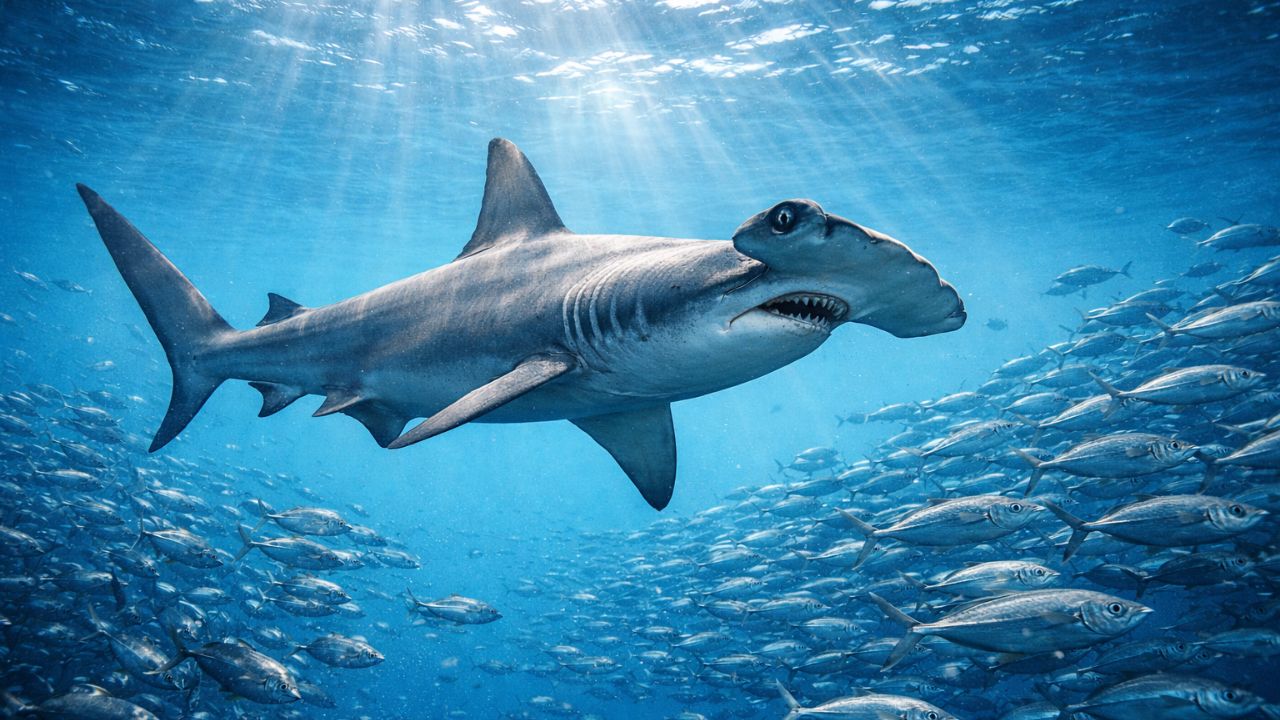
Published Research In Science Indicates That Scalloped Hammerhead Sharks May Hold Their Breath During Deep Dives, Keeping Their Bodies Warm While Hunting.
An unexpected behavior may be allowing scalloped hammerhead sharks, a 3.6-meter species, to explore environments considered hostile to most fish.
According to a recent study published in the journal Science, these animals, traditionally associated with warm waters, may hold their breath during deep dives in icy regions of the ocean.
The research was conducted by scientists led by the University of Hawaii and analyzed how, where, and why the species manages to hunt at depths exceeding hundreds of meters.
-
He started running at 66 years old, broke records at 82, and is now a subject of study for having a metabolic age comparable to that of a 20-year-old, in a case that is intriguing scientists and inspiring the world.

-
Oldest tree on the planet reappears after 130 years of searches: Wattieza, 385 million years old, was 10 meters tall and had no leaves or seeds; Gilboa fossils in New York solved the mystery in 2007.

-
A 48-square-meter house assembled in hours with 4,000 bricks made of recycled plastic that does not absorb moisture, has natural thermal insulation, and costs less than 90,000 reais in a complete kit.

-
Luciano Hang revealed that Havan’s air fleet has already accumulated more than 20,000 landings, 10,000 flight hours, and 6 million kilometers traveled, and he says that without the planes, the company would never have grown so quickly.


The discovery comes at a critical time, as scalloped hammerhead sharks are classified as critically endangered.
Scalloped Hammerhead Shark: Hunting In Extreme Cold Requires More Than Strength
During dives, scalloped hammerhead sharks dive to about 800 meters to catch squid and other animals that live in deep waters.
In these layers of the ocean, the temperature can drop drastically, creating an environment that directly affects vital functions.
Water that is too cold can compromise metabolism, heart activity, and even vision, reducing hunting efficiency.
Still, data shows that these sharks remain active and precise in these environments.

Breathing Enters The Core Of The Explanation
Normally, sharks depend on constant motion to push water through their gills, ensuring breathing.
However, maintaining this flow in icy waters increases exposure to cold.
And this is where the main hypothesis of the study arises: by temporarily closing their mouth and gills, scalloped hammerhead sharks may limit contact with cold water, preserving body heat during dives.
“This kind of behavior has never been observed in any type of fish that dives deep,” said Mark Royer, a biologist specializing in sharks and the leader of the research.
The idea of breath-holding in diving fish was considered unlikely until now.
According to Royer, the observed strategy is “completely unexpected” and raises questions about how much is still unknown about the behavior of large marine predators.
Furthermore, scalloped hammerhead sharks do not have known anatomical adaptations to conserve heat, unlike species such as bluefin tuna and mako sharks.
The Old Theory Of “Large Body” Loses Strength
Before the new study, many scientists believed that these sharks maintained temperature solely due to thermal inertia, an effect associated with body size.
Biologist Marianne Porter of Florida Atlantic University explained this idea with a simple analogy:

“Imagine you are trying to thaw your 7 kg turkey for Thanksgiving: you take it out of the freezer and it takes a long time to thaw — that is like thermal inertia.”
However, records obtained by researchers indicate that this explanation is not sufficient.
Sensors Show When The Body Cools — And When It Does Not
To test the hypotheses, the team tracked six male scalloped hammerhead sharks around Hawaii.
Over several weeks, the animals made over 100 dives, while sensors attached to their bodies — described by Royer as a “Fitbit for sharks” — recorded depth, movement, and muscle temperature.
The data revealed that the sharks were able to maintain body temperature both at the surface, with water around 26.6 °C, and at depths where the water reaches about 5 °C. Cooling occurred surprisingly during ascent, possibly when the animals resumed normal breathing.
Cooling occurred, surprisingly, during ascent, possibly when the animals resumed normal breathing.
“This is not what would be expected with thermal inertia,” explained Royer.
Visual Evidence Supports The Hypothesis Of Scalloped Hammerhead Sharks
Besides the sensors, other observations strengthen the study conclusion. Images captured by remotely operated vehicles show an adult scalloped hammerhead shark swimming at more than 900 meters depth with its gills closed.
Already in surface waters, records show the breathing slits open.
Additional experiments conducted with dead sharks exposed to hot and cold water baths also presented results consistent with breath-holding behavior.
For Porter, the data set is convincing. “It’s a convincing paper,” she asserted. “I am convinced.”
What Does This Discovery Reveal About The Future Of Oceans?


The ability to hold their breath may help scalloped hammerhead sharks tolerate environments with low oxygen levels, increasingly frequent in an ocean impacted by climate change.
In a scientific commentary accompanying the study, Mark Meekan and Adrian Gleiss highlight that this ability may explain the presence of the species in regions like the Gulf of California.
However, experts warn that surviving for short periods does not mean permanent adaptation.
“I wonder what would happen if this became their reality all the time,” questions Porter.
Nevertheless, the discovery redefines the known limits of marine biology and shows that, even when threatened, scalloped hammerhead sharks continue to reveal surprising strategies for survival in a rapidly transforming ocean.
With information from National Geographic Brasil.








-

-

-

4 pessoas reagiram a isso.