





 Portuguese
  English
  Spanish
  4 min of reading
  0 comments


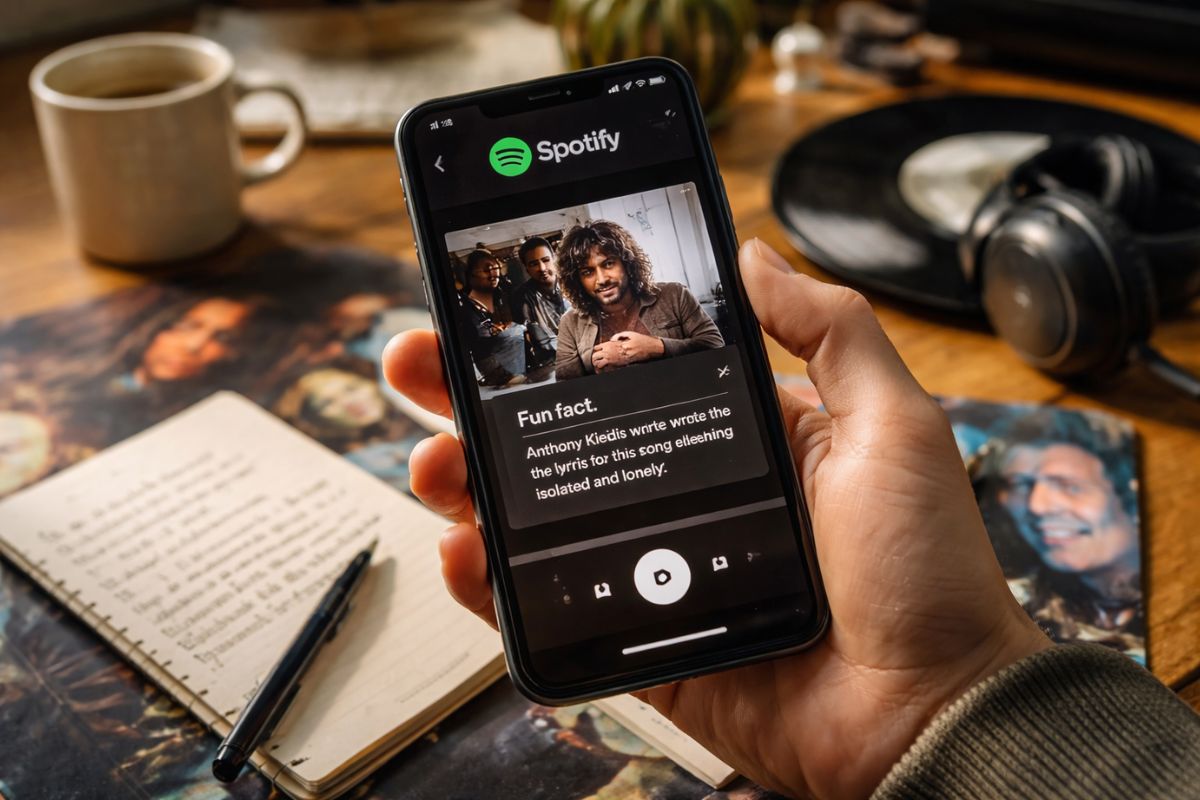
In The New Spotify Test, Premium Subscribers In Six English-Speaking Countries Will Start Seeing, Right After The Lyrics, Cards With Behind-the-Scenes, Inspirations, And Meanings Of The Songs, In Summaries From Third-Party Sources. The Company Wants To Increase Retention, Engagement, And Session Time Without Losing Focus On Daily Mobile Listening.
The Spotify has started rolling out the “About The Music” feature, an area that appears below the lyrics and provides stories, curiosities, and context about the playing track. The news was announced on Friday (6) and enters beta phase in the mobile app. The proposal is simple: keep the music playing while the understanding of it grows on the same screen.
In practice, the move repositions the act of listening as an editorial experience within streaming. Instead of forcing the user to leave to research, the app concentrates behind-the-scenes, inspiration, and meaning in the natural flow of playback. This reduces friction, increases retention, and changes the way the audience relates to each song.
How “About The Music” Works Within The App
The feature appears in the form of an informational card right after the lyrics section. As the user scrolls through the currently playing song, they find the texts and can swipe to explore the content. Spotify also included a feedback signal, allowing the listener to indicate whether they liked the displayed information or not. It’s a fast consumption mechanic, designed for short and continuous reading.
-
Motorola launched the Signature with a gold seal from DxOMark, tying with the iPhone 17 Pro in camera performance, Snapdragon 8 Gen 5 that surpassed 3 million in benchmarks, and a zoom that impresses even at night.

-
Satellites reveal beneath the Sahara a giant river buried for thousands of kilometers: study shows that the largest hot desert on the planet was once traversed by a river system comparable to the largest on Earth.

-
Scientists have captured something never seen in space: newly born stars are creating gigantic rings of light a thousand times larger than the distance between the Earth and the Sun, and this changes everything we knew about stellar birth.

-
Geologists find traces of a continent that disappeared 155 million years ago after separating from Australia and reveal that it did not sink, but broke into fragments scattered across Southeast Asia.

According to the platform, the texts are summaries based on third-party sources and focus on creative context, production backstories, and references behind the songs. This design avoids interrupting the listening experience and creates a cycle of discovery without switching apps. In terms of product, the gain is in the integration of audio and context in the same usage environment.
Where The Test Starts And Who Can Access It
In this initial stage, Spotify has limited access to the premium plan and the English language. The beta has been opened to users in the United States, United Kingdom, Canada, Ireland, New Zealand, and Australia. This segmentation reduces operational risk, allows measuring behavior in mature markets, and facilitates adjustments before a broader expansion. It’s a controlled release, not an immediate global rollout.
The choice for mobile devices is also not random. It is on smartphones that most daily listening occurs, with short sessions, task switching, and high scrolling consumption. In this context, placing “About The Music” below the lyrics makes discovery almost organic. The user doesn’t need to learn a new path: they just keep scrolling down the screen.
Why Spotify Is Investing In This Format Now
Spotify argues that music fans experience the same feeling: a track catches attention, and then a desire to understand where it came from arises. By answering this curiosity within the player, the company aims to strengthen emotional bonds, session time, and frequency of return to the app. When the content explains the work, listening tends to become more memorable.
There is also a significant competitive component. The platform claims that this format does not exist in the same way in competing services and bets on differentiation through experience, not just catalog. Instead of competing only on the quantity of tracks, Spotify seeks value in depth of usage. The battle becomes about context, not just playback.
What Changes For The Audience, Artists, And The Music Chain
For the audience, the immediate gain is understanding: the track stops being just background music and starts to have accessible narrative at the right moment. For those who listen daily, this creates a habit of discovery and can enhance the feeling of personalized curation. The music remains at the center, but the informational layer gains a role in retention.
For artists and creative teams, the feature opens a contextual window within the consumption itself. Composition stories, production decisions, and references can gain visibility without relying on lengthy interviews or external content.
If expansion occurs, the trend is that the music chain will start treating narrative metadata as a strategic asset, alongside cover, title, and distribution. Listening becomes more informed, and the work gains more interpretation of intent.
The “About The Music” test shows Spotify trying to transform spontaneous curiosity into qualified use time. With a restricted rollout, direct feedback on the card, and a focus on premium mobile, the company prioritizes behavioral validation before scaling up.
If it works, streaming stops being just a player and also becomes a space for real-time musical interpretation.
When you discover the story behind a track, does it change your relationship with it or is it just an extra that you ignore? And in your routine, do you prefer Spotify to deepen context in the player or keep the experience as streamlined as possible?







-

-

-

14 pessoas reagiram a isso.