





 Portuguese
  English
  Spanish
  4 min of reading
  0 comments


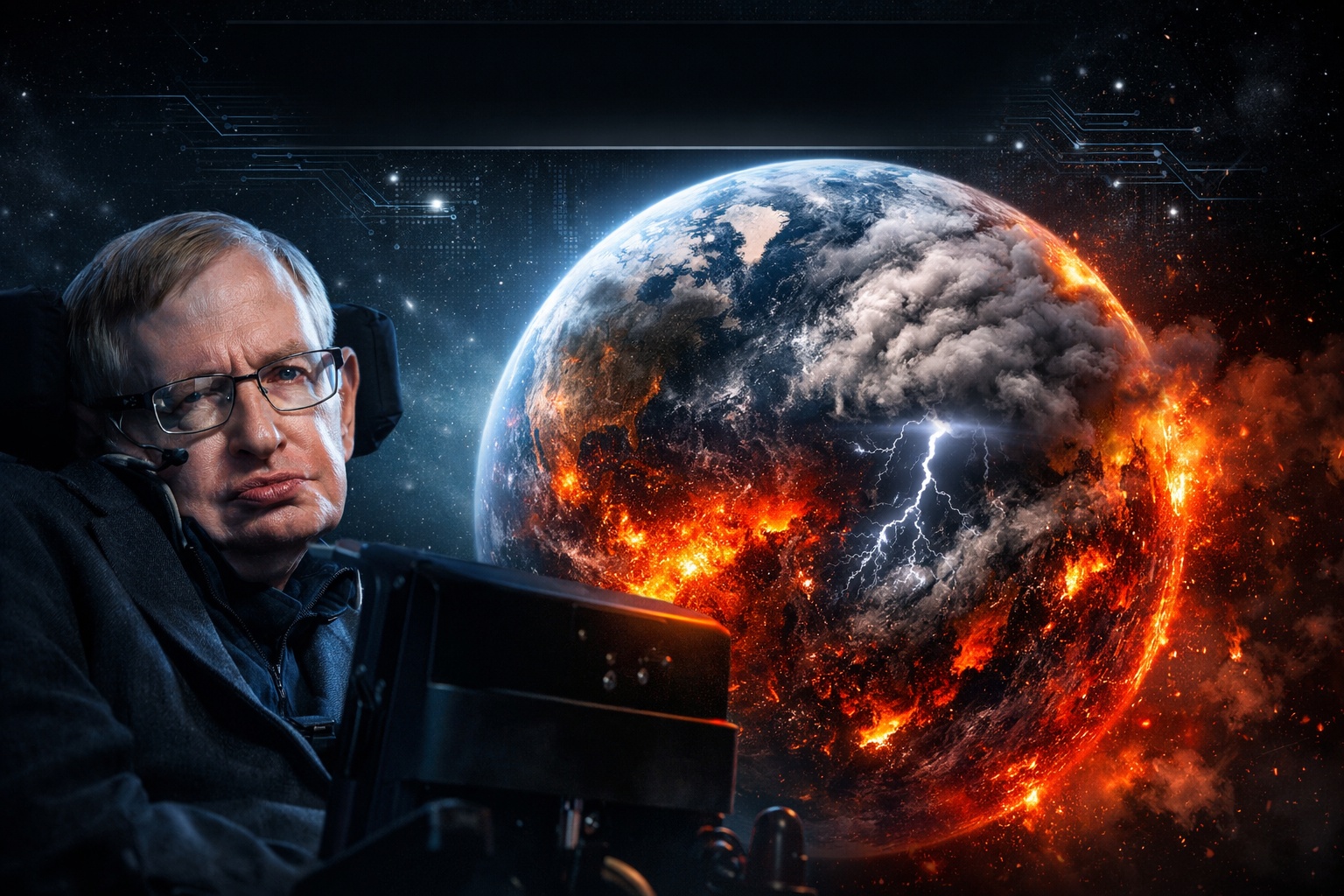
Stephen Hawking said that humanity may not survive more than about a thousand years on Earth without colonizing other worlds, citing risks like global warming, nuclear wars, pandemics, and uncontrolled AI.
During his lifetime, Hawking did not make a “precise scientific prediction” about a definitive time limit, but in several interviews and lectures he expressed a concrete estimate of the time humanity would have to survive on Earth without expanding its presence in space. In one of his most well-known statements, he said:
“I don’t think the human race will survive the next thousand years unless we spread out into space.”
This statement has been repeated by several outlets at various times, and reflects a recurring public stance of Hawking over the years — that the survival of the species depended on not being confined to planet Earth in the face of the risks we create ourselves.
-
Motorola launched the Signature with a gold seal from DxOMark, tying with the iPhone 17 Pro in camera performance, Snapdragon 8 Gen 5 that surpassed 3 million in benchmarks, and a zoom that impresses even at night.

-
Satellites reveal beneath the Sahara a giant river buried for thousands of kilometers: study shows that the largest hot desert on the planet was once traversed by a river system comparable to the largest on Earth.

-
Scientists have captured something never seen in space: newly born stars are creating gigantic rings of light a thousand times larger than the distance between the Earth and the Sun, and this changes everything we knew about stellar birth.

-
Geologists find traces of a continent that disappeared 155 million years ago after separating from Australia and reveal that it did not sink, but broke into fragments scattered across Southeast Asia.
The Context of the Statements: Why Hawking Talked About This Limit
Hawking discussed the future of humanity in interviews, lectures, and events like the Reith Lectures. For him, several factors could jeopardize our continuity:

- Accelerated climate changes, with global warming and its effects on the global climate;
- Nuclear wars, which could devastate much of the biosphere;
- Natural or human-caused pandemics;
- Asteroid impacts or gigantic cosmic events;
- Advanced uncontrolled technologies, including superintelligent artificial intelligence.


In one of his most comprehensive statements, Hawking said that although the probability of a global disaster in any given year is low, that probability accumulated over centuries makes a collapse of civilization “almost certain” if drastic measures are not taken.
This does not scientifically establish an “exact” date or rigorous mathematical formulation as in theoretical physics; it is a warning based on the observation of multiple existential risks and reflection on the history of the species.
The “Thousand Years” Hawking Mentioned Several Times
The statement that humanity may not survive “more than a thousand years on Earth without colonizing beyond the planet” has become one of Hawking’s most quoted phrases in debates about the future of the species.
He repeated variations of this message and elaborated that:
- the risks we face are real and cumulative;
- the planet is not an infallible shelter against natural or self-created threats;
- and that the only chance of survival on a geological scale involves becoming multiplanetary.
It is important to highlight that Hawking did not literally say the world would end in year X; he associated the number “a thousand years” with the idea that current political, social, and environmental conditions place a plausible time ceiling on human survival on Earth, should we not expand beyond it.
Risks That Support Hawking’s Warning

Global Warming and Climate Change
Hawking expressed concern numerous times about global warming, suggesting that, without control, the planet could become inhospitable over centuries. Some popular statements even extrapolated his position to suggest that Earth could become similar to Venus — extremely hot — by the year 2600.
Nuclear War and Pandemics
Hawking also mentioned that a nuclear war could devastate large regions of Earth, compromising the ability to sustain large human populations. Similarly, the threat of natural and artificial pandemics was seen as a critical factor.
Artificial Intelligence and Uncontrolled Technology
According to reports on his comments, Hawking warned that advanced artificial intelligence could pose an existential risk if there were no mechanisms to ensure that human interests were preserved in the face of self-improving systems.
Why Hawking Linked Human Survival to Space Expansion
A central part of Hawking’s statements was the idea that Earth is a fragile environment, facing internal and external risks.

He stated on several occasions that humanity needed to start colonizing other planets and star systems to ensure a chance of survival over longer periods. This vision aligns with the approaches of various experts in the future of civilizations, who see dispersal beyond a single planet as a way to reduce concentrated global risk.
Hawking pointed out that in extreme events like asteroid impact — even if rare — or severe environmental changes, the flexibility of a multiplanetary presence would be a decisive element for the continuity of the species.
Popular Interpretations Versus Precise Statements
Some reports and articles interpreted Hawking’s statements as strict scientific predictions of exact dates — such as saying “the world will end in 2600” or that we only have 100 years. However, according to analyses of his original statements:
- He did not set a definitive endpoint for human extinction as if it were a physical law;
- His words are based on risk scenarios, not on mathematical formulas for prediction.
- And the number “a thousand years” is better understood as a warning threshold when we accumulate multiple risks.
In other words, the phrase “we do not survive more than a thousand years” is a synthesis of warning combining several concerns of the physicist about human vulnerability, and not a deterministic prediction about a specific date.
Final Message from Hawking About the Future
In his last public statements, Hawking emphasized that the future of humanity depends more on our collective choices than on inevitable events.
He encouraged space exploration not just as scientific curiosity, but as a long-term survival strategy, reminding us that staying on a single planet makes our civilization vulnerable to inevitable risks that arise over geological eras.
From this perspective, his estimate of “a thousand years” can be understood as a warning to broaden technological, scientific, and social horizons, seeking paths that ensure the continuity of humanity through environmental, technological, and cosmic challenges.








-

2 pessoas reagiram a isso.