





 Portuguese
  English
  Spanish
  5 min of reading
  0 comments


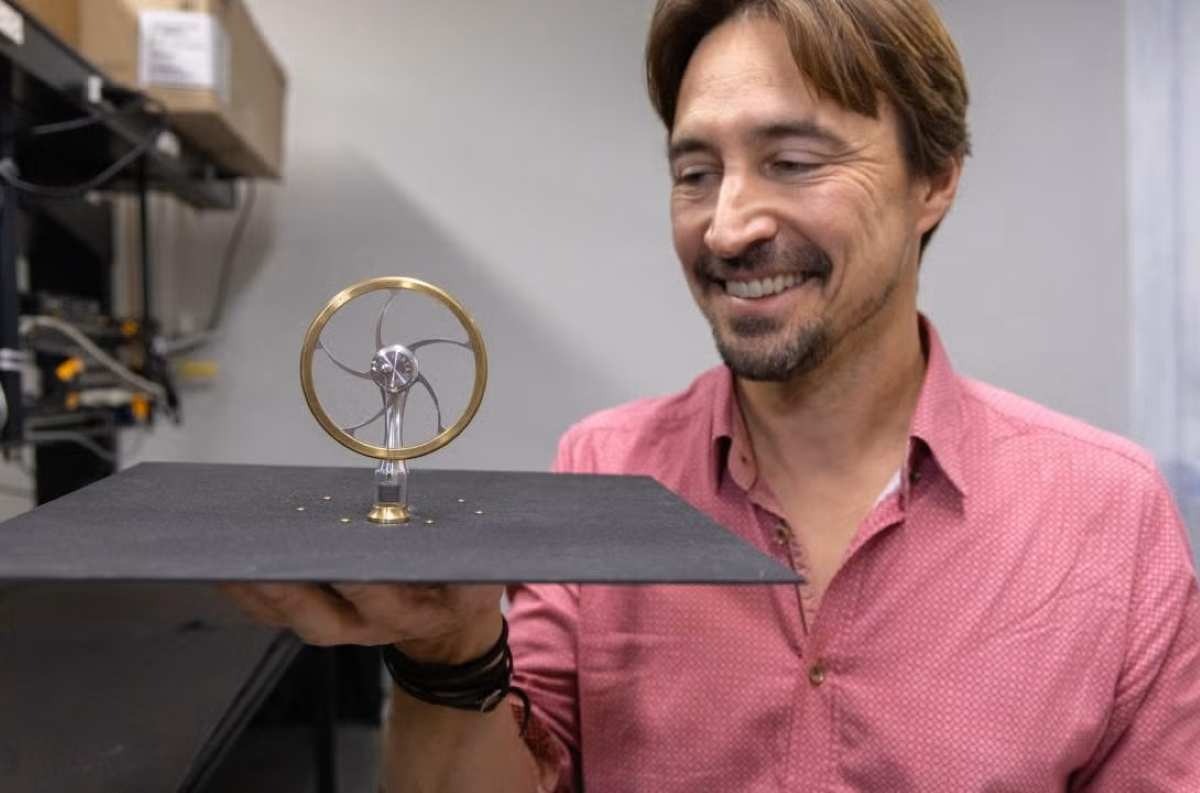
Experimental Technology Transforms The Thermal Contrast Between Heated Soil And Deep Space Into Continuous Mechanical Energy Produced At Night.
The creation of a motor capable of generating mechanical energy at night has caught the attention of researchers for using only the heat stored in the ground and the cold of deep space.
The device, developed by a team at the University of California, Davis, operates outdoors and transforms the temperature difference between the Earth and the night sky into continuous movement, without combustion and without emissions.
This silent operation has made the experiment a milestone for nighttime applications in dry and clear-sky environments, where the thermal contrast is even more pronounced. The system has already demonstrated the capacity to power fans and generate electricity during extended outdoor testing.
-
10 million robots per year in unprecedented industrial scale place China at the forefront of automated production and raise the question of how far machines can manufacture other machines.

-
Researchers in Malaysia buried sensors at 15 and 30 cm and can now predict soil moisture with 95.49% accuracy, helping the field to irrigate only at the right time and reduce water waste.
-
Technology developed to protect military communications in the 1940s scrambled voices and today gives rise to the robotic sound that dominates current music.
-
If you look at the sky this Wednesday, you will see the Pink Moon shining at its peak at 10:11 PM, but before you get disappointed, know that the name has nothing to do with the color and instead refers to flowers that bloom at this time in the United States.

The Idea That Drove The Experiment
Engineers Jeremy Munday and Tristan Deppe started with a simple principle: the Earth retains heat during the day and loses some of it at night through radiative cooling. This process creates a temperature difference sufficient to move a Stirling engine, even with variations considered small for other thermal equipment. The operation occurs because the engine uses external heat instead of generating combustion. With each oscillation of the internal gas, caused by the contrast between heating and cooling, mechanical energy is produced that can move a piston.
The team realized that this combination of terrestrial heat and spatial cold could keep the engine operating throughout the night. To achieve this, the researchers connected the device to a radiative antenna that establishes thermal contact with space, which has an approximate temperature of -270 °C. Thus, the equipment remains between two clearly defined thermal extremes.
How The Stirling Engine Works
The Stirling engine transforms temperature variations into motion by heating and cooling a confined gas. When heat enters the device, the gas expands.
When it cools, it contracts. This alternation creates the necessary cycle to move a piston, generating useful energy. Since the heat source is external, the device does not rely on combustion to maintain operation. This allows the use of solar heat, industrial waste heat, or minimal contrasts, such as heated soil and cool air during the night.
The structural simplicity and silent operation have made the Stirling engine an increasingly attractive option for distributed generation projects. Its efficiency in stable conditions and minimal maintenance increase interest in applications that utilize ambient energy without emissions, especially in places where small thermal differences can represent opportunities for continuous production.
The Thermal Connection With Deep Space
The most innovative aspect of the experiment lies in how the team leveraged radiative cooling. When the sky is clear, the heat emitted by the Earth’s surface dissipates easily, creating an intensified feeling of cold outdoors. The motor developed in Davis uses exactly this characteristic to operate. The antenna installed in the ground directs the heat radiated by the Earth and establishes a constant thermal exchange with space.
Tests conducted over a year showed that the system produces at least 400 milliwatts of mechanical energy per square meter.
This power, although small compared to traditional systems, is sufficient to move fans and power low-consumption electrical generation. In dry, low-humidity areas, the performance has proven even better, reinforcing the device’s potential in regions where nights are colder and the sky remains clear.
Possible Applications At The Current Stage
Even in the experimental phase, the technology already shows practical utility. The motor can be applied in nighttime passive ventilation for greenhouses, allowing air exchange without electricity during sunless periods.
Another possible application involves refrigeration systems that operate without a stable power grid, especially in rural areas facing infrastructure limitations.
Autonomous sensors installed outdoors could operate continuously with low energy demand throughout the year.
Since the motor does not require batteries and does not depend on fuels, its use stands out for reduced maintenance and durability. Regions where temperatures drop quickly after sunset show favorable conditions for the use of this type of equipment, which can help improve the energy efficiency of smaller structures.
The Context Of Similar Research
The research conducted in California is part of a broader movement that seeks to harness natural energy flows without direct human intervention. Related technologies have already been tested in other countries.
In 2023, researchers in Saudi Arabia studied ways to generate nighttime electricity by combining radiative cooling with small thermoelectric generators. The recorded powers were low, but sufficient to power sensors, LED lighting, and other low-consumption devices.
In Europe, funded projects sought to integrate radiant energy systems into sustainable buildings. The idea was to use heat stored during the day and nighttime cooling to reduce air conditioning use, creating hybrid solutions for energy efficiency in urban environments.
Scalability And Possibilities For Expansion
The strength of this technology lies not only in the individual performance of each motor. The difference is in the possibility of simultaneously using multiple devices installed in large areas. Since they operate silently and without emissions, they can be incorporated into rooftops, facades, or urban surfaces without altering the environment.
Production accumulates over time, especially at night when other sources, such as solar energy, are unavailable.
The technical simplicity opens the door for applications in regions of the Global South.
Unlike systems that depend on expensive batteries, the Stirling engine with a radiative antenna provides basic power at night, allowing ventilation, lighting, and refrigeration of medicines in locations without reliable electricity. This characteristic becomes relevant in communities where energy stability is still a distant issue.
A Promising Path To Clean Energy
The creation of the motor represents a breakthrough that utilizes the planet’s natural conditions without altering them.
The thermal contrast between the soil and space transforms into a constant source of mechanical energy, broadening the repertoire of solutions that function even when other technologies are inactive.
In a scenario of climate crisis and the search for quick low-impact alternatives, the experiment demonstrates how small temperature differences can contribute to new generation models.
The development conducted by the team at the University of California, Davis, reinforces a simple idea: the Earth continuously emits heat, and deep space remains cold. Connecting these two extremes, in a controlled and efficient manner, paves the way for systems capable of operating all night long without combustion, noise, or emissions.
The research highlights a type of energy that harnesses the planet’s own dynamics to function and could gain traction as new applications are tested.








-

Uma pessoa reagiu a isso.