





 Portuguese
  English
  Spanish
  4 min of reading
  0 comments


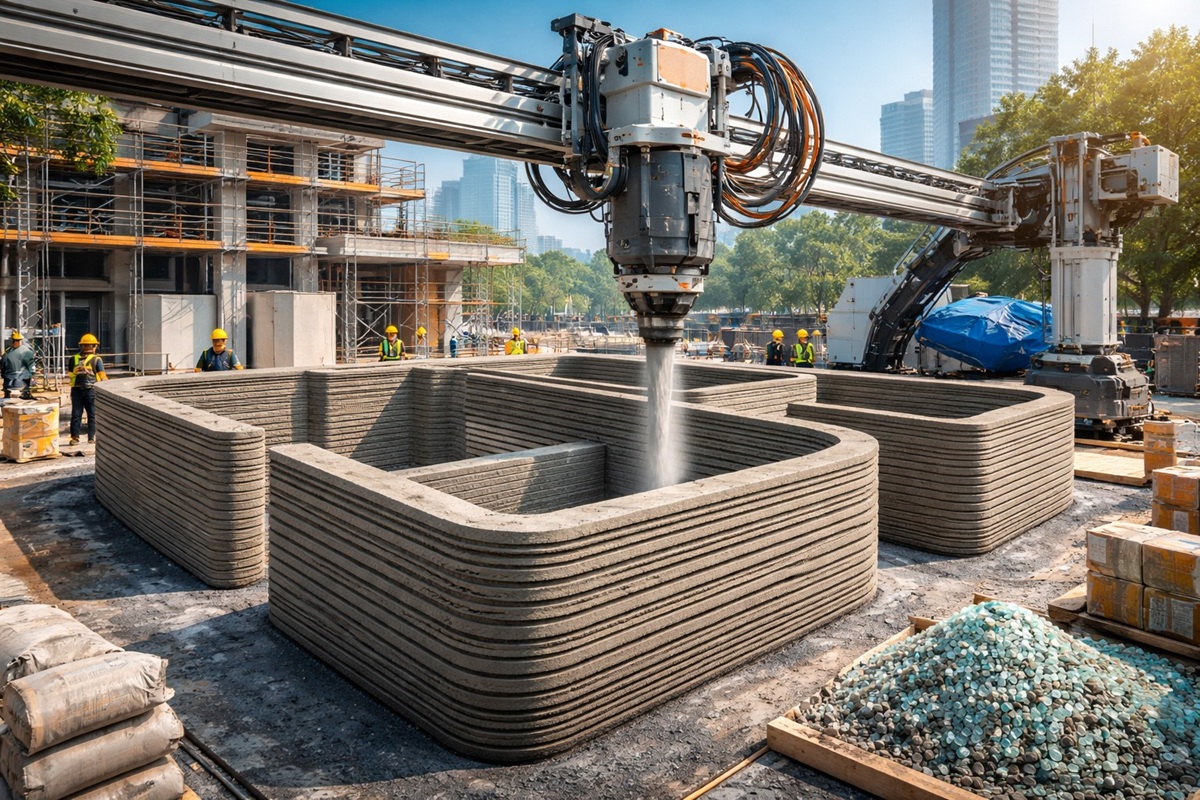
Tests Conducted by the National University of Singapore Validated the 3D Printing of Structural Concrete with Up to 30% Reduction in Material Use, Over 40% Labor Savings, and 50% Fewer Hours on Site, along with a 52% Cut in CO₂ Emissions by Replacing 60% of Cement with Recycled Glass
The 3D printing of structural concrete was validated by researchers from the National University of Singapore, who demonstrated a reduction of up to 30% in material usage and 50% fewer hours on site, with tests conducted in August 2025 and January 2026.
3D Printing of Structural Concrete Advances from Experimental Phase to Validated Application
Researchers from the College of Design and Engineering at the National University of Singapore confirmed that 3D printing of concrete can manufacture real structural components, meeting mechanical, regulatory, and industrial production requirements.
Until now, the use of the technology remained limited to non-structural elements or low-rise buildings, deemed insufficient for demanding urban environments like Singapore.
-
Motorola launched the Signature with a gold seal from DxOMark, tying with the iPhone 17 Pro in camera performance, Snapdragon 8 Gen 5 that surpassed 3 million in benchmarks, and a zoom that impresses even at night.

-
Satellites reveal beneath the Sahara a giant river buried for thousands of kilometers: study shows that the largest hot desert on the planet was once traversed by a river system comparable to the largest on Earth.

-
Scientists have captured something never seen in space: newly born stars are creating gigantic rings of light a thousand times larger than the distance between the Earth and the Sun, and this changes everything we knew about stellar birth.

-
Geologists find traces of a continent that disappeared 155 million years ago after separating from Australia and reveal that it did not sink, but broke into fragments scattered across Southeast Asia.

The tests demonstrated that the technology can surpass this limit, integrating into real construction workflows without requiring a complete reinvention of the construction system.
Reduction of Material, Fewer Molds, and Automation on Site
The advancement is based on the combination of moldless printing and conventional construction techniques. The resulting structural components use only the material strictly necessary, avoiding oversizing due to mold limitations.
The elimination of formwork removes one of the main hidden costs of conventional construction, where each special structural piece requires the manufacturing of a specific, expensive, and limited-use mold.
According to project estimates, 3D printing of concrete allows for material reductions close to 30% compared to traditional techniques.
Laboratory and real-scale tests confirmed that the elements achieve the required loads using significantly less material.
Automation provided labor savings exceeding 40% and efficiency improvements above 60% in complex components.
In August 2025, the first 3D printing in situ of structural elements in Singapore took place, verified by the regulatory authority. The result was 50% fewer work hours compared to conventional methods.
In January 2026, a second phase was initiated, reinforcing the reliability of the process under real operational conditions.
Formulations of Concrete and Integration with Structural Systems
Two pillars support the presented advancement. The first involves new formulations of printable concrete, adjusted for stable extrusion, good layer adhesion, and compatibility with structural reinforcement systems.
The material must not only be printable but also must perform as a load-bearing element for decades.
The second pillar consists of a manufacturing flow aligned with existing industrial prefabrication, encompassing production, transport, and assembly.
The collaboration with the construction company Woh Hup allowed for the evaluation of assembly, logistics, and execution on site, as well as mechanical resistance.
Early engagement with regulators was highlighted as a decisive factor, allowing the innovation to move beyond the laboratory phase.
Replacing 60% of Cement with Recycled Glass Reduces CO₂ Emissions by 52%
The 3D printing of concrete poses the challenge of the high cement content required to ensure printability and initial strength.
In a study published at the end of January 2026, the team developed a printable mix that replaces 60% of Portland cement with powdered recycled glass.
The resulting material achieved compressive strengths exceeding 50 MPa, suitable for structural components.
Besides strength, a 44% reduction in embodied energy and a 52% decrease in CO₂ emissions were recorded compared to conventional printable mixes.
The material also demonstrated greater resistance to chloride penetration, translating into higher durability and lower maintenance needs.
Local waste, previously of no structural value, has begun to be used as raw material in the manufacture of components.
Urban Impact and Potential to Transform the Sector
The 3D printing of structural concrete does not entirely replace traditional construction but can progressively complement and transform the sector.
The potential includes accelerating housing construction in dense urban environments, reducing worker exposure to repetitive tasks, and decreasing the sector’s environmental footprint.
The combination with low-carbon materials, local waste, and design criteria focused on efficiency amplifies the impact of the technology.
The project demonstrates that construction can be thought of with less waste and greater material intelligence.
The results obtained in Singapore indicate that 3D printing is already being applied layer by layer under real site conditions.
More information: Shin Hau Bong et al, High-volume glass powder cementitious material for low-carbon concrete additive manufacturing, Construction and Building Materials 2026. DOI 10.1016/j.conbuildmat.2026.145431.








-

Uma pessoa reagiu a isso.