





 Portuguese
  English
  Spanish
  6 min of reading
  0 comments


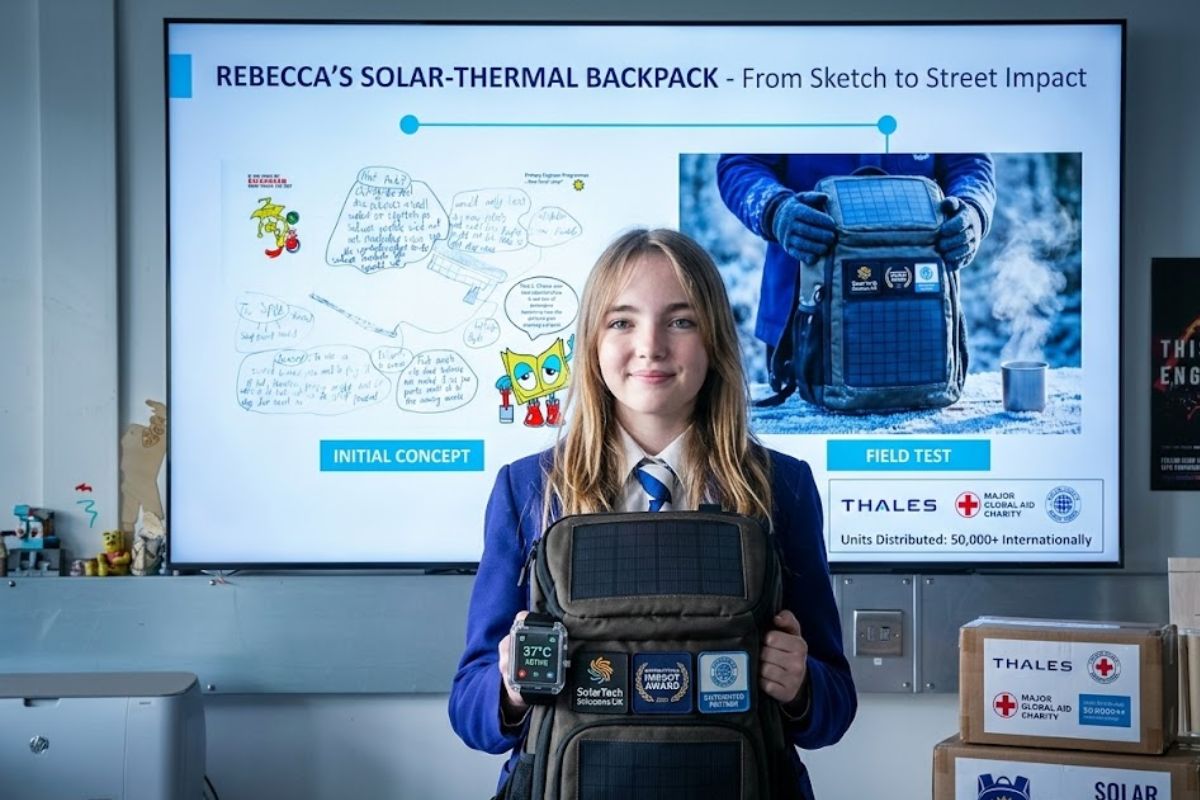
Inspired by Seeing People in Homeless Situations Facing Sub-Zero Temperatures in Winter, Rebecca Young Transformed a Design into a Prototype: A Solar-Powered Backpack That Activates an Electric Blanket. After Winning a Contest with 70,000 Registrations, the Invention Gained Production and Distribution by Six Institutions in Glasgow.
Rebecca Young was 13 years old when she decided that she didn’t want to just observe winter tightening its grip on the sidewalks of Glasgow. Seeing people in homeless situations facing sub-zero temperatures, she imagined a practical response: a set that combined shelter and energy autonomy, using solar energy as a starting point to warm those who spend the night outdoors.
The idea, which started as a drawing, took shape as a prototype and crossed borders. Rebecca was named one of the 10 Girls of the Year by Time magazine, in a list that seeks to highlight female achievements even in adolescence, and saw her invention come to life: units were produced and distributed through support institutions in Glasgow, broadening the debate on social innovation and technology applied to care.
From the Street to the Prototype: When the Problem Becomes a Project

The origin of the project does not lie in a sophisticated laboratory, but in a challenging and uncomfortable everyday scenario: the contrast between illuminated shop windows and freezing nights in Glasgow. It was there that Rebecca connected a real discomfort to a simple yet powerful question: what could be created to help someone get through winter more safely?
-
Motorola launched the Signature with a gold seal from DxOMark, tying with the iPhone 17 Pro in camera performance, Snapdragon 8 Gen 5 that surpassed 3 million in benchmarks, and a zoom that impresses even at night.

-
Satellites reveal beneath the Sahara a giant river buried for thousands of kilometers: study shows that the largest hot desert on the planet was once traversed by a river system comparable to the largest on Earth.

-
Scientists have captured something never seen in space: newly born stars are creating gigantic rings of light a thousand times larger than the distance between the Earth and the Sun, and this changes everything we knew about stellar birth.

-
Geologists find traces of a continent that disappeared 155 million years ago after separating from Australia and reveal that it did not sink, but broke into fragments scattered across Southeast Asia.

This type of shift, from looking to acting, often defines the most useful inventions. Rebecca didn’t start with an abstract goal, but rather a pressing need, using solar energy as a viable alternative when there is no outlet, heated shelter, or any guarantee of infrastructure. The message she shares with other young people follows the same logic: identify a problem, reject the idea that it is permanent, and try to build a response.
How the Solar-Powered Backpack Connects to the Thermal Blanket

The central concept combines two layers of solution. The first is the backpack itself, designed to be carryable and protective, and the second is the electric thermal blanket within the set, which relies on a power source to function. The choice of solar energy places heating in the realm of autonomy, even though the available light in winter is limited and variable.
In engineering terms, proposals of this type usually require three concerns simultaneously: generating electricity, storing energy, and delivering heat in a controlled manner. The generation comes from the photovoltaic principle, where a panel converts light into electricity.
Storage typically involves some type of battery or electric reservoir, and the delivery of heat needs to be stable to avoid waste and reduce risks. The important detail here is the objective: it is not “comfort,” it is thermal survival, especially when the temperature drops below zero.
There is also a practical dimension that tends to be invisible to those who only read the headline: portable systems need to function simply. If the proposal is to support people experiencing homelessness, the set cannot require complex steps, frequent maintenance, or ideal conditions to operate.
The technology, in this case, only makes sense when it adapts to the street, and not the other way around. This is where the logic of solar energy emerges again as a strategic element, seeking to reduce dependencies.

From Award to Real World: Contest, Manufacturing and Distribution

The project gained traction after winning an engineering award in a national competition in the United Kingdom that received 70,000 registrations.
This volume of competition helps explain why the invention caught attention, as the recognition came in an environment with a high diversity of ideas and proposals evaluated.
After that, the transition to the physical world was not just a promise. The engineering company Thales, sponsor of the contest, manufactured 30 blankets and distributed them to six charities focused on homeless individuals in Glasgow at the beginning of the year.
In addition to this batch, a plan was mentioned to produce another 120 units. When a prototype reaches support institutions, it begins to be tested where it matters most, in direct contact with the routines and limitations of those living on the street.
This point often separates “pretty” inventions from useful ones: logistics. Producing, distributing, guiding institutions, and ensuring that the item reaches the right hands requires coordination, criteria, and continuity.
Solar energy, here, ceases to be just a technological component and becomes part of an access strategy: the attempt to provide heating where infrastructure fails.
International Recognition and the Symbolic Weight of “Girl Builder”
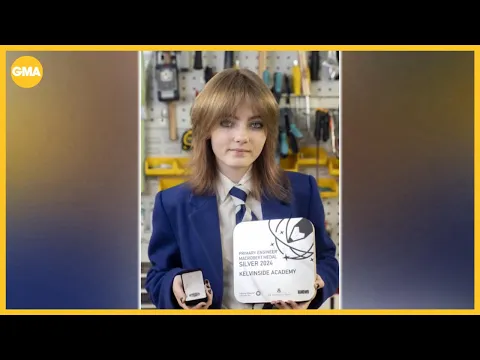

The recognition from Time magazine placed Rebecca alongside nine other girls from different countries, in a list created to highlight female achievements in youth.
Among them are fantasy writer Rutendo Shadaya, 17, born in Zimbabwe and based in New Zealand; Olympic skateboarder Coco Yoshizawa, 15, from Japan; and organ donation advocate Naomi S. DeBerry, 12, from the United States. Nine of the ten girls were reimagined as Lego figures on the cover of the issue.
The list was launched in partnership with the Lego Group as an extension of the “She Built That” campaign, which seeks to challenge stereotypes and encourage girls to see themselves as builders. This symbolic framing matters because it changes the social expectation of who “can” invent.
The speech associated with the launch reinforces this idea: their generation doesn’t have to wait until adulthood to lead change, because change can start when someone identifies a problem and refuses to treat it as normal.
By connecting solar energy and heating for people experiencing homelessness, the project also changes the narrative about innovation. Instead of technology as a luxury, technology appears as care.
The invention becomes public language, not just a technical item: it speaks of winter, inequality, urgency, and at the same time, possibility.
What This Story Reveals About Social Technology in Urban Winter
There is a reason why projects like this resonate: they expose a tension that is hard to ignore. In cities that function with services, commerce, and mobility, there are still people enduring freezing nights outside. When a teenager creates a response, the issue stops being distant and gains a face, narrative, and moral pressure.
At the same time, the story helps set realistic limits on the conversation. A solar backpack and thermal blanket do not “solve” homelessness, which involves housing, health, income, public policies, and support networks.
But targeted solutions can reduce immediate harm, especially during critical winter periods. Social technology does not replace structure, but it can save time, warmth, and dignity while that structure does not arrive.
This is where Rebecca’s project becomes most interesting: it does not promise the impossible. It tries to lessen the impact of real cold, in a real city, for real people, with solar energy functioning as a tool of autonomy.
And when units reach support institutions, the invention enters a decisive stage: to be improved, reevaluated, and perhaps inspire even more accessible versions.
Rebecca Young’s story draws attention not only for having solar energy at its center, nor for coming from a 13-year-old student.
It draws attention because it frames winter as a human engineering problem, where every design choice must fit into the lives of those without shelter.
I want to hear from you directly: have you ever seen any simple solution that could alleviate the lives of homeless people in your city, especially in the cold?
And if solar energy could be applied to more “urban survival items,” what idea would you prioritize: heating, lighting, phone charging, or another need that almost nobody sees?








-

-

-

17 pessoas reagiram a isso.