





 Portuguese
  English
  Spanish
  3 min of reading
  0 comments


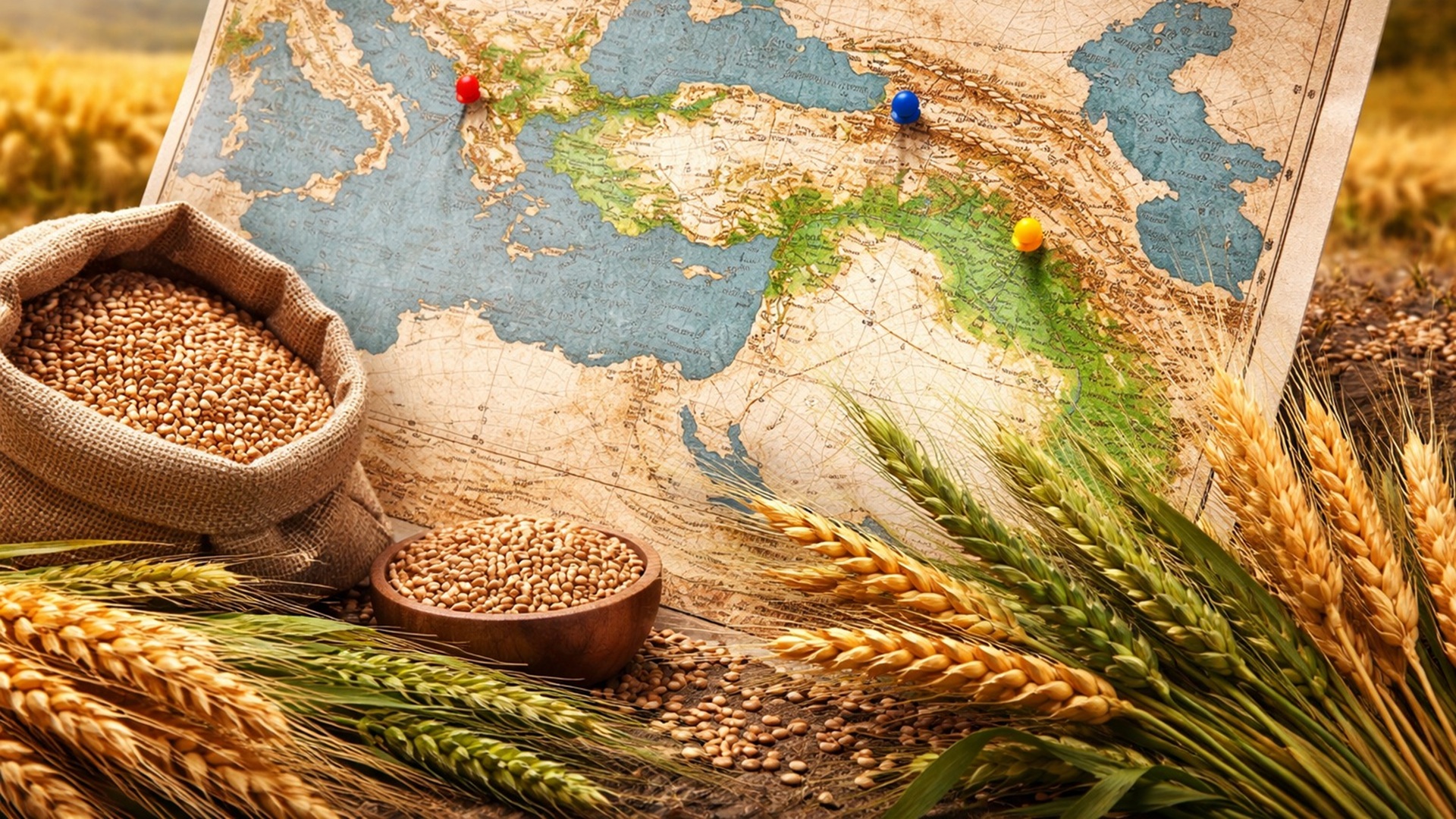
Modeling With Machine Learning and Climate Simulations Reconstructs the Distribution of 65 Wild Species in Western Asia and Indicates That Wheat, Barley, and Rye Were Concentrated on the Mediterranean Coast of the Levant 12,000 Years Ago, Contradicting Traditional Hypotheses About Domestication
A study published in Open Quaternary mapped where wheat, barley, and rye grew 12,000 years ago and indicates that these species were less widespread in the Middle East than previously believed, with a concentration along the Mediterranean coast of the Levant.
Wheat, Barley, and Rye Were Less Widespread 12,000 Years Ago
Researchers from the University of Copenhagen and the University of the Basque Country reconstructed the probable geographic distribution areas of 65 species of wild plants associated with early agriculture in Western Asia.
Among these species are the wild ancestors of wheat, barley, rye, lentils, and other crops that initiated the agricultural revolution over 10,000 years ago.
-
Scientists have created robots made with living cells that have their own nervous system, swim on their own, explore the environment, and self-organize without any genetic engineering, and now they want to do the same with human cells.

-
Students create a solar-powered ambulance that operates without a plug, without fuel, and still keeps medical equipment running in remote areas.

-
French “ghost” submarine lost in World War II reappears after more than 80 years on the seabed near the coast of Spain.

-
A simple stitch in wood with nylon thread can reduce adhesives, speed up production, and make sheets up to 4 times stronger and 14 times more difficult to break.

Using advanced machine learning and climate models, the study demonstrated that the ancestors of crops such as wheat, barley, and rye were likely much less widespread in the Middle East 12,000 years ago than previously thought.
According to the authors, the data challenge traditional assumptions about the geography of plant domestication and early agriculture.
Reconstruction of Natural Vegetation at the Beginning of the Neolithic
The first agricultural societies established themselves in the Middle East about 12,000 years ago, according to evidence from artifacts, seeds, and animal bones recovered in archaeological excavations.
According to archaeologist Joe Roe from the University of Copenhagen, little is known about the natural vegetation of these areas, making it challenging to determine where Neolithic peoples found the plants they eventually domesticated.
Based on the new data, the ancestors of key plants for modern agriculture, such as wheat, rye, and barley, did not grow where expected and were also much less widespread than thought.
Researchers state that this alters the understanding of the ecological context in which the transition from gathering to agriculture occurred.
Concentration on the Mediterranean Coast of the Levant
Roe and archaeobotanist Amaia Arranz-Otaegui identified that many ancestors of the early agricultural cultures appear to have concentrated on the Mediterranean coast of the Levant.
The study suggests that this region may have acted as a refuge during the extremely harsh climate at the end of the Ice Age.
According to Arranz-Otaegui, many wild crops were well adapted to cold and dry conditions and did not necessarily expand with the arrival of a warmer and wetter climate.
This finding indicates that wheat, barley, and rye may have remained restricted to specific areas even with significant climate changes during the period.
Methodological Innovation With Machine Learning and Climate Models
The study combined large open datasets on the current distribution of plant species with advanced computational simulations of the past global climate.
The researchers used the same climate simulations employed by the IPCC to predict future climate, but in reverse, integrating them into a machine learning model regarding the environments to which plants are adapted.
This approach allowed for the creation of detailed maps that indicate where ancient plants likely grew.
According to the authors, the modeling represents a new line of evidence for understanding the ecological context of early agriculture.
By not relying on archaeological preservation, which can be affected by burial, human activity, and recovery biases, the methodology offers an independent view of ancient vegetative environments.
New Portrait of the First Agricultural Landscapes
Taken together, the findings provide the clearest portrait yet of where the world’s first agricultural plants grew.
The study also details the type of landscapes in which ancient communities lived when they made the transition from gathering to agriculture.
For the authors, the combination of machine learning and climate simulations expands the understanding of how wheat, barley, and rye were distributed at the end of the Ice Age.
The researchers conclude that the results offer a completely new perspective on the ecological context of the world’s first farmers and the landscapes that shaped the emergence of early agriculture.







-

Uma pessoa reagiu a isso.