





 Portuguese
  English
  Spanish
  3 min of reading
  1 comment


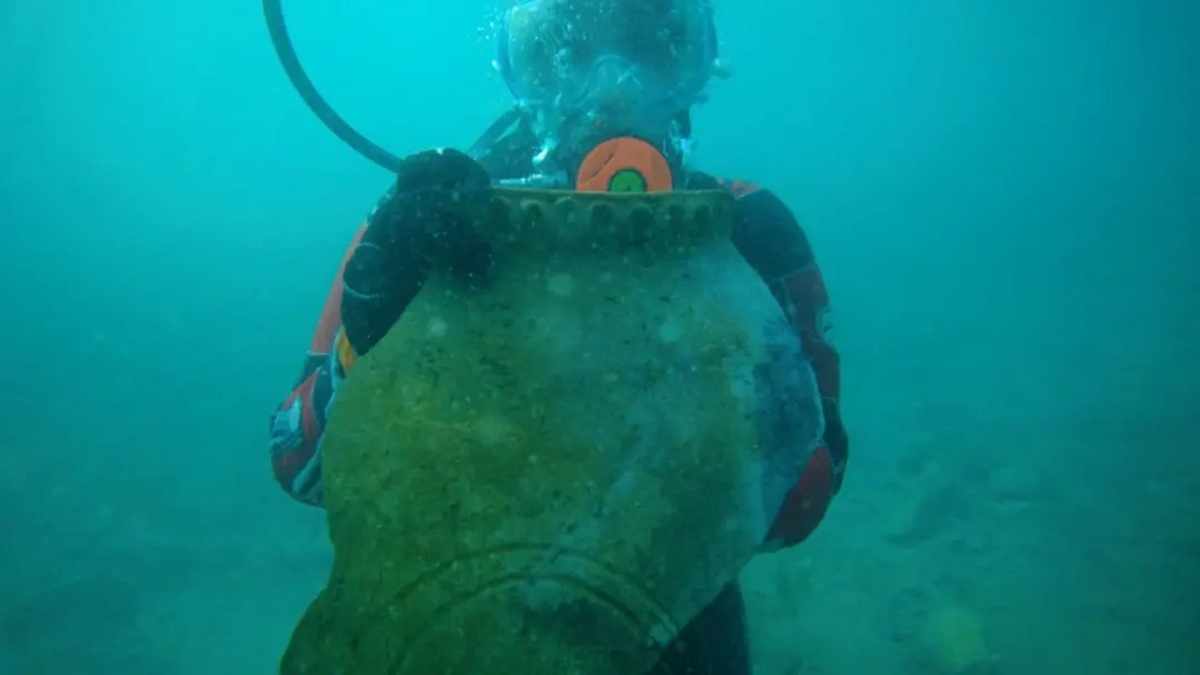


Russian Academy of Sciences Expedition Discovers Preserved Remnants of a City Engulfed After an Earthquake, Including Structures, Artifacts, and a 13th Century Muslim Necropolis.
Archaeologists revealed an extraordinary discovery by locating a vast submerged city from the ancient Silk Road in Issyk Kul Lake, in western Kyrgyzstan. The team from the Russian Academy of Sciences dove into the cold waters of this 25 million-year-old alpine lake and found remnants of an urban center that was engulfed after a devastating earthquake.
The find gained international attention as the New York Post compared the site to a true lost Atlantis.
A City Engulfed by an Earthquake
Researchers identified the remains of a secret settlement that served as an essential stop for travelers and merchants.
-
After decades of failed attempts, Brazil is once again looking to space with an orbital rocket measuring 12 meters, weighing 12 tons, costing R$ 189 million, and scheduled for launch in 2026, in a new race to finally achieve autonomous access to orbit.

-
The Earth will plunge into a few minutes of darkness in broad daylight in August 2026, when a total solar eclipse transforms the sky into one of the most impressive astronomical phenomena in recent years.

-
How the terraforming of Mars can transform the planet: artificial aerosols can increase the temperature by up to 35°C in 15 years, creating conditions for liquid water.

-
Scientists drilled nearly 8,000 meters into the ocean floor above the fault that caused the 2011 tsunami in Japan and discovered that a layer of clay 130 million years old was responsible for making the wave much worse than any model had predicted.
The site housed an extensive Muslim necropolis, underscoring its significant role along the trade route connecting East and West.
The team conducted the investigation through four distinct layers of the lake, which allowed them to accurately map and document the preserved structures.
This process paved the way for more detailed studies that should deepen knowledge about the submerged complex.
Toru Aygyr Complex and the First Finds
The archaeological site, officially named the Toru Aygyr complex, is located near the northwest shore of Issyk Kul Lake.
The archaeologists dove into shallow waters between 1 and 4 meters, but the shallow depth did not diminish the impact of the finds. The short distance from the shore contrasted with the historical depth revealed by the structures found.
According to The New York Post, this initial area revealed baked brick constructions, including one that preserved a medieval grain millstone. Although many walls have collapsed, wooden beams remained in remarkable condition, something highlighted by the researchers.
Additionally, Heritage Daily reported that the expedition identified what may have been a building of great public importance.
The structure raised hypotheses about being a mosque, a public bath, or a madrasa.
The area also featured a vast 13th-century necropolis, composed of clay brick tombs and rectangular forms yet to be interpreted.
The New York Post described skeletons found face down, oriented toward the north, in accordance with traditional rituals, facing the qibla.
Evidence of a Strategic Commercial Center
Valery Kolchenko, lead researcher from the National Academy of Sciences, confirmed the magnitude of the discovery by identifying the site as a significant city or commercial center within the Silk Road. The New York Post described the site as a large commercial hub that thrived for over 1,500 years, from the 2nd century BCE to the mid-15th century.
During this period, merchants traded silk, spices, metals, and even essential concepts that shaped history. This intense flow made the city a strategic point within the most important trade route of the time.
A Sudden End and New Directions for Research
The history of the site ended abruptly. A major earthquake caused its structures to collapse and sink beneath the lake.
The team believes that the inhabitants fled before the disaster, leaving room for nomadic groups to occupy the ruins at some later point.
Now, Kolchenko and his team are working to reconstruct this lost city. The first artifacts are undergoing detailed analysis, while new dives are expected to expand understanding of the site.
The question guiding the archaeologists remains open: what other secrets does this submerged city still hold?







Bom se descobrissem o nome real da cidade. Deve ter sido muito importante pra durar 1500 anos.