





 Portuguese
  English
  Spanish
 4 min of reading
  0 comments


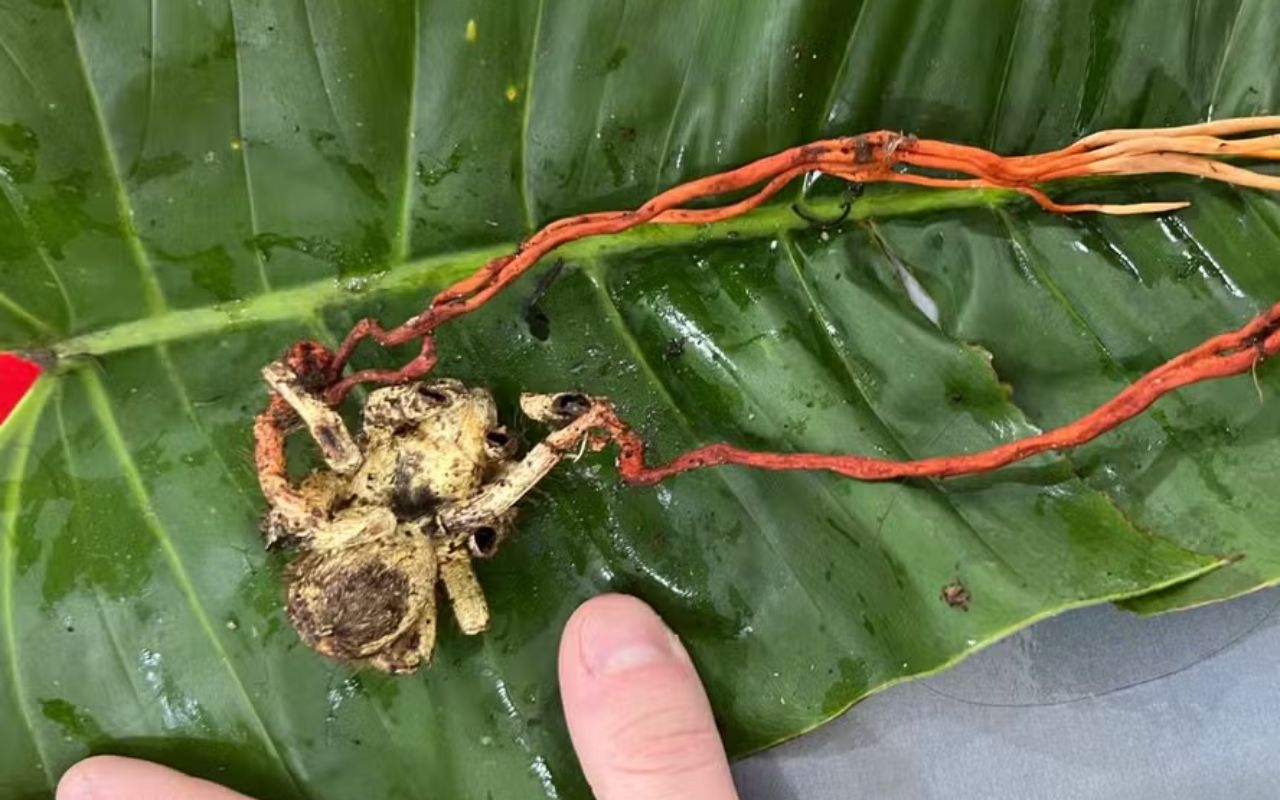
Scientists Register Tarantula Dominated by Zombie Fungus in the Amazon. Rare Phenomenon Reveals the Complexity of Brazilian Biodiversity.
A parasite fungus capable of turning a tarantula into a true “zombie” was recorded by researchers in the Amazônia rainforest, near Manaus, confusing curious people and specialists on social media.
The phenomenon was captured on video by scientists during a field expedition, showing the organism dominating the animal’s body and awakening comparisons to the fictional universe of zombies, although it does not pose a risk to humans.
How Does the Fungus Act on the Host?
Brazilian and Danish researchers identified a gigantic tarantula of the species Theraphosa blondi covered by a fungus of the genus Cordyceps, colloquially known as “zombie fungus” for its ability to take control of its host and manipulate it metabolically and behaviorally.
-
Motorola launched the Signature with a gold seal from DxOMark, tying with the iPhone 17 Pro in camera performance, Snapdragon 8 Gen 5 that surpassed 3 million in benchmarks, and a zoom that impresses even at night.

-
Satellites reveal beneath the Sahara a giant river buried for thousands of kilometers: study shows that the largest hot desert on the planet was once traversed by a river system comparable to the largest on Earth.

-
Scientists have captured something never seen in space: newly born stars are creating gigantic rings of light a thousand times larger than the distance between the Earth and the Sun, and this changes everything we knew about stellar birth.

-
Geologists find traces of a continent that disappeared 155 million years ago after separating from Australia and reveal that it did not sink, but broke into fragments scattered across Southeast Asia.

The record was made during field activities of the Tropical Mycology Field Course, an intensive course in mycology (the study of fungi) held at the Ducke Reserve, near Manaus.
The fungus infiltrates the tarantula’s body through spores, adhering to the exoskeleton and entering the organism through a combination of mechanical and enzymatic processes.
Once inside the body, the parasitic structure consumes internal tissues and interferes with the spider’s nervous system, leading to behavioral changes before the animal’s death.
This process partly resembles mechanisms observed in other species of fungi that manipulate their hosts, such as Ophiocordyceps unilateralis, famous for turning ants into “zombie ants” in tropical forests.
After the tarantula’s death, the fungus grows externally and exhibits orange reproductive structures, which produce spores ready to infect new organisms.
The researcher explains that the incident occurred when the fungus had already completed nearly its entire parasitism process.
At this point, the organism had completely consumed the internal structures of the tarantula and began to develop externally, a stage that precedes its multiplication in the environment through spore production.
“The spores will be released and will infect other giant spiders of the Amazon,” the researcher explains in the video.
Why Is the Phenomenon Compared to Zombies?
Despite the unusual and even disturbing appearance, scientists emphasize that this type of interaction between fungi and arthropods is part of the natural dynamics of biodiverse ecosystems.
What makes the case exceptional is not the phenomenon itself, but the fact that it was recorded so clearly in a large species.
In a second video, Drechsler-Santos expands on the meaning of the discovery and highlights its impact beyond science. “Documenting this richness in our natural ecosystems represents a scientific, social, and economic advancement, as well as a matter of national sovereignty,” he explains.
For the researcher, the rarity of the finding helps to gauge how little is still known about Brazilian fungi and their relationship with the environment.
“That’s why I’m so emotional about finding such a rare species. Documenting the diversity of fungi in Brazil is also about understanding the state of conservation of our fungi.”
The idea of “zombie” comes from the fact that the fungus takes physiological control of the host until death, a scenario frequently portrayed in pop culture — especially in the series and video game The Last of Us, where a mutant fungus infects humans and transforms them into erratic and violent creatures.
In real life, real parasitic fungi do not infect humans, and specialists emphasize that the finding does not pose a risk to the population.
Ecological and Scientific Importance of the Finding
Fungi play a fundamental role in natural ecosystems, acting in the nutrient cycle and as regulators of small animal and insect populations.
For researchers, documenting such an explicit case of parasitism in a tarantula so large broadens the understanding of the fungal diversity in the Amazon — a region that houses a vast variety of species that are still poorly studied.
This type of discovery may also generate insights into complex ecological interactions between fungi and arthropods, as well as potential interest in medical and biotechnological research, since fungi produce bioactive compounds used, for example, in antibiotics like penicillin.
Although the image of a fungus turning a tarantula into a “zombie” may seem like something out of a movie, the phenomenon is a real example of how certain fungi manipulate and exploit their hosts in nature.
Experts highlight that, despite the superficial resemblance to fictional stories, there is no evidence that these fungi can infect humans or cause similar effects in mammals.
Thus, the occurrence serves as a alert about the complexity of natural life and the importance of preserving biodiversity-rich habitats, such as the Amazon rainforest, where many biological mysteries still await discovery.
Source: Galileu Magazine








-

-

-

-

-

25 pessoas reagiram a isso.