





 Portuguese
  English
  Spanish
  4 min of reading
  1 comment


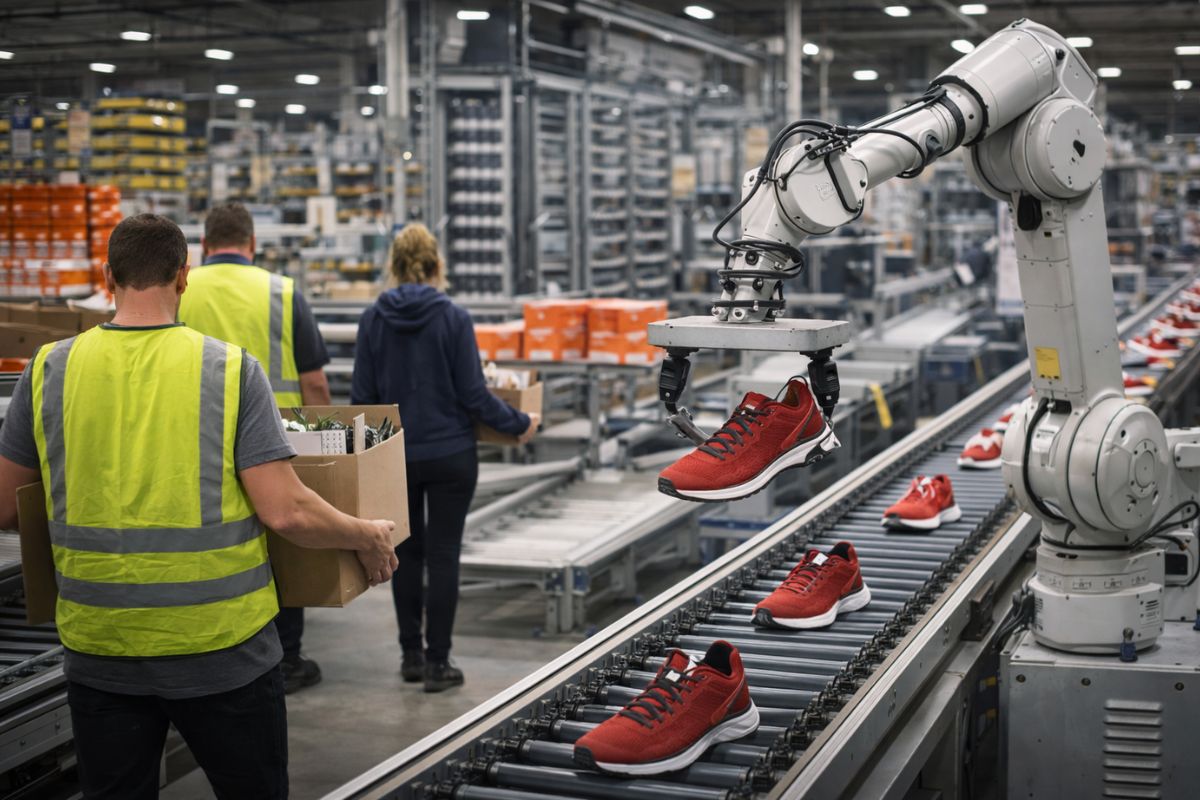


The Sneaker Giant Nike Confirms Cuts In Distribution Warehouses And Concentrates The Impact In Tennessee And Mississippi, Saying It Wants To Reduce Complexity And Gain Flexibility. The Promise Is To Accelerate Automation And Advanced Technology, Reorganize Inventories, And Return To Growth After A Strategy That Inflated Teams And Centers.
The sneaker giant Nike announced it will lay off 775 employees primarily associated with distribution functions in the United States, with a stronger impact on operations in Tennessee and Mississippi. The number is large enough to signal a public shift, not just an internal adjustment.
The cut comes packaged in a discourse of “more agile operations” and a shift in the supply chain. The issue is that this shift occurs after a strategy that increased distribution centers and teams, but did not deliver the expected volume, precisely at a time when the company is trying to recover sales.
Why 775 Became The Number That Exposes The Shift
The central justification is to reduce complexity and increase flexibility.
-
The government requests the Federal Revenue Service for a new system to automate the income tax declaration, reducing errors, time, and bureaucracy for millions of Brazilians.

-
Pix in installments, international Pix, and contactless payment without internet: the Central Bank revealed the new features coming to the tool that is already used by almost every adult in Brazil.

-
Mercado Livre has just started selling medications with delivery in up to three hours to your door, and this move could completely change the way Brazilians buy medicines on a daily basis.

-
In Dubai, rising tensions from the war in the Middle East are causing super-rich individuals to leave the Gulf and direct their fortunes to a new financial refuge in Asia.


The company points out that it seeks a more agile, resilient, responsible, and efficient operation, directly linking this to the advancement of automation.
When the word is efficiency, the target is often people, especially in repetitive activities in distribution centers.
The cut also reveals the extent of the brake applied.
If logistics were bloated, it was not by chance; it was because the structure was built for one type of strategy and now needs to serve another.
The layoff of 775 appears as a marker that the reconfiguration will not be smooth or invisible.
Tennessee And Mississippi At The Center Of The Internal Map
The geographical cut is not a detail. Tennessee and Mississippi are cited as points where Nike operates large warehouses, and therefore concentrate distribution functions that tend to be reorganized when the supply chain changes its design.
It is there that the impact appears first, because it is where the physical flow of stock is most sensitive to any adjustment.
This focus also helps to understand the type of position most exposed.
In distribution centers, the company can replace part of the work with automation, redesign shifts, integrate sorting and shipping systems, and reduce manual steps.
The risk is that the transition, when accelerated, creates a period of operational instability that the company tries to hide behind goals and corporate language.
Automation And Advanced Technology As Promise And Threat
Nike says it is enhancing the supply chain and accelerating advanced technology and automation.
The problem is that “automation” becomes an umbrella term, because it can mean anything from better routing and picking systems to physical robots and more automated sorting.
In the materials, there are no details on how automation will be expanded and what the exact impact will be on the announced layoffs.
This void is important because without design and schedule, the promise becomes just a narrative to calm the market, while the immediate effect falls on specific employees and regions.
The Drop In Sales, The Weight Of Inventory, And The Change In Commercial Direction
The cut occurs while CEO Elliott Hill tries to rebuild the company after a significant drop in sales, attributed to a strategy by former executive John Donahoe that prioritized direct sales and reduced the weight of wholesale partners.
This disrupts logistics in a brutal way, because selling directly changes rhythm, inventory, returns, and distribution.
With the change, distribution centers and the number of employees increased, but production volume did not compensate for the size of the team, according to people familiar with the matter cited in the base.
Now, management is talking about regaining wholesale partners, liquidating obsolete inventory, and innovating, suggesting that the problem was not just a lack of demand, but also a bad operational architecture.
What Weighs On The Cash Flow Beyond Logistics
In December of last year, Nike reported that net income fell 32%, citing tariffs, restructuring-related costs, and a slowdown in China, described as its main market.
This trio explains why the discourse of efficiency becomes the top priority, as it tries to compensate for an external environment that worsened simultaneously.
The sensitive point is that when costs rise and the market slows, the company usually seeks two quick levers: cut expenses and adjust inventory.
The layoff of 775 fits into this logic as a quick action, while the deeper restructuring tries to solve what inflated distribution centers in the recent past.
The sneaker giant is trying to sell the idea that laying off 775 and automating is an inevitable step to recover sales, reduce complexity, and make the supply chain more flexible.
However, the detail that remains is this: the company is publicly correcting a logistics system that grew for a strategy that did not hold up.
I want a practical and personal response: if you depended on a job in a distribution center, would you prefer a slow transition with more security or accelerated automation that promises “the future” but cuts 775 now? And, as a consumer, do you think Nike will grow faster again with wholesale partners or by insisting on direct sales?









Lamentavelmente essas crises no mercado consumidor afeta quase tudo, inclusive a saúde mental dos que mais precisam, enqaunto ****, que os mais pobres votam nele, são os que mais sofrem porque na maoria acham que **** é a salvação deles. Vamos pedir a DEUS pelas pessoas humanas e bem intencionadas, verdadeiramente, em olhar pelo povo Brasil. FORA LULADRAO **** DESGRAÇADO.