





 Portuguese
  English
  Spanish
  6 min of reading
  0 comments


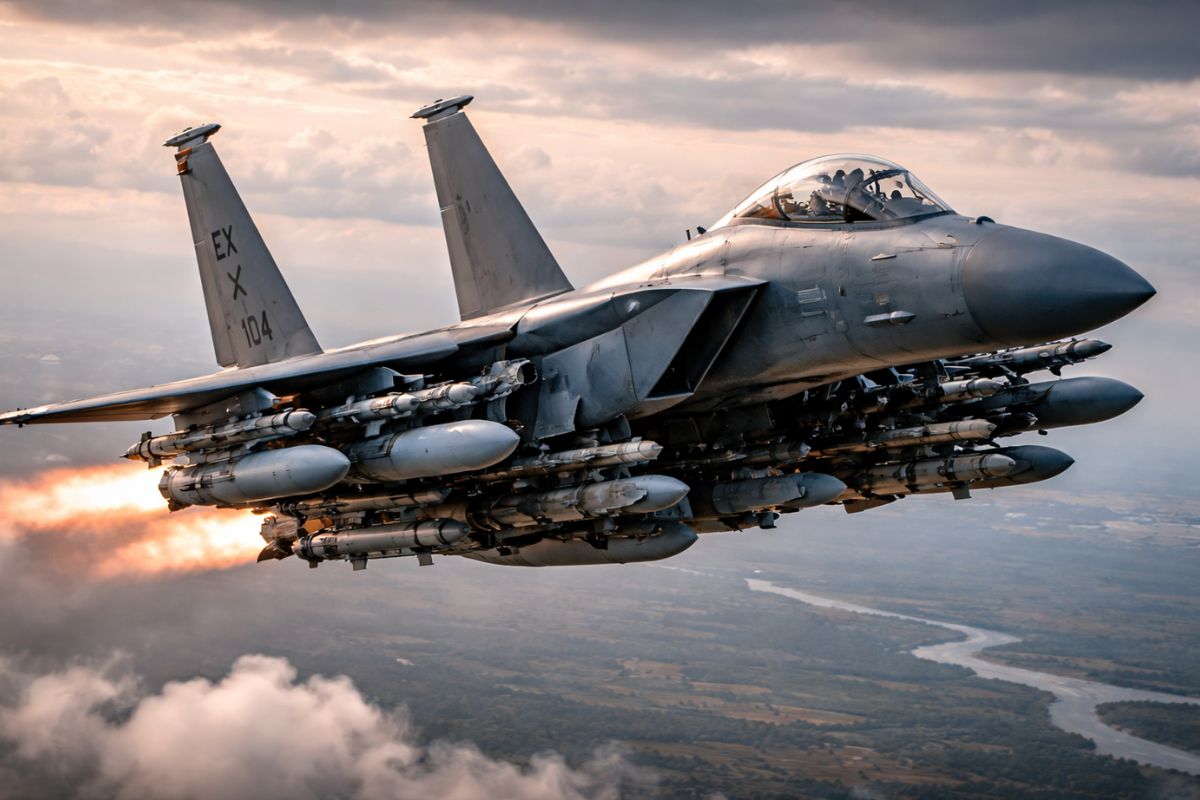
Called the Missile Truck, the F-15EX Eagle II Gains Ground in the American Strategy by Prioritizing Power, Fuel, and a Payload of 13.3 Tons, with Up to 22 Missiles or 28 GBU-39 Bombs. The Promise is Simple: Maintain Sustained Fire When Stealth Clears the Way and Transforms Paradox into Operational Doctrine.
The F-15EX Eagle II is at the center of a choice that bothers stealth purists: in 2026, the U.S. Air Force bets on a large, visible fighter packed with weapons to address a problem that isn’t always present in briefings, that of sustained fire capability in high-demand scenarios.
The lingering question is less about nostalgia and more about operational mathematics. Who needs to take out the target after the door is opened, how much armament arrives per sortie, where the platform remains relevant, and why speed and range continue to be strong currencies in aerial warfare, even when public discourse revolves around “invisibility”.
Why a Non-Stealthy Fighter Has Come to Be Viewed as a Solution in 2026

The paradox of the F-15EX Eagle II arises from the contrast between appearance and function. It does not try to be discreet.
-
Motorola launched the Signature with a gold seal from DxOMark, tying with the iPhone 17 Pro in camera performance, Snapdragon 8 Gen 5 that surpassed 3 million in benchmarks, and a zoom that impresses even at night.

-
Satellites reveal beneath the Sahara a giant river buried for thousands of kilometers: study shows that the largest hot desert on the planet was once traversed by a river system comparable to the largest on Earth.

-
Scientists have captured something never seen in space: newly born stars are creating gigantic rings of light a thousand times larger than the distance between the Earth and the Sun, and this changes everything we knew about stellar birth.

-
Geologists find traces of a continent that disappeared 155 million years ago after separating from Australia and reveal that it did not sink, but broke into fragments scattered across Southeast Asia.

It seeks to be useful when the airspace is already partially “organized” by other platforms, and when what matters is the quantity of weapons, range, and time on station to maintain pressure.
This disrupts a common intuition that modern aerial warfare would be an exclusive corridor for stealthy vectors.
However, in practice, there is a second problem, almost bureaucratic, which is making the volume happen. An identified target does not destroy itself, and a window opened by stealth does not last forever.
It is in this interval that the F-15EX Eagle II comes in as a tool for execution, not as an entry tool.
From the Wound of Vietnam to the First Flight of 1972, the DNA of the Eagle
To understand why the Eagle family still influences decisions, it is worth revisiting the context of its origin.
At the end of the 1960s, the United States emerged from the Vietnam War with an “open wound,” according to the narrative spread among military personnel and analysts, because it exposed problems of doctrine, training, identification, and rules of engagement, along with the real limitations of programs that were sophisticated on paper but restrictive under certain conditions.
In the same period, the Soviet Union introduced a new generation of fighters, raising alarms in Washington.
The result is a clear priority: air superiority, speed, and long-range firepower.
The F-15A made its first flight in July 1972 and entered service in 1976 with a proposal that already contained the germ of the current debate, not everything is close combat, and gaining time, altitude, energy, and range can be decisive.
From F-15C/D to F-15E, the Evolution that Prepared the Ground
In 1979, the single-seat F-15C and the two-seat F-15D entered the scene, featuring improvements such as more internal fuel and greater maximum weight.
Over the decades, the Eagle family accrued a rare reputation, with over 100 aerial victories and no combat losses to enemy action, a statistic often cited to explain the symbolic weight of the program.
The turning point, however, is the F-15E Strike Eagle, when the evolution shifts from being merely “more fighter” to also “more mission.”
Conformal fuel tanks, which follow the contours of the fuselage and carry more fuel with less drag than external tanks, along with sensors and avionics also aimed at ground targets, help transform the platform into a multirole fighter.
This continuity matters because the F-15EX Eagle II fits as a continuation of a philosophy, not as a standalone piece.
What Changes in the F-15EX Eagle II, from 20,000 Hours to 13.3 Tons
The most repeated argument in 2026 about the F-15EX Eagle II is pragmatic.
The Air Force has kept F-15C and F-15D flying for decades, often beyond comfort for a fleet that should always be at the top, and needed a replacement with relatively quick transition, leveraging existing units and infrastructures.
The promise here is simple: to enter without requiring a logistical revolution, but delivering a new aircraft with a long service life.
In this package, the structural life of 20,000 flight hours becomes a centerpiece, also allowing for the dilution of acquisition costs over the decades.
The F-15EX Eagle II also emerges as the first F-15 in the U.S. Air Force with fly-by-wire controls from the start, and the integration list avoids risks, maintaining the already widely tested GEF110 engine.
In terms of sensors, it features the APG-82 active electronically scanned array radar, multifunctional and described as robust against electronic attacks, alongside the EPAWSS suite, presented as a set for alerting, identifying, and engaging advanced electronic threats.
It’s not glamour; it’s systemic survival.
Missile Truck, in Practice, from Mass Bombing to Air Defense
The nickname of missile truck is not sustained by marketing, but rather by numbers that attract attention even in an environment accustomed to superlatives.
The total payload capacity is described as about 13.3 tons, translated into up to 22 long-range missiles or up to 28 precision GBU-39 bombs for ground attacks.
It’s a proposal of organized excess: to carry a lot, reach far, and maintain rhythm.
In employment, this creates two readings. In the first, the F-15EX Eagle II is the “hammer” tool, the one that enters after more immediate threats have been degraded and the way has become less hostile.
In the second, it is an airspace defender with a large stockpile of missiles, capable of engaging enemy aircraft over 160 km away, a distance that changes the geometry of interception and pressures the adversary to operate differently.
And here enters a less glamorous detail, aerial warfare is also about logistics of munitions and sorties, not just design.
The Combined Doctrine, Where Stealth Opens and Volume Decides
The most frequently cited logic to explain why the F-15EX Eagle II makes sense in 2026 relies on integration, not replacement.
Stealth vectors like the F-35 would clear the way, identifying, locating, engaging, and destroying radars and air defenses, allowing the F-15EX Eagle II to enter with its volume of bombs and missiles, executing mass bombing more efficiently than stealth platforms, which carry less and tend to pay dearly for each kilo of payload.
This combination, in theory, resolves a real tension: stealth grants access and creates opportunity, but does not guarantee the “final hammer” on its own.
However, it also requires doctrinal maturity, coordination, and a cold reading of risk. A non-stealthy fighter carries clear advantages but also obvious vulnerabilities, due to its signature and dependence on context. For this reason, the debate is not moral, it’s operational.
Many people still do not understand that the plan is not to choose a side, but to stack functions.
What This Choice Says About the Future of Aerial Warfare
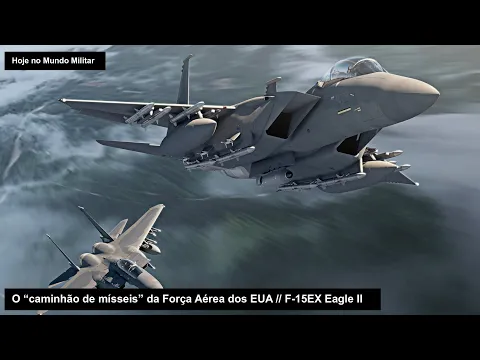

The return of the F-15EX Eagle II as a symbol in 2026 highlights an uncomfortable realization: there are problems that “access” does not solve alone.
If the environment is contested and time is short, the question becomes how much armament arrives at the right moment, at what range, with what speed of repositioning, and for how long the fleet can sustain the cycle without breaking.
At the same time, the choice exposes a narrative conflict.
Part of the public associates modernity with stealth as an end in itself. Another part looks at the whole and sees a portfolio solution, where stealth is the key and the missile truck is the cargo that passes through the door. Neither reading is entirely comfortable, and perhaps that is the point.
Aerial warfare is less elegant than it seems when it comes time to sustain fire.
In your understanding, in which scenario does the F-15EX Eagle II make more sense: air defense with a stockpile of missiles and range, or ground attacks after defenses have been neutralized? And if you were deciding purchases for a medium air force, would you prioritize stealth or volume of weapons, considering cost over decades and 20,000 hours of structural life?








-

-

-

-

-

-

30 pessoas reagiram a isso.