





 Portuguese
  English
  Spanish
  4 min of reading
  0 comments



Designed To Destroy Buried Targets Dozens Of Meters Deep, The GBU-57 MOP Emerged To Neutralize Deep Nuclear Installations Without Recourse To Tactical Nuclear Weapons.
The GBU-57 Massive Ordnance Penetrator, known by the acronym MOP (Massive Ordnance Penetrator), was not born for conventional war scenarios. It was conceived from a very specific strategic problem: how to neutralize military and nuclear installations buried dozens of meters below the surface, protected by successive layers of rock and reinforced concrete, beyond the reach of traditional bombs and even tactical nuclear weapons, whose use would bring unacceptable political and humanitarian consequences.
In the early 2000s, U.S. intelligence services began to map underground complexes in countries considered strategic adversaries more clearly. Many of these installations were specifically designed to survive nuclear attacks, with tunnels dug in mountains, structures in natural caves, and high-density concrete reinforcements. The response was to create a weapon that exploited not the explosion itself, but the extreme kinetic energy.
Dimensions That Redefine The Concept Of Bomb
The GBU-57 is colossal by any metric. Weighing approximately 13,600 kg, it surpasses the weight of penetrating bombs previously used by several times. Its body is constructed from high-strength steel, with a thick casing designed not to fragment on initial impact.
-
Motorola launched the Signature with a gold seal from DxOMark, tying with the iPhone 17 Pro in camera performance, Snapdragon 8 Gen 5 that surpassed 3 million in benchmarks, and a zoom that impresses even at night.

-
Satellites reveal beneath the Sahara a giant river buried for thousands of kilometers: study shows that the largest hot desert on the planet was once traversed by a river system comparable to the largest on Earth.

-
Scientists have captured something never seen in space: newly born stars are creating gigantic rings of light a thousand times larger than the distance between the Earth and the Sun, and this changes everything we knew about stellar birth.

-
Geologists find traces of a continent that disappeared 155 million years ago after separating from Australia and reveal that it did not sink, but broke into fragments scattered across Southeast Asia.

Its length exceeds 6 meters, and its diameter is significantly larger than that of conventional bombs.
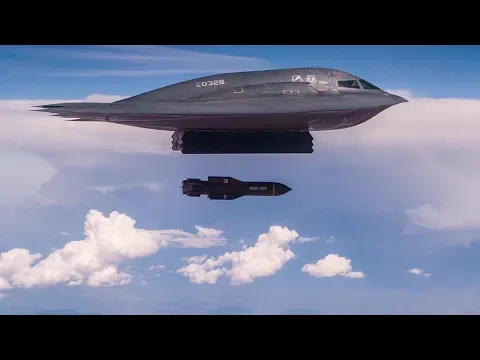

Unlike classic free-fall weapons, its design prioritizes stability, perfect alignment with the target, and extreme structural resistance, allowing it to hit the ground at supersonic speed before beginning to penetrate.
How The GBU-57 Crosses Mountains And Bunkers
The operating principle of the MOP is brutally simple yet sophisticated. Instead of detonating upon touching the target, the bomb penetrates deeply into the ground, rock, or concrete before exploding.
The impact energy, combined with weight and speed, allows it to penetrate up to 60 meters of reinforced concrete or dozens of meters of compact rock, depending on local geology.
Only after reaching the programmed depth is the warhead detonated. At this point, the explosion occurs literally “inside” the enemy structure, collapsing tunnels, crushing internal rooms, and destroying sensitive equipment through mechanical shock, extreme heat, and confined pressure waves.
Millimeter Precision Guidance
Despite its size, the GBU-57 is not a “dumb” weapon. It uses an INS/GPS navigation system that combines inertial sensors with satellite correction.
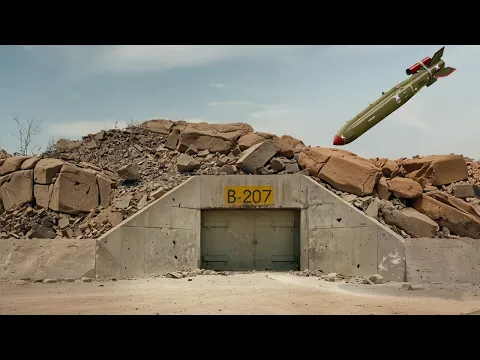
This allows the bomb to be launched from high altitudes while still hitting targets with enough precision to exploit specific points in the underground structure, such as tunnel entrances, vertical shafts, or areas of lesser resistance.
Successive updates have improved this capability, reducing the probable circular error and increasing reliability even in environments with attempts at electronic interference.
The Only Aircraft Capable Of Launching It
Another aspect that makes the GBU-57 unique is the fact that only one type of operational aircraft can carry and launch it: the stealth bomber B-2 Spirit. The weight and volume of the bomb are so large that no fighter or conventional bomber can operate it.

The B-2, with its massive internal compartment and stealth intercontinental flight capability, was specifically adapted for this mission. It can penetrate advanced air defense systems, launch the MOP with precision, and return undetected, transforming the bomb into a strategic deterrent tool, not just tactical.
A Weapon Without Nuclear Alternative
One of the most sensitive points of the GBU-57 is its role as a partial substitute for nuclear weapons in extreme scenarios. Before it, destroying deeply buried installations practically required the use of earth-penetrating nuclear warheads, something politically explosive and environmentally devastating.
The MOP offers an alternative: a conventional weapon capable of achieving effects previously exclusive to the nuclear arsenal, but without residual radiation, without long-term contamination, and with a far more controllable geopolitical impact. Thus, it occupies a unique strategic space in U.S. military planning.
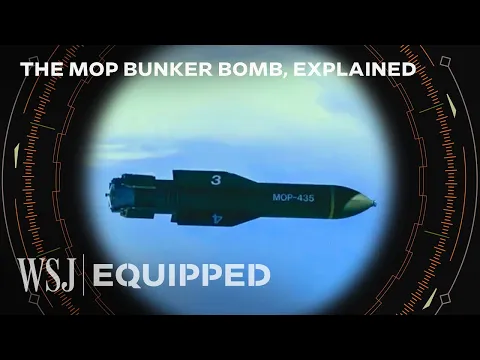
Since its introduction, the GBU-57 has undergone significant improvements. More recent versions have incorporated more precise guidance systems, increased detonation reliability at extreme depths, and adjustments to the penetration profile for different types of soil and rock.
These updates reflect a key point: the bomb was not designed as a static solution but as an evolving platform, keeping pace with changes in bunker engineering and global geopolitics.
Why It Is Considered The Most Powerful Non-Nuclear Bomb In The World
The fame of the GBU-57 comes not only from its size or weight but from the combination of factors rarely seen in a single weapon: colossal mass, surgical precision, unprecedented penetration capacity, and a strategic role that alters national defense calculations.
It is not a weapon for frequent use, nor was it made for conventional battlefields. Its existence, in itself, already serves a deterrent role.
By proving that even bunkers buried under mountains are not entirely secure, the GBU-57 redefines the limits of modern warfare without crossing the nuclear line.
In the current scenario, few weapons concentrate as much physical, technological, and symbolic power in a single artifact. The GBU-57 is one of them, and its mere presence continues to influence strategic decisions far beyond any actual explosion.







Seja o primeiro a reagir!